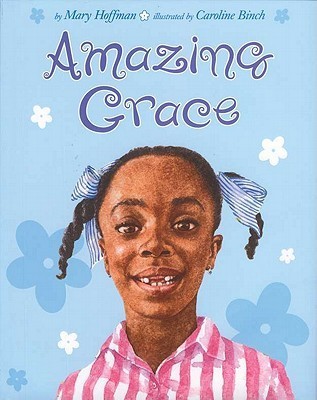
Grace loves stories, whether they're from books, movies, or the kind her grandmother tells. When her school decides to perform Peter Pan, Grace longs to play the lead, but her classmates point out that Peter was a boy. Besides, he wasn't black.
With the support of her family, Grace learns that she can be anything she wants to be, and the results are amazing!
Remarkable watercolor illustrations give full expression to Grace's high-flying imagination.
Mary Hoffman is a bestselling British author and reviewer, born in 1945. She is a true enthusiast of Italy and spends a lot of her time there, which shows in her Stravaganza novels: a series currently in publication. In total, she has written over 80 books, including the aforementioned Stravaganza series and the bestselling picture book, Amazing Grace. Mary is also the editor of a review magazine Armadillo for kids.
From this simple sentence Mary Hoffman goes on to write an inspiring and positive picture book for young children. It is full of optimism; a book with a message. And the message is, to follow your dreams. If you stay true to yourself, you can be whatever you want to be, regardless of what other people say.
Because Grace is a little girl who loves to imagine things, she "lives" her stories. She loves to to act them out, constantly adopting the roles she reads about. We see her pretending to be Joan of Arc, Anasi the spiderman, Mowgli, Hannibal with his elephants ... and many more wonderful storybook characters. She revels in her fantasies.
One day at school her teacher tells the class that they will be performing a play about Peter Pan. This idea is so exciting for Grace, and really fires up her imagination. Immediately Grace becomes Peter in her mind. She could be Peter ... she is Peter! But the other children scoff. However can she be Peter? She looks nothing like him. That doesn't deter Grace. She didn't look like Joan of Arc or Hiawatha either. What has that got to do with it?
Grace becomes very dispirited by their attitudes, and at home tells her mother and Nana what the others had said. Her mother becomes angry, but her Nana is more philosophical, insisting,
"You can be anything you want Grace, if you put your mind to it."
Nana has a plan. She takes Grace to see a new ballet of "Romeo and Juliet". Grace's eyes almost pop out of her head. The starring role is taken by a black ballerina! Her Nana tells her that this is Rosalie, the granddaughter of a good friend from back home in Trinidad.
After the performance Grace is inspired. She becomes Juliet in her mind and imagination. "'I can be anything I want,' she thought. 'I can even be Peter Pan.'"
Of course at the auditions Grace gives a magnificent performance. She is so confident that she feels as if she can fly! Encouraged and empowered by what she has heard and seen, she simply excels, stunning everyone. There is no question about it; they have to vote for her.
So Grace wins the role of her dreams. And when the day of the performance comes, Grace is a real star, making a truly amazing Peter Pan.
The story ends with Nana's wise words, "If Grace put her mind to it, she can do anything she want."
Amazing Grace was written by Mary Hoffman in 1991, and was so popular that it sparked off an entire series. Grace features in all of them, and in this one we first met the little girl whose strength of character, positive attitude and natural talent for drama carry her through to achieve great things. It also contains a great message about a supportive family, and how Grace herself is encouraged to share her talents with others, for their enjoyment. It demonstrates to little children how important is to respect the individual, and also the principle of social justice, regardless of gender, race or culture. And it does this in an imaginative way; we are carried along with Grace's fantasies.
The illustrations in this picture book are stunning. The artist Carol Birch has produced beautiful and realistically detailed watercolours. They are very expressive, authentic and true to life. The glimpsed spontaneous moments we have of these characters are full of life and emotion. Carol Birch's work on Amazing Grace was shortlisted for the Kate Greenaway Medal in 1992.
The author, Mary Hoffman has written over 70 books for children, and Amazing Grace was selected for the 1992 Children's Books of the Year. Her prose is always simple, direct, lively, informative and sensitive. Anyone reading this book can empathise with the characters; the message transcends class, identity, gender or race.
In many ways, Amazing Grace, written by Mary Hoffman and illustrated by Caroline Binch, is a truly wonderful story for all children, with an inspiring text and evocative, descriptive accompanying illustrations (visuals that while realistic also glow and sparkle with much power of imagination), presenting the important, essential message that anyone can be anything he/she desires to be (any role, any job, any position), regardless of race, gender, social status etc. And I also find it both refreshing and encouraging (life affirming) that when it comes to the actual voting period, everyone in class votes for Grace to play Peter Pan, including Raj and Natalie (who had previously made prejudiced comments about Grace not fitting the role because she is not a boy and is African-American, or rather considering that the author and illustrator are British, Anglo-African). Natalie even whispers to Grace that she did a wonderful job at the audition, which not only demonstrates that Natalie has learned a lesson, but that she voted for Grace because Grace showed the most talent, that the fact that Grace is a girl and not ethnically Caucasian did not much matter to anyone in the end; all that mattered was Grace's ability and talent.
However, I do have a rather major problem with one part of the book. Amazing Grace is supposed to be a picture book about tolerance and fighting prejudice and stereotyping, and by extension, it should therefore also be as universally culturally sensitive as possible (or it should at least not describe or illustrate scenes or scenarios that could be deemed as being potentially culturally insensitive). And with that in mind, I do have a rather huge problem with the fact that Grace is not only described as playing Hiawatha, but that she is also illustrated as an Indian chief in full tribal regalia, as many Native American and First Nations individuals find the mere concept of people (including children) playing "Indian" massively insensitive and insulting to their culture and background, their traditions.
I think that Amazing Grace would have been a much more global, and definitely a much more encouraging and sensitive offering without that little addition. It left and still leaves a rather strange, potentially massively bitter taste in my mouth, and also makes me wonder, why we are still so loath, and so seemingly unable to consider the sensitivities of our Native Americans our First Nations, even at a time when we are becoming more attuned to the sensitivities of other visible and invisible minorities. The description and depiction of Grace playing "Indian" also makes me strongly hesitant to even remotely consider recommending this otherwise excellent picture book to Native American or First Nations children (which is a real pity, because Amazing Grace does have an inspiring, essential and necessary message that should be for everyone).
Maybe I am being somewhat hyper-critical here, but this did and continues to bother me, especially since both author and illustrator could so easily have made use of a less culturally insensitive example, a less potentially problematic character for Grace to imagine herself being and playing.
Edited to Add in December 2016: I have just been informed by my GR friend Sheila that in the 25th Anniversary US Edition of Amazing Grace, the entire Hiawatha sequence has now been removed, and while I do much appreciate and applaud that the potential issues this specific "character playing" episode can/could pose especially to and for Native Americans and Native Canadians have now and finally been seemingly officially recognised and noticed, I am also a wee bit aghast at the removal of the entire scene as I generally tend to chafe at this kind of superimposed sanitising. But then again, leaving the Hiawatha episode out really in no way diminishes Grace's playacting and imagination either and does now make the empowering and strengthening messages and morales of Amazing Grace much more universally suitable and shareable (because no Hiawatha sequence really does neither change the messages presented in any way nor does it diminish Grace's imaginative playacting and abilities thereof). I do find it kind of ironic that the removal of the Hiawatha episode has seemingly only occurred in the US anniversary edition and that the UK anniversary edition has supposedly kept the sequence of Grace playing "Indian" as is (at the very least, there perhaps could and should have been an explanatory footnote added to the UK anniversary edition with regard to the potential issues and bones of contention that the Hiawatha scene has caused and engendered over the years).
A worthy addition to the 1001 Children's Books You Must read list.
This inspiring simple tale tells of a young girl who loves stories and joyfully reenacts her favourite characters. The notion of her favourite parts were from literature was a nice touch.
Through determination she discovers that she can play Peter Pan in a school production despite being told she couldn't by various classmates as she's a black girl.
A really great picturebook on representation and following your dreams.
This was a cute story about being able to follow your dreams. Anyone is capable of anything no matter their sex and race. My students enjoyed this book and I loved the message behind it.
“Amazing Grace” is a truly inspiring story from the mind of Mary Hoffman along with illustrations by Caroline Binch and it is about how an optimistic girl named Grace tries out for the role of Peter Pan even though her classmates thought that she cannot be Peter Pan. “Amazing Grace” is a truly inspirational story about believing in yourself no matter what other people say.
Mary Hoffman has done a magnificent job at writing this story as I honestly have never read a story that confronts the issues of race and gender in a children’s perspective. Mary Hoffman subtly tackles these issues that Grace has to confront when she wants a role of Peter Pan and her classmates tell her that she cannot be Peter Pan because she is a girl and black and many children’s books have never tackle these issues of race and gender in a subtle and light hearted way as the issues of race and gender in this book are never fully explicit and dark. Many children will definitely relate to Grace’s predicament as they might have confronted a situation where they are told that they cannot do a certain role in a play because of their race and gender and many children will feel inspired by Grace’s determination to become Peter Pan no matter what the other kids told her. Caroline Binch’s illustrations are extremely beautiful and realistic, especially of the image of Grace herself as she wears pigtails and she always has a toothy smile on her face every time she acts out her favorite scenes, which are equally beautiful as Grace is dressed in different kinds of costumes in her roles.
“Amazing Grace” is a brilliant book about believing in yourself and going for your dreams no matter what race or gender you are and this book will definitely be an inspirational story for children who want to go for their dreams. I would recommend this book to children ages four and up since there is nothing inappropriate in this book.
This lives up to the title. Grace is one amazing girl with an incredible imagination!
She loves to act and creates all sorts or roles and scenes for herself. Sometimes alone, other times with her cat and supportive family. and how I loved her family, encouraging her and letting her imagination thrive!! Even when others put her down her family finds a way to lift her back up and help her defy the odds. This was such a up-lifting book!
The art is well done, and just goes to show the depth or Grace's creativity and lifestyle. Between the words spoken and pictures given you get a real feel for the times, setting and way in which Grace grows up. I highly recommend this book!
A wonderful story about a young girl who is encouraged to be anything she wants to be. I greatly enjoyed the message of this book, and then was confused when I came here to Goodreads and saw reviews mentioning how Grace was pictured as playing Hiawatha in the story, as my book contained no illustration of mention of this at all. I then did a search and found that for the 25th Anniversary edition (which is what I have), that illustration was removed from US copies of the book, so apparently the complaints about that specific illustration were listened to and it was removed. Here is a story about this issue: https://americanindiansinchildrenslit...
This is an excellent picture book that is perfect support for reflecting realities. It follows the story of a young black girl - Grace - who loves stories and using her imagination. Something we should be encouraging all children to do. When finding out her class were going to perform the play of Peter Pan she wanted to play Peter. This was immediately shot down by her peers for the fact she was a girl and had brown skin. These are two very current issues that the book then covers in a touching was through exposing "famous" black people on a grand theatre stage. This gave Grace the confidence to do anything she wanted to if she put her mind to it and she did. I would personally use this in a KS1 class and look at it in depth with the children questioning their understanding and developing their awareness on such a relevant topic. The illustrations also compliment the text by showing Grace in a powerful and passionate way. Enhancing the message implied by the story.
The watercolour illustrations in here are just gorgeous--it's lovely to see the tones of black people's skin painted with such care and detail--even the wrinkles on the grandmother's hands and feet! I love the detail of the cat, who is often accompanying Grace on her acting adventures.
This is overall an empowering fun book about a girl named Grace who loves stories--especially acting them out. The first part 0f the book focuses on all the different kinds of parts she loves to play: Joan of Arc, a pirate, Aladdin, a doctor, and ..... an "Indian." This is an unfortunate oversight in an otherwise culturally sensitive book (note: this book is about an African-American girl, but neither the author or illustrator are African-American, so that may be something to consider). I would definitely not recommend this for indigenous kids, and would suggest discussing this issue with non-native kids. It's only one page of the book, but is still a problem.
The second part of this book is the action: where Grace wants to play Peter Pan in the school play, but other kids tell her she can't because she's black and a girl. Through encouragement from her mom and grandmother and the example of a black ballerina (this is a very woman-centred book, actually now that I think of it), of course, Grace learns she can be anything she wants to be and gets the part of Peter Pan in the school play because she rocks.
Amazing Grace is a bit pedantic, hitting you over the head with "anyone can be anything they want" but it's a message I appreciate.
This book shows how the actions of others can have a negative and positive impact. Grace wants to be Peter Pan in the school play but two children says she can’t because she is a girl and is black. Grace goes home sad and dejected, but when she gets home her Mother and Grandma tell her she can be anything she wants to be. Grace feels happier and goes to audition for the part of Peter Pan, the class vote and she is voted as the lead role! This book demonstrates how despite being told she couldn’t be who she wanted to be, it pushed her further into doing what she wanted! It’s a good representation of society today having included ethnic groups and the main character as a girl, it shows that all children are being included.
An inspiring book about a young girl with an incredible imagination and love of stories. Grace learnt that she could be anything/anyone she wanted to be if she put her mind to it, regardless of her race, gender or what others said. The book subtly tackles modern day racial and gender prejudices from a child's perspective.
Grace loves stories - to read them, hear them, watch them, imagine them, and act them out. She is always in the lead role accompanied by her trusty cat. When the school decides to hold auditions for Peter Pan, Grace knows that she will be amazing as Peter Pan despite objections that she is a girl and black. As her Trinidadian grandmother told her, “You can be anything you want, Grace, if you put your mind to it.” This picture book came with a cassette tape (fortunately, I still have a cassette player) to listen as I read the book. Beautiful illustrations in this joyous celebration of imagination and belief.
Grace is disappointed when her friends tell her she can't be Peter-Pan in the school play because she's a girl and she's African American! With the help of her grandmother, Grace wins over the class in auditions! With hard work and determination, you can do anything!
Grace was a girl who loved stories. She loved them when her Nana told them to her, she loved them when she read them herself, and she loved them when they were interpreted for her through film. Always casting herself into the story - invariably with the most exciting role! - Grace is in no doubt as to which part she wants when her teacher announces that her class will be putting on a play about Peter Pan. But when her classmates tell her she cannot play the boy who never grew up because she is a girl and is black, she is temporarily cast down. Fortunately her mother and Nana are there to pick her up, and to show her she can do anything she sets her mind to...
Originally published in 1991 in the UK, Amazing Grace has become a classic of the picture-book genre since then, offering a heartwarming and affirming story of an imaginative and feisty young girl who dreams big dreams, and who makes those dreams a reality in the face of some not-so-enlightened classmates. I appreciated the fact that those classmates are depicted as capable of having a change of heart - although two of them initially think that Grace can't play Peter Pan because of her sex and race, after the auditions, she is elected to the role unanimously - and that Grace herself is such a joyful, strong character. I also appreciated the family dynamic here, with the support and love that Ma and Nana give to Grace. Although not an African-American book (I have seen it described as such), this book about a young black British girl will appeal to many in the African-American community, and to many others as well.
A beautifully illustrated book, Amazing Grace boasts the gorgeous watercolor artwork of the talented Caroline Binch, who captures Grace's joy in play, her discouragement in the face of prejudice, and her triumph at making her dreams a reality with great skill in her paintings. The edition of this book that I read is the standard one, including the scene in which Grace imagines herself as Hiawatha, which some here in the USA have found objectionable. It is interesting to note that the publisher has produced a new 25th Anniversary edition as well, which changes that scene, removing the artwork and substituting an image of Grace pretending to be Aladdin. I appreciate that both versions are available, so that those who want to read the full, original edition as created by the author and artist are able to, but those distressed by the Hiawatha scene can now enjoy the story as well.
Amazing Grace is a touching story, particularly children who engage in imaginative play and storytelling. The protagonist enjoys engaging in role play using her imagination. When she is at school, she is told by a pupil that she can't play Peter Pan in the school play as it's a "boy". Another says she can't because "he isn't black". Her grandmother and mother inform her that she can do anything she put her mind to. Grace attends Romeo and Juliet ballet, with an BAME ballerina playing Juliet. Inspired, Grace wins the vote to play Peter Pan, and plays the character wonderfully. This is such a fantastic text which covers many themes, which could be discussed in depth with a primary class. The story covers the themes of race, diversity, cultural understanding, tolerance, acceptance and the importance of holding onto imagination and self-esteem.
A wonderful story that starts with a young girl that loves reading and links reading with other activities such as drama. I felt it really demonstrated a passion for reading. However, it also covers topical topics such as inequalities and how children deal with this in their lives. I can imagine some of the rich conversations you could get from discussing this book. This book was wonderful to read.
'Amazing Grace' by Mary Hoffman, tells the story of a girl called Grace who has a vivid imagination and loves to recreate famous roles and include her family in the fun. When the school auditions for the role of Peter Pan, Grace decides she wants to try out; despite the prejudices of her classmates, Grace's talents shine through. 'Amazing Grace' explores issues of sexism and racism in a child friendly way in situations that children can relate to.
This story would be useful when teaching children about respect and embracing each others differences, particularly if there were any bullying issues in the class. The various parts Grace plays in the story could also be acted out and the stories they are related to could be read to the children and explored further. In connection with the story it would also be nice to have visitors in to talk to the children with occupations that people may stereotypically not expect ie. a male nurse or a female fire fighter.
The story is beautifully illustrated and dual language versions of the story are also available. 'Amazing Grace' is an optimistic story that instils in children the fact that they can achieve anything they put their minds to whoever they are and however they look.
Amazing Grace is about a young girl named Grace who loves stories. She loves to read and she loves hearing about them. Often times, she would act out these stories playing the exciting parts. She would be Aladdin rubbing the magical lamp, Joan of Arc with her sword, and even pretending to be Hiawatha. One day in school, their teacher was going to put on the play of Peter Pan and Grace wanted to be Peter Pan along with other the children. The teacher decided to have an audition. A couple of her classmates told that she couldn’t be Peter Pan because she was a girl and she was black. With the loving support from her mother and grandmother, they told her that could be any thing she wanted. All weekend long, Grace practiced her part and practiced dancing and pretend flying until she was perfect. During the audition, every thought Grace should be Peter Pan because of how well she did.
I thought this story was a great story. It shows children how any thing is possible with a little bit of work and effort. This is a great story to read to children in any setting.
Okay. This book continually shows up on so many recommended book lists for picture books with Black protagonists. I am creating such a list for my school library, and so I read it. There are some great messages here about not being constrained by gender or race when it comes to the things you want to do. Fabulous. Love that.
And then there's the Hiawatha scene. From what I understand, it is not included in the newer editions of this book. But the one on my school library shelf includes it (don't worry - I'm going to remedy that and order the newer edition), and I'm guessing that is the case in many school and public libraries. In it,. Grace dresses up in a full "Indian" headdress and plays pretend, using what is sometimes referred to as "Tonto-ized" language. It's not good.
This was published in 1991. Not 1950. This is still a prevalent problem that we see every Halloween, where people use important cultural and spiritual items as part of a costume. I'm glad it has been removed in newer editions, but it shouldn't have happened in the first place. I won't be including it on my recommended picture books list for that reason.
Grace's family has always given her the room and encouragement to play and explore her imagination to the fullest. Grace has played and gone on several adventures, where she was the main character and she could do it all. One day, Grace finds out her class will be putting on a play, but when her classmates tell her that she can't be the main character because of the way she looks Grace is hurt. Will Grace ever get her happiness back, or have her feelings changed forever?
According to Children's Literature, Briefly, chapter 2, there are thirteen literary elements that are most commonly used when judging excellence in fiction. After reading Amazing Grace, the literary element that resonated with me was the theme. After having so much fun exploring her imagination through play Grace's self worth is crushed in away after being told she cannot be a specific character in a class play. However thanks to her family Grace learns that no matter what she can be anything she wants; thus revealing the overall theme of Mary Hoffman's Amazing Grace. Chapter 2 of Children's Literature, Briefly states that the theme is the story's central idea and allows students the ability to make deeper connections to their lives and the world around them, and this is seen in the childlike feelings and actions of the story's main character Grace.
Amazing Grace, really is an amazing story. Mary Hoffman, is able to take real life issues and put them into story form drawing the reader in creating a story showing the harsh realities of life are still present for everyone, even the most hopeful people. This story allows the reader to connect to the character Grace in one way or another, allowing us to hurt as she does and cheer for her as the theme of the book is revealed, and reaffirmed.
Amazing Grace, drew me in and identify with Grace and make me want to read this book again and again. My seven year old loved that Grace was able to play everything she wanted and also identified the theme of the book; which filled me with happiness as it's one we emphasize with her too.
Amazing Grace Review by Anastasia Hutson Amazing Grace is a contemporary realistic fiction story about a little girl named Grace who loved stories and adventure. She loved hearing stories, making stories and being in stories. She always gave herself the best part. In class they were doing the play, Peter Pan, and Grace wanted to be the best part of the play and be the lead character, Peter. When the teacher asked who wanted to be Peter, Grace raised her hand high and proud for the part as did all the other boys in the class. One of her classmates told her that she couldn’t be Peter Pan because she was a girl and another classmate in her class told her that she couldn’t be Peter Pan because she was black. These remarks really bothered Grace because her grandma always told her that she could do anything she put her mind to and this is what she wanted to do. I appreciated this book because it was very encouraging to little girls, especially little girls of color because it encourages them to do whatever they set their minds to regardless of what other people say and that’s a great message to send to that audience. The use of character in this book is effective because it helps a minority of people, both African American and women, relate to situations such as these. It addresses the stigma that women and minorities are not as capable as everyone else. A scene in the book directly displays this act when Grace wants to be Peter Pan but her classmates discourage her and tell her she can’t do that. The author also portrays the women in this book as very strong and independent which also encouraging for young readers. I appreciated the style that the author chose to use in this text because it adds to the strong figure of the character that the author is trying to portray. In the picture book she used strong word choice while the sentences flow with eloquence, showing the strong but gracious personality of Grace. When Grace comes back from school she says to her grandma, “Raj said I can’t be Peter Pan because I’m a girl” “That just shows what Raj knows” said Ma. “A girl can be Peter Pan if she wants to”. This scene shows the strength and integrity that the authors want to portray for younger girls. In terms of visual elements, there are many uses of frames or not frames in this book. A good examples would be of a page that is a double page spread bleed of Grace going to the garden on an adventure with her cat and on the right page there is a framed picture of her holding a magic lamp. This layout is appealing to the eye because it gives enough action to stay engaged but is not too busy to distract the reader from the story. The style of the art was also a good choice because the used a more realistic art form and I feel that that helps the reader connect to the character more and gives them the ability to place themselves in this book. Since the book is contemporary fiction it made the most sense to use this art style and it showcases the genre in its fullest form. This picture book is contemporary realistic fiction because this isn’t a story that actually happened but it’s an event that many younger children can relate to and is set in a modern time, especially for the audience it is targeting.
Amazing Grace is a story about a strong young girl with an immense imagination. In Grace's world there is nothing that can stop her from being anything she wants to be. Her curious immagination is encouraged by her wonderful mother and her grandmother who support her.
Grace loves to read all sorts of stories. As she read about new characters, those characters come alive in her livingroom as she acts them out. Grace is a great performer and when she finds out her class will have a chance to put on a play, she sees her oportunity to share with others her talent. Her exitment to play the main role quickly dissapears when some of her classmates comment about her apearance which they think prevents her from getting the lead role. With her talent and her family's support, Grace will prove everyone that you can be anything you want to be if you put your mind to it.
This book tells the importance of believing and staying true to yourself regardless of what others think about you. The story also challenges our view about gender roles in society. Furthermore it provides a great point for classroom discussion about identity, race and perseverance. Teachers can use this with various grade levels to talk about embracing our differences, culture and gender roles. Most importantly, this story is inspirational in that it teaches children to work hard, pursue thier dreams and to restate that you can be anything you want to be in life.
Amazing Grace is an empowering book about an African-American girl who loves stories and acting them out. One day she is excited and inspired to try out for the role of Peter Pan in the school play. Until peers negative words fill her mind with doubts because she is a girl and black. You will want to read how Grace overcomes real issues children face today?
This realistic fiction book is about a story that did not happen but could happen. This story capturing real life issues that still persist today such as gender and racism that are presented in a kid friendly experience. This text would fall under school and family issues that could help students share through writing or classroom discussion about aspects of diversity. "The offerings of contemporary realistic fiction are as wide as life, helping explore today's people, problems and places (Young, pg. 168)." Furthermore, this mirror book can be a self- affirming experience, seeing oneself in literature makes you feel recognized , understood , and valued by society. Note:Mary Hoffman know your authors when it comes to representation. Including beautiful detailed watercolor paintings illustrated by Caroline Binch. Recommended for ages/reading level 4-8 years old.
I personally recommend this story and think it's a remarkable way to be used as teachable moment in the classroom by genre of realistic fiction. A lesson of imagination, confidence, individuality, differences and kindness. Including the underlying message, that we can be anything you want to be even through our most difficult challenges. I can't wait to share this remarkable story with my own 8yr old son and others. #Children'sSelf-EsteemBooks
Amazing Grace is about a little girl who loves stories, especially from her Nana. She loves to act out the characters in the stories. At school, her class will be performing Peter Pan, Grace wants the lead role. Some of Grace’s classmates don’t think that she can have the role because of her skin color and her gender. Grab a copy to find out what happens and enjoy the incredible artwork and story that is, Amazing Grace
“A good book tells a credible, interesting story and is an honest, believable experience, regardless of the content.” (Children’s Literature, Briefly 7th edition, page 81) By those standards alone, I would say this is a good book, but being that this book contains diverse content, there are a few more standards to consider. It is important that the story doesn’t speak for an entire group of individuals and that is represent cultural details accurately. The book should represent culture authentically in order to be true to members of the culture. The illustrations should also appropriately reflect the cultural group in a non-stereotypical way. These standards also come from Children’s Literature, Briefly.
I feel that this book meets all of standards of a quality diverse book. The story is specifically about Grace and her experience alone. In my opinion, the book represents cultural details and culture authentically through text and amazing illustrations! I definitely recommend reading this book, not only can it simply be enjoyed, it can also be used to teach inclusivity in both school and society.
Amazing Grace is a brilliantly written book that discusses the issue of both racial and gender discrimination, in a way that children understand. It is sad that it even has to be pointed out anymore, but inequalities are still rife and the sooner children learn and understand that it is wrong, the better. Grace loves stories, and she especially loves telling and acting stories. When her class play is announced as Peter Pan, Grace says that she wants to play Peter. Sadly, one of her class mates tell her she can't play Peter Pan because she's a girl. Another says she can't play Peter because she is black. Grace is very sad about those comments, which is really reflected for children to visualize in the lovely illustrations. Grace's gran tells her she can do anything, and that her class mates are wrong. Once Grace picks herself up and believes in herself again, she auditions very successfully. This book can be a teaching lesson for students as to no matter the color, or size of a person you can do anything you set your mind to. A reading response activity I would do in the classroom in response to the book would be for my students to make a connection with the book. They will be asked to draw a picture of Gracie, and then themselves. I will then have a discussion prompt on the board it will read: Sometimes when people read, connections are made. Grace is told by Nana that she can achieve everything she sets her mind to. What are you hoping to achieve as a goal? How are you going to reach your objective? They will then write a sentence or two on the lines to respond to the prompt, and then we will share aloud as a class.
An empowering story for any child, or for that matter, any person who's been told they can't do something for whatever reason. I read this story to a year 2 class of mostly white children and they understood all the issues surrounding race and equality. Grace had a dream and she chased that dream. Why shouldn't she be Robin Hood in the play if she wanted to be? It also touches on the reactions of her extended family and how they respond in different ways to the things Grace is told in a realistic way. It's not surprising her mother feels anger when she's told her daughter's been told she can't do something because of the colour of her skin. It's a thought provoking and moving story.