It’s been more than two decades since Spartina won the National Book Award and was acclaimed by critics as being “possibly the best American novel . . . since The Old Man and the Sea” (The New York Times Book Review), but in this extraordinary follow-up novel barely any time has passed in the magical landscape of salt ponds and marshes in John Casey’s fictional Rhode Island estuary.
Elsie Buttrick, prodigal daughter of the smart set who are gradually taking over the coastline of Sawtooth Point, has just given birth to Rose, a child conceived during a passionate affair with Dick Pierce—a fisherman and the love of Elsie’s life, who also happens to live practically next door with his wife, May, and their children. A beautiful but guarded woman who feels more at ease wading through the marshes than lounging on the porches of the fashionable resort her sister and brother-in-law own, Elsie was never one to do as she was told. She is wary of the discomfort her presence poses among some members of her gossipy, insular community, yet it is Rose, the unofficially adopted daughter and little sister of half the town, who magnetically steers everyone in her orbit toward unexpected—and unbreakable—relationships. As we see Rose grow from a child to a plucky adolescent with a flair for theatrics both onstage and at home during verbal boxing matches with her mother, to a poised and prepossessing teenager, she becomes the unwitting emotional tether between Elsie and everyone else. “Face it, Mom,” Rose says, “we live in a tiny ecosystem.” And indeed, like the rugged, untouched marshes that surround these characters, theirs is an ecosystem that has come by its beauty honestly, through rhythms and moods that have shaped and reshaped their lives.
With an uncanny ability to plunge confidently and unwaveringly into the thoughts and desires of women—mothers, daughters, wives, lovers—John Casey astonishes us again with the power of a family saga.
This is the sequel to Spartina written eleven years after Spartina won the National Book Award in 1989. It helps to have read the earlier book but it’s not necessary. I liked both and I think Compass Rose is just as good.
Both are set in coastal Rhode Island. A hardscrabble fisherman has an affair with a neighbor who is a state forest ranger. Now they have a child, Rose. In Spartina I’d say the main character is the fisherman but in Rose it is Rose’s mother who is the main character. In any case, there are many characters (perhaps a few too many) and it’s a small town, so many are related. And there are a lot of things going on.
Here are the main themes and story lines in the book.
The fisherman’s wife knows of the affair and the child; it’s her next-door neighbor. She decides she wants to integrate the child into her family and have Rose become family with their two high-school-age sons - her half-brothers. So Rose becomes part of the family and the wife and former mistress exist in an uneasy relationship. Who should be told? Who already knows?
The domineering father already has a difficult relationship with his sons. After learning of his father’s unfaithfulness to his mother, one son turns against his father and won’t speak to him. Little by little they work on that.
Rose, the child, is no saint. She and her mother have vicious arguments and the daughter is so is verbally aggressive that she eventually drives away even her long-term live-in nanny and maid.
A theme in both books is the older, wealthier, educated Yankees (of the New England white church on the town green) and the ‘Swamp Yankees,' the blue collar folks like the fisherman’s family, who struggle to make a living, even relying on fish, shellfish and their garden to make ends meet. There is a lot in the book about an older unmarried woman who is wealthy, a best friend, and former teacher of the fisherman’s mistress who epitomizes the old Yankee type.
There's another force making waves in town too: a wealthy ocean resort owner, who is a ‘rainmaker’ working behind the scenes to further his own interests – even proposing having the town take over the fisherman’s property by eminent domain.
We have sea drama too. The fisherman goes out on the Spartina, which he built himself, for days at a time with a crew of four or five. Suddenly there is no radio word from them.
All in all a good story. Maybe a bit long and maybe a few too many characters, but with a lot of dialog it moves along.
Here is a link to my review of Spartina by this author:
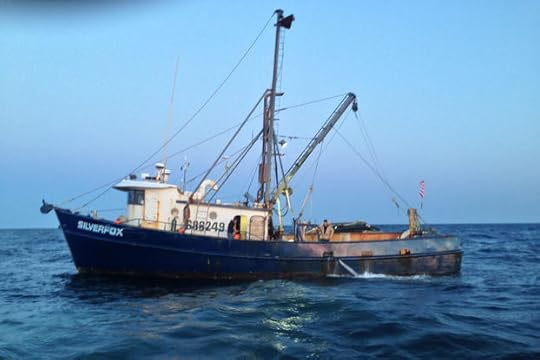
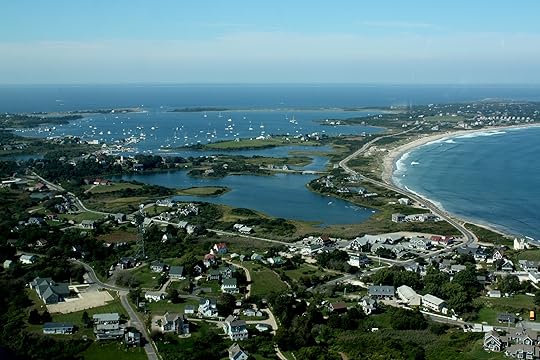
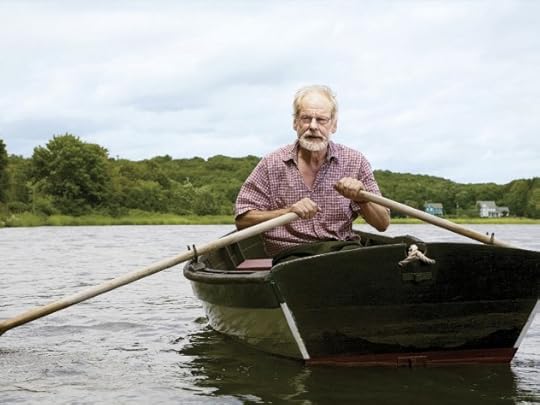
Top photo: Typical small New England fishing boat from images04.military.com Coastal Rhode Island (Block Island) from circleofblue.org The author from harvardmagazine.com
Duology. I had to fish for it. I had to cast out in more than one direction to finally reel in the mysterious term for two linked novels. Compass Rose links with John Casey's earlier novel Spartina, concerning itself with the same characters and a few additions, mainly Rose, the graceful center of the novel. Casey's great strength, as with Spartina and equally evident here, is elegant descriptive prose and strong characterizations.
Spartina was Dick Pierce's story, how he built his own fishing boat, how he had an affair with Elsie Butterick and how she became pregnant and out of love for him decides to have the child on her own. In Compass Rose Casey continues the story from the moment of the child's birth. In the narrative Rose grows from infancy to a young woman finishing high school. But it's not her story. As novel Compass Rose belongs to May, Dick's wife, Elsie, and to Mary Scanlon, her best friend, and others. The narrative is told from the points of view of those women, though never from that of Rose or from any man. Rose acts as the glue holding these characters together. She sits at the center like a compass and points in every direction of the novel.
To be honest, there isn't much plot development. It's about Rose's growing up and her relationship to the women and to Dick. There is an offstage incident at sea seen from the angle of women whose men make their hard livings on boats exposed to nature and the merciless ocean. The novel's build to denouement involves a land grab. It's a little heavy-handed. One key moment is when Elsie, a game warden and one at home in the woods, watches a snake invade a bluebird nest and swallow the babies. By this time you've begun to care for the characters so much you don't mind that it's a little too pointed. And about this time in the novel, too, the reader realizes he's reading something more than a straightline narrative. It rings as sharply as a loud, clear note from a bell struck deep in Elsie's sylvan groves and booms out over Dick's inlets and ponds of spartina on the coast to awaken the reader's mind to possibility. Casey has written a classical theme. He has imagined Rhode Island as Olympus and environs, populated by gods and spirits in common guise. It's easy to see Elsie as Dione, a wood nymph. In fact, she has a relationship to bark in the novel and at one time Casey writes her so angry she feels herself hardening over like bark, just as the mythical Dione once turned herself into a tree. As nymph and game warden she's so close to nature she's a kind of caretaker and is indistinguishable from it. Nature itself is one of Casey's themes. A character asks, "Do we stand outside of nature, or do we stand inside it? Is nature everything but us? Or is it simply everything?" And Dick? Dick is Zeus as May becomes Hera. The handsome god Apollo, a "fine figger of a man," as Elsie reflects, rides a motorcyele in the novel and in one of the more delightful lines Elsie remembers he "had pulled orgasms out of her like fish on a trotline." Rose? As the daughter of Zeus and Dione, Rose becomes Aphrodite. In mythology Aphrodite has enormous presence. She's love itself. And I suspect her story will require its own novel, making a trilogy.
In rugged South County, off the coast of Rhode Island, the rustic beauty of the salt marshes, creeks, rivers, and ocean provides the substance and domain of Casey's follow-up/sequel to his 1989 National Book Award winner, Spartina. This book begins roughly where the other left off, circa 1989, and then segues to fourteen years later midway through the novel. It is the story of love and family, and the vicissitudes of six or less degrees of separation.
Middle-aged Dick had an affair with nubile Elsie (in Spartina), which resulted in baby Rose. Dick, the boat-builder and sea-lover, lives primarily out on the ocean. When he is landlocked, Dick stays in the house with his wife, May, and their two sons, Charlie and Tom. Dick and May have not quite resolved the pink elephant in the boat's deck. May wants Rose to be part of their lives, and she hasn't fully forgiven Dick. She is tormented about seeing Rose, and about not seeing Rose. How to accommodate the X-factor, Elsie? And the why oh Y-factor, Dick.
"May wondered how long she'd have to go on pulling thoughts out of her head. It seemed as endless as pulling rocks out of a field."
Elsie is free-spirited and nature loving. A Natural Resources officer, she is euphemistically called "the warden of the Great Swamp." Despite her affair with Dick, she is a sympathetic, strong, and enchanting character. She is feisty and warm, as seen through her nurturing devotion to the island's aging doyenne, Miss Perry. And she still loves Dick.
"She [Elsie] looked at Dick's face. She'd wanted him for the certainty of his fierce instincts; she'd put herself in the way of them. Now he was uncertain. Perhaps he was undone by seeing his daughter--perhaps he was undone by the trouble he was in."
This tight-knit, incestuous Irish community, where almost everyone is related by blood or marriage, is a roaring and clattering collection of individuals that form an uneasy alliance of entanglements and estrangements. As Rose grows up, she bickers hotly with her mother; while Elsie is the butterfly, Rose is the butterfly out of the chrysalis.
But Rose is also the compass, or the "compass rose." Casey uses this nautical term as a superb extended metaphor, whereby there are two rings--the outside ring denoting cardinal directions and the inner ring referring to magnetic cardinal directions. Rose's positioning in the two families exemplifies the symbolic and directional purview of their bonds--to each other, to the island, and to the trajectory of their hearts.
I had to start this book twice. The stylized beginning has staccato sentences and bulleted names, initially confusing me and turning me off. However, it is short-lived, and Casey's prose soon opens into a poetic and lyrical rhythm. The cadence is occasionally offbeat, but is uniquely exhilarating and provides a salty mood and atmosphere. The story is spicy, unpredictable and mouth-wateringly messy. The wily characters sizzle--from the dedication of Rose's protectors, such as Mary Scanlon, the town's chef and songbird, to Jack Aldrich, the town's land-grabbing, acquisitive swine.
"...it was part of the same thing over and over, the sun heating the surface of the ocean, vapor rising into clouds and fog, blowing over the land, turning back into water and running back into the sea, carrying bits of earth, the earth made of cracked and crumbled rock and the dead matter of everything else once so busily alive."
I felt like one of the residents of South County. John Casey is an assured storyteller whose spiky, nervy characters fly off the pages with pluck and spunk and longing. I highly recommend this for readers who love resonant, character-driven stories. This is not chick-lit.
Casey's prose is lush and meaning-full, and his characters are so real as to feel as if he's only transcribing a world seen directly in front of him, except in that the interior thoughts are so true that he'd need to be a mind-reader, as well. As with Spartina, this book brings to life a whole cast of characters whose interconnected lives are as humorous as they are heartbreaking, and there's a certain romance brought to the depiction of the natural world here, especially.
Perhaps there were a few too many similar names and characters to keep track of, and perhaps it ended with less closure than I'd have liked, but all told, I really enjoyed this.
Recommended for readers of general/literary fiction, but you should start by reading Casey's Spartina.
Finally! A sequel to SPARTINA, the 1989 National Book Award winner. It usually takes John Casey about 10 years between new novels, and we had to wait 20 years for this sequel—but every sentence is expertly crafted, every element carefully thought-out and brilliantly executed without flash or dazzle.
COMPASS ROSE (perfect title!) makes me think of the feminist T-shirt saying: A Woman Needs A Man Like A Fish Needs A Bicycle. Rose, the teenaged drama queen, is the center of this small fishing community in Rhode Island. (“Face it, Mom,” Rose says, “we live in a tiny ecosystem.”) In orbit around her are the women who are raising her, primarily Elsie and May, but also an extended network of unofficially godmothers. Still in orbit, but at a Plutonian distance, is her biological father, Dick.
Not wanting to miss thing, I appreciated that COMPASS ROSE picks up about where SPARTINA ended (after the best description of a small vessel trying to ride out a deadly hurricane since Sebastian Junger’s THE PERFECT STORM). The laconic Dick Pierce may be a master boatbuilder and seaman, but on land he’s no match for the women in his life. His teenaged sons, Charley and Tom, don’t fare much better. This story is all about the women, and Casey writes with precision and empathy about the complicated thoughts, feelings and dreams of these wives, mothers, daughters and lovers.
I also recommend Casey’s first novel, AN AMERICAN ROMANCE, which came out way back in 1977 and completely hooked me even then on his extraordinary abilities as a novelist.
This is the highly anticipated second book in a projected trilogy that opened with Spartina , a National Book Award winner in 1989. Whereas Spartina unfurls the complicated life of Dick Pierce and the events leading up to his infidelity, this novel’s protagonist is Elsie, with whom Dick had an affair. As the mother of Dick’s child, Elsie finds herself navigating her own life through the spaces of Dick’s wife, May; Dick’s sons, Jack and Charlie; and Dick and Elsie’s child, Rose. The result is a well-crafted story of a woman seeking acceptance from both her daughter and the family of the man she seduced, with the characters all serving to highlight Casey’s implicitly stated metaphor that relationships of all stripes are as complicated as the vagaries of the open sea. VERDICT Readers unfamiliar with Spartina will have misgivings about the abbreviated introduction of characters, which confuses the tensions among them. However, the enrichment of these complications is what makes Casey’s latest effort a challenging and enjoyable read. [See Prepub Alert, LJ 5/1/10.]—Joshua Finnell, Denison Univ. Lib., Granville, OH
John Casey is one of those writers who creates prose that sinks into your subconscious. When I read his writing, I almost forget that I'm reading at all. An hour with one of his books can feel like five minutes. That said, I didn't love the story of Compass Rose. I wasn't entirely sure it was worth revisiting the world that Casey created in Spartina, Casey's masterwork in my opinion. It seemed like he wrote Compass Rose more for himself, as if he simply wanted to spend time with some of the characters he created in Spartina.
Reading Compass Rose, you'll be impressed with John Casey's writing and his story-telling capabilities, but you also may be a bit bored. I prefer stories that focus on small periods of time rather than years or decades. In Compass Rose, Casey covers a lot of events over an extended period of time. As a result, it often feels as if you're being told the story with the fast-forward button held down.
I would read the book again just because I'm a John Casey fan (I think he is one of the best fiction writers out there today), but if I were to rank all of his books, this would not be near the top of the list.
I made a vow to return all library books on time this year. And then I broke it when I got started on this one late and just couldn't give it up when the due date came. Really excited to read Spartina and find out how the whole story begins. Great writing, and Casey is clearly one of those rare-ish male authors with a real gift for female characters.
I picked this book off the bargain table (when will I ever learn?). From the jacket, it seemed the author had been well reviewed for previous books and the theme of the book certainly looked promising. Other books with higher priority (book club, loaned books) pushed this one aside for quite a while. I finally had time to pick it up and put it my read list.
The book starts off with seven characters in the first two paragraphs. None are explained or described until later on. Even the first sentence, "May sat on the first row of the bleachers, watching the boys warm up" created confusion. It took some reading before I figured out these were her boys and they were teenagers. Characters are introduced rapidly and the reader is left floundering to figure out relationships. Names are thrown out like "Sawtooth Point" and the "Wedding Cake" as if it were common knowledge. I assume, in retrospect, that the author assumed the front jacket gave enough explanation (and that everyone would carefully read the jacket before starting in to read). By chapter 17, I gave up in frustration.
I couldn't remove this book from my list so it got moved to "want-to-read." It bugged me seeing an unread book on my list. Some time later, when I again had a free spell, I picked up "Compose Rose" and tried again. This time I had a better idea of relationships and made better progress through the first section. However, that is not to say my frustration lessened. I still had serious issues with the author's lack of description. May and Dick are married and Dick has had an affair. How old are these two? What do they look like? Did they start their family when they were barely out of high school? Or was May older, so that by the time of the affair this become an issue of Dick being attracted to a younger woman, a better-looking woman? We don't know because we don't really know what May looked like.
We cannot form a clear picture of any character in the book. The author only gives occasional clues of "long, red hair," or "slender legs." Because his characters are so difficult to imagine, many of the relationships remain hard to follow. The fact that one is stable and mature (Mary) does not tell us if she is young or middle-aged . . . and yes, it does make a difference in understanding the plot and her relationship to other characters.
The jacket claims: "With uncanny ability to plunge confidently and unwaveringly into the thoughts and desires of women--mothers, daughters, wives, lovers--John Casey astonishes us again with the power of a family sage." I've read male writers who can do this and I'm always amazed and thrilled when a male writer can understand and communicate so completely the thoughts and emotions of women.
I don't see this is "Compose Rose." Casey might have talked to a lot of women and maybe even run parts past women friends, but I found his female characters annoying. It sounded just like a man writing what he "thought" women might think. A male fantasy. Certainly the logic and personalities of the main characters don't fit anyone I've ever met or heard of.
A good author would give enough background to make us understand why and how characters made their unusual choices. None of the women's motivations made sense to me and had to be accepted "on faith." Dick was supposed to be the true love of Elsie's life? I never got the impression she was in love. She was in lust. Constantly. She went after any male who looked like a good lay and it was always out to prove something to herself. She used men and then tossed them overboard. Dick might have been appealing because he was married and "unavailable," or because he was trying to be honorable, but nowhere did I see any signs of genuine love and concern by Elsie for Dick's welfare. Nor was there ever a really believable explanation of why Elsie herself considered Dick the love of her life. Until the end of the book (unless you read the jacket) there isn't a clue that Dick meant anything more than someone who ended up being the father of her child.
In a town this small and interconnected, when everyone knows everyone else's business, it seems strange that Elsie's promiscuous sex life had not long ago labelled her as the village tramp, family money or not. The little description we have of Dick makes me wonder why he would be vulnerable to someone with a such an undesirable reputation. And no, taking care of Mrs. Perry does not change my mind about Elsie's desirability as a love object. Quick roll in the hay. Maybe.
I was disappointed by the jacket's hype, ". . .it is Rose, the unofficial adopted daughter and little sister of half the town, who magnetically steers everyone in her orbit toward unexpected---and unbelievable---relationships." So misleading. I expected from that description that Rose would grow up with the ability to reach out and bring people together, to mend broken bridges, to forge new understandings. No. Rose does her own thing.
Everyone else focuses their attention on darling Rose. She laps up the attention. Not a bad person. But as self-centered as her mother. I'm never convinced why people even take to her so passionately. That half the town loves her seems a stretch, since she is never shown to have more than a singing voice to win over people, to keep from being labeled the bastard child of the town's harlot.
The shallowness of characters turned this into a TV reality show. I hate reality shows because they are so far removed from actual reality. By the end, I stayed up late to finish the book, not because I had to learn about the ending, or because I cared about what happened to any of the characters. I just wanted the damn ordeal to be over so I could get rid of the book, once and for all.
It's been years since I read this, and I still remember how well-developed the characters were. This is a character-driven book. However, I can't rate this as high as Spartina. That book took my breath away. I'd really recommend reading that book first, and the read Compass Rose
Beautiful writing. Wonderful complicated characters. Rose is the darling of the story with her extended family. She is the daughter of an illicit affair, her mother and her father and his wife living in the same small community for lots of added tension.
Essentially, this book is about a small Rhode Island community. It revolves around young Rose - from her birth to about 16 years - and the relationships between the three families that "raise" her. The most shocking thing about this novel was that it was written by a man, because the main characters are women (Rose, Elsie, May, and Mary), and their relationships are written in a totally believable way. I never really got into this book, mostly because I didn't really relate or like any of the characters. They all go through periods of being more likeable than others, but none are consistent. Rose, she who the entire world revolves around, was just kind of *there*. I doubt whether her family interactions are in any way realistic and she certainly wasn't anything special. And I had a bit of a tough time keeping the male characters straight (Dick, Jack, Eddie, Walt), especially since they were fairly absent from the main action. I was incredibly disappointed by the end. The book climaxes with this grand dinner at Jack's with all the main characters around the same table (however awkward that would be for them), but nothing is really resolved. Jack succeeds with his plans to take over the Pierce property, despite the actions of all these strong women to stop him. There's really no closure: Does Dick get a new boat? What eventually happens with him and Elsie? What happens to all these characters when Rose finally leaves the community? In the end, I really don't care that much anyway.
I read Spartina years ago, so did not necessarily remember much of the plot or characters. I do remember that I thought highly of the book. Maybe it was me, but t seemed as if this follow-up novel began in media res, assuming we knew at least a bit about the situations at hand, so it took me awhile to settle in. I found the domestic dramas involved to be compelling, but by the last third of the novel, felt a bit weary of the ruts everyone seemed to be in.
Rose, the daughter of Elsie and Dick, a married man, is said (on the front jacket copy) to be the tether between everyone, but I did not find it to be so. At a certain point in the novel, a huge section of her childhood is skipped over and suddenly she is a teenager. Dick's wife, May comes to love Rose and enjoys watching the bonds grow between her sons and the love child of her husband. There is a big bad meany, Jack Aldrich, related by marriage to Elsie. He tries to run everything in the marshy Rhode Island town all these characters live in. He even tries to seize Dick and Elsie's land. So that is one of the subplots. Elsie cares for an older woman who once taught her Latin, and I really enjoyed that relationship. But Elsie seems never to get over her love for Dick, and though she messes around with other men, she is often in a sexual funk. So for me it all got a bit predictable. Yet I found myself impressed by John Casey's ability to get under the skin of his female characters, and thus I had to give this novel 4 stars. If Goodreads allowed half stars, maybe 3.5.
Compass Rose is a novel about a small town in Rhode Island and centers around Rose. Rose is the daughter of Elsie, a free-spirited ranger, and Dick, a married and well respected local fisherman. Both are deeply entrenched in South County with ties binding them tightly on all sides. When Dick's wife unexpectedly decides to make Rose a part of her life, Rose quickly becomes the darling of their circle and the center around which everyone orbits.
Compass Rose is a quiet, contemplative character study of a book. Its all about the choices the women have and the choices they make to love and grow and to be at peace with their lives. I did like the characters and often thought Casey had hit the mark on their thoughts and feelings. I haven't read Spartina, so I can't make the obvious comparisons. I do wish more had happened in Compass Rose, in the end it didn't really feel like much had occurred. It seemed as if the book started in the middle of the story and then ended in the middle too. Nothing was really resolved and it felt more like a 356 page short story than a novel. Still, nice writing and very well drawn characters make me not sorry that I read the book. I am very tempted now to pick up Spartina.
A followup to Spartina, 20 more years, about, in the lives of the small community in South County Rhode Island next to Sawtooth Point, which is now developed into a club and marina for yachts, right next to Dick and May's property--he is still fishing for whatever he can bring in, with his hand-bult boat, Spartina. But this is the women's story, May's, and Elsie's, and Mary's, and Rose's, the women who orbit around Dick. May reconciles herself to the fact that Dick is Rose's daughter by Elsie, accepts her, helps raise her. Elsie continues to be a free spirit, screwing the young lawyer in the back of a car, impulsively seducing Dick again after all these years. They all fight Jack's ambitions to expand the Sawtooth Club, and after shipwrecks and strokes and Miss Perry's long decline, it all comes to a fruitful resolution. Sort of an odd read, in that in Part I Rose is an infant, and in Part II, a chubby preteen, justlikethat--a dozen years skipped over, and everyone pretty much as they were, but then the story picks up steam. A satisfying novel.
The New York Times Book Review described Spartina as "possibly the best American novel since The Old Man and the Sea." Casey's sequel, as a result, has a lot to live up to. Whereas Spartina focuses on Dick, Compass Rose centers on Rose and the women who influence her. His depictions of coastal Rhode Island are still wonderfully evocative, as are his observant renderings of small town life and extended family relationships. Only the San Francisco Chronicle felt the multiple protagonists resulted in a "splintered structure" and an "unfocused" narrative. Although critics disagreed over whether Compass Rose rises to the heights of Spartina, they all agreed that it was well worth reading, though best preceded by a reading of the latter. This is an excerpt from a review published in Bookmarks magazine.
Readers who are drawn to characters will enjoy this book. If you are a plot reader, this one will drive you batty.
This is the second book to examine the lives of a small town in New Hampshire--the first, Spartina won the National Book award (and I did not read and was still able to pick up the back story well enough in Compass Rose). Apparently, Spartina is the story of Dick Pierce the fisherman and father of Rose. I enjoyed this book well enough to know I will pick up Spartina in the future. Casey is a masterful writer.
Compass Rose begins with Rose in her infancy and ends at her in high school. It is told through the eyes of all of her mothers: Elsie, birth mother, Mary Scanlon, best friend to birth mother and May, Dick's wife. The characters are lovely--all broken and damaged in their own distinct ways but always there for their compass, Rose.
This book disappoints in many ways. Wrtiten by a National Book Award winning author and meant to be a sequel to the prize winner, at a 20 year remove, the novel fails to deliver a credible story line. The author has several interesitng characters, including a single mother who is also a park ranger, a rugged fisherman, father to the child of the ranger, and the fisherman's wife and other two sons. Throw in a real estate developer, greedy for the other's properties an aged patrician school principal, and a history of shared secerets, and you'd hope for some great confrontations and confusions. Those don't develop. Instead, the story goes flat. The author tells us years pass, moves his characters along,and manages the story lines as if the characters were one dimensional.
As a huge fan of Casey's "Spartina," I had eagerly awaited this book, which continues the story about some families living by and from the ocean in a small community in South County, RI. Both books have interesting characters, but Spartina had a big storm and a traumatic romance to propel the story, while the conflicts in Compass Rose are more psychological and slow-moving. Casey paints the setting beautifully and is certainly a master of describing the most subtle of human emotions, but toward the end I found myself skimming through whole paragraphs and pages, looking for some more decisive action. That's just my opinion - I'll look forward to reading what others think.
I finally finished this sequel to "Spartina". I found it to be too rambling and disjointed to enjoy it a great deal. There were just too many characters' POVs that detracted from the overall story. Spartina was much more of a "spare" read to me; told mainly from Dick and Elsie's POVs, with a lot more descriptive passages of the upper East Coast area. There was also much more of a sense of anticipation and apprehension in the first novel. If you haven't read John Casey before, I do not recommend starting with this book. He is pretty great writer IMO, but this book doesn't quite showcase his talents as well as his earlier works. I'm giving this book a 3 star rating.
I'm a big fan of John Casey's - LOVED Spartina and had high expectations of Compass Rose (which picks up with the same setting/protagonist from Spartina). I enjoyed the writing - Casey has such a nice, conversational tone - but I wasn't as thrilled with the storyline, and I questioned some of the intentions/actions of the characters here and there. I did, of course, enjoy the RI references, which were spot-on. All in all a good read - worth picking it up - but if you haven't read Spartina yet, I'd definitely start there.
I really loved the first book John Casey wrote, Spartina. However, it was very hard for me to finish this follow-up book (essentially a sequel to Spartina). I was very disappointed in it. The author had a hard time choosing a point of view and staying with it throughout the story, so no character fully develops. In the end the author tries to tie in a natural world theme but it is largely missing from the rest of the story. Because the characters never fully developed, it was hard to support any of the characters. I recommend reading Spartina, but I wouldn't recommend reading this book.
Elsie, a young woman who marches to her own drummer, lives in a small Rhode Island community on Long Island Sound. This story opens as she is beginning to deal with the complications of having a baby whose father is a married fisherman, living very near. How Elsie and those close to her interact and, some senses, raise baby Rose makes for good reading. And as Rose grows, it is she who helps integrate the fragmented community. Casey's writing is fine, especially when he describes the woods and marshland Elsie loves.
Nothing happens in this book. There is no real plot. No beginning, no ending. I'm not even entirely sure there's a conflict, given how everyone is so taken in with ROse and peacefully co-existing. You never find out what drew Dick and Elsie to each other, or why everyone just adores Rose. Hell, you don't even find out about what happens regarding the Pierces' house.
This is quite simply a random shot of a community and there's nothing there for anyone to really care about.
Engaging and satisfying--John Casey does it again. He takes us through the lives of characters we can relate to, allowing us to reflect on our own during moments that are truly arresting for the reader (and sometimes the characters). Nature as a metaphor, ecosystem and reflection is beautiful and not artificially inserted. And, as several reviewers identified, his communication of the thoughts and feelings of women demonstrates his talent (and probably reveals some of his family of wife and 4 daughters).
While I loved re-reading Spartina, I didn't enjoy this one quite as much. It's a sequel (in the first story, it's about a man building a fishing boat, a love affair and resulting pregnancy) and tells the story of the the child who is born and the women in her life. I enjoyed the characters but didn't like that it skips through time too quickly to really get a feel for their lives at any one point in time. Language is still beautiful, but just not as satisfying an ending
compass rose by john casey Dick Pierce is now focusing on the women in his life: his wife May. Elsie the woman who born their daughter Rose. She allows him to bring the baby to his house for hours during her life as Dick has two boys at home. Everybody loves Rose. Land deals, ship being broadsided and sinking, and some sex scenes make this a really good read about family life and living on the island and making a living from the sea.
Enjoyable read, especially since I live in South County. Well written in terms of prose, descriptions, etc. A little disappointing in terms of actual storyline - I'm not sure a male author gets it all "right," telling the story from the perspective of various females. As a character, Rose is somewhat "flat" and a bit of a brat. Yes she's connected to the other characters, but I'm not sure I see her as this great unifying force, as advertised in the reviews.
This Rhode Island family story was good, but I have a feeling it will be forgettable. I was never completely taken by the character of Elsie. Then when the land/power struggle seemed to be coming to a showdown finale, the story trailed off without conclusion. Elsie, fogbound and confused in the pond, was a pretty little chapter, but unsatisfactory for an ending. Left me high and dry and wondering.