

What do you think?

How Music Works: The Science and Psychology of Beautiful Sounds, from Beethoven to the Beatles and Beyond
"Any readers whose love of music has somehow not led them to explore the technical side before will surely find the result a thoroughly accessible, and occasionally revelatory, primer."— Seattle Post-Intelligencer
What makes a musical note different from any other sound? How can you tell if you have perfect pitch? Why do ten violins sound only twice as loud as one? Do your Bob Dylan albums sound better on CD vinyl? John Powell, a scientist and musician, answers these questions and many more in How Music Works , an intriguing and original guide to acoustics. In a clear and engaging voice, Powell leads you on a fascinating journey through the world of music, with lively discussions of the secrets behind harmony timbre, keys, chords, loudness, musical composition, and more. From how musical notes came to be (you can thank a group of stodgy men in 1939 London for that one), to how scales help you memorize songs, to how to make and oboe from a drinking straw, John Powell distills the science and psychology of music with wit and charm.
What makes a musical note different from any other sound? How can you tell if you have perfect pitch? Why do ten violins sound only twice as loud as one? Do your Bob Dylan albums sound better on CD vinyl? John Powell, a scientist and musician, answers these questions and many more in How Music Works , an intriguing and original guide to acoustics. In a clear and engaging voice, Powell leads you on a fascinating journey through the world of music, with lively discussions of the secrets behind harmony timbre, keys, chords, loudness, musical composition, and more. From how musical notes came to be (you can thank a group of stodgy men in 1939 London for that one), to how scales help you memorize songs, to how to make and oboe from a drinking straw, John Powell distills the science and psychology of music with wit and charm.
272 pages, Hardcover
First published January 1, 2010
About the author
John Powell
2 books35 followersLibrarian Note: There is more than one author in the Goodreads database with this name.
John Powell holds a PhD in physics from Imperial College at London University. He has taught physics at the University of Nottingham and the University of Lulea in Sweden. In 2003, he earned a master's degree in music composition from the University of Sheffield in Great Britain.
Source: How Music Works - Hachette Book Group.
John Powell holds a PhD in physics from Imperial College at London University. He has taught physics at the University of Nottingham and the University of Lulea in Sweden. In 2003, he earned a master's degree in music composition from the University of Sheffield in Great Britain.
Source: How Music Works - Hachette Book Group.
Ratings & Reviews
Friends & Following
Create a free account to discover what your friends think of this book!
Community Reviews
Displaying 1 - 30 of 283 reviews

May 26, 2011
This is a fun book by a geeky professor type who isn't afraid to be silly to get his points across. I have a background in both music and physics, and if I were to write a book on this topic, I'd be hard pressed to be as engaging as Dr. Powell. I even learned a few things myself while reading this thing even though it's primarily designed for those not technically inclined.
How Music Works reads like a semester long course in the physics of music for non-scientists. It comes with a CD so you can hear some examples (very helpful). The writing style is jokey and lighthearted throughout. I agree with at least 90% of the opinions contained in the book so Dr. Powell is speaking to the choir when it comes to me (although I don't agree with him that everyone can develop some degree of musical ability; he never met my mother or mother-in-law!).
The book does lose a bit of steam at the end; it's kind of like a course that has been too thorough in the beginning so to make up for it rushes through a bunch of important topics in the last week. For example, there is only one chapter on rhythm. While the physics of rhythm is probably nothing to get excited about - thump, thump, thump isn't as interesting from a wave standpoint as a melody - rhythm is just as essential to music as pitch and deserves at least three chapters on its own in my humble opinion.
For the first 200 pages or so, How Music Works offers just the right amount of detail; it's thorough but not ponderous. It you like books that explore the science of art (or cooking), I highly recommend this delightful book.
How Music Works reads like a semester long course in the physics of music for non-scientists. It comes with a CD so you can hear some examples (very helpful). The writing style is jokey and lighthearted throughout. I agree with at least 90% of the opinions contained in the book so Dr. Powell is speaking to the choir when it comes to me (although I don't agree with him that everyone can develop some degree of musical ability; he never met my mother or mother-in-law!).
The book does lose a bit of steam at the end; it's kind of like a course that has been too thorough in the beginning so to make up for it rushes through a bunch of important topics in the last week. For example, there is only one chapter on rhythm. While the physics of rhythm is probably nothing to get excited about - thump, thump, thump isn't as interesting from a wave standpoint as a melody - rhythm is just as essential to music as pitch and deserves at least three chapters on its own in my humble opinion.
For the first 200 pages or so, How Music Works offers just the right amount of detail; it's thorough but not ponderous. It you like books that explore the science of art (or cooking), I highly recommend this delightful book.

June 10, 2018
Ricette musicali
Un saggio interessante, questo di Powell, che, scritto con un linguaggio divulgativo, parla di musica in un modo abbastanza poco consueto.
Non una storia della musica, non una enciclopedia, non un invito all'ascolto, non un libro per descrivere differenti generi musicali.
Un libro che cerca piuttosto di aiutarci a capire cosa sia "fisicamente" la musica, come si forma, come si trasmette, come si riproduce e perché certe combinazioni di suoni hanno un particolare effetto su di noi.
Esempi? Un brano di Johan Sebastian Bach ha un effetto rilassante su di noi. Proviamo invece ad ascoltare lo studio n. 13 "L'escalier du diable" di Gyorgy Ligeti; la rapidissima (da fiatone) successione di tasti bianchi e neri del pianoforte in fortissimo, con un ritmo che cambia in continuazione, rende l'ascolto faticosissimo ed estenuante. Il libro semplicemente cerca di spiegarci il perché.
Veniamo al libro, ricetta per 2 persone:
Prendiamo una solida base di fisica e matematica (onde, vibrazioni etc: 400 g); aggiungiamo lentamente un po' di teoria musicale (50 g) e un pizzico di psicologia dei suoni.
Lasciamo riposare per un po'; decoriamo poi il tutto con aspetti storici, pedagogia, anatomia, armonia, strumenti musicali e curiosità varie (quantità a piacere).
Mettiamo in forno a fuoco lento fino a completa cottura. Alla fine farciamo il tutto con uno stile brillante e con tanti aneddoti q.b.
Gustare con il sottofondo musicale preferito.

January 5, 2011
Every so often I come across a book that I can imagine giving as a gift to at least half the people I know. The last one was Yellowrocket, the one before that was Earth. My 2010/2011 choice is: How Music Works
Not just for music geeks:
Is How Music Works about music or physics?
Is it for readers who want to better understand music as they are listening?
Is this book for percussionists? for those who play wind instruments? For those who play guitar? Piano?
For those who play their car stereos as loud as they can?
For those who have left a concert crying? or with their eyes crossed? or their hearts beating madly?
Is it for dancers? choreographers? band teachers? parents? People who cry when they hear the NPR theme song?
Movie lovers who know the sound track is crazy important to how much they like a film, but don't know why?
Guess what? The answer is yes to every question above!
Why? Because John Powell uses easy to understand, well illustrated language, lots of descriptive textual and audio examples(on the accompanying CD), plenty of anecdotes and self deprecating humor to help the reader through a huge range of knowledge about the physics and techniques of music which can help anyone become a better musician, listener, teacher, student or just plain music lover!

Still reading? then you might enjoy From Bach To Beer Bottles, The Physics of Music an Ira Flatow NPR Science Friday interview with John Powell.
I received this book for free as part of goodreads' first-reads program.
Not just for music geeks:
Is How Music Works about music or physics?
Is it for readers who want to better understand music as they are listening?
Is this book for percussionists? for those who play wind instruments? For those who play guitar? Piano?
For those who play their car stereos as loud as they can?
For those who have left a concert crying? or with their eyes crossed? or their hearts beating madly?
Is it for dancers? choreographers? band teachers? parents? People who cry when they hear the NPR theme song?
Movie lovers who know the sound track is crazy important to how much they like a film, but don't know why?
Guess what? The answer is yes to every question above!
Why? Because John Powell uses easy to understand, well illustrated language, lots of descriptive textual and audio examples(on the accompanying CD), plenty of anecdotes and self deprecating humor to help the reader through a huge range of knowledge about the physics and techniques of music which can help anyone become a better musician, listener, teacher, student or just plain music lover!
Still reading? then you might enjoy From Bach To Beer Bottles, The Physics of Music an Ira Flatow NPR Science Friday interview with John Powell.
I received this book for free as part of goodreads' first-reads program.

January 17, 2016
An Arpeggio of “Aha” moments
Do you know what is an “Aha” moment? It is not a moment when you learn something completely new. No, such moments are restricted to things that you think you know (whether consciously or subconsciously), but actually don’t know. These are those light-bulb moments that suddenly illuminate a darkened room in which you had been roaming for quite some time, and you end up realising that the origami plants on the window were in fact organic (I cannot deny the possibility of some of you having an “aha” moment on reading the definition of the moment itself).
One doesn’t usually get many such moments while reading. That is because we rarely pick up books on such topics since we subconsciously feel we already know about it. So, for example, most of the science books I have read taught me new things, but almost none have made me reinterpret things I already knew, to the extent this book has. One must note that the simple moments when you understand something are radically different from light-bulb moments. For example if someone were to explain, to those of us who have never played drums, why the notes of the bass drums last so much shorter than the notes of the cymbals, we will get the feeling of having understood something new, but it will never be that light-bulb moment, for we aren’t familiar with the instrument. But if you explain the same thing to someone who has played the instrument for some time, he will start nodding vociferously with a wide grin on his face. Say hello to the “aha” moment.
Pardon me if I have spent too much time explaining a term (the “aha” moment) which many people, including some of my friends, find very irritating. But this is really a crucial aspect of my experience of reading this book. As the pages turn, Powell builds up the lay-person’s theory of music, starting from notes, the alphabets of music.
Do you know what is a note? It is any sound which has a repeating waveform – which basically means our ears receive the same information again and again many times a second. This often, though not necessarily, has a physical basis. For example, when you hit your table, it will also produce a note for the layers and particles of wood will always vibrate in the same way (provided you hit at the same point with a similar force each time). That is why most of the solid objects give, more or less, the same sound on being hit again and again. Some of these notes will be crystal clear (like tapping a piece of good quality glass) while others we will hardly characterise as notes (like asbestos) - but that is because they aren’t producing notes but noises, which are themselves a chaotic combination of notes (and a different set each time you hit them) due to which there is no repeating pattern as such.
From notes emerges the idea of the octave (do you know the relation between the various notes in an octave?); the relations between the notes in an octave lead us to keys (do you know what major and minor keys really are? Theoretically there are many other possible keys, many of which have been tried at different points in history, and the fact that just two survive today is an example of musical evolution over the ages); keys lead us to chords, and chords to symphonies.
The fact that Powell has a great sense of humour adds to the experience of reading the book. It is not uncommon to find authors who try to sound funny but fail miserably. Thankfully though, Powell has a great sense of timing and execution in this regard and this lifts up his exposition by a few notches.
Reading this book was like walking into the kitchen with the chef as he told you the recipe of your favourite dish, and although you can’t make the dish yourself, you are still able to grasp the importance of each item, and its role in the final dish.
Now I know why the sound of a violin is much more rich and complex than that of a flute; why major keys seem to sound cheerful and minor keys sad; what exactly the role of a conductor in an orchestra is, and loads of other such things.
If you had asked me, a fortnight back, why plucking a particular guitar string at different places, without changing the fret, produces different sounds, I would have stared at you with a lost expression, and then blurted some random physical reason, in which I myself didn’t believe one bit. But now, I can tell you it is because plucking at different places leads to the generation of different combinations of harmonics, leading to a different sound.
Reading this book has enabled me to see an art form from a very close perspective. Many people love music, most of them listen to it passively, and that is not because they don’t want to be active listeners – they just don’t know how to interpret the structure of a given musical piece. This book is doing a great job of turning passive listeners to active listeners.
Talking about structure, there is one aspect in which the book does fall behind a bit. Towards the end the author tries to take up some topics, but does not cover them to the extent needed. As a reader I felt I would be learning them in slightly more detail, because of the importance of the topics chosen, but they are handled in a rushed, almost forced, manner.
However, that should not take anything away from the lucidity of the rest of the book and I am sure that by the time you finish reading it, you will learn a lot of new things you previously had no clue about – including why I chose this specific title for this review.
Do you know what is an “Aha” moment? It is not a moment when you learn something completely new. No, such moments are restricted to things that you think you know (whether consciously or subconsciously), but actually don’t know. These are those light-bulb moments that suddenly illuminate a darkened room in which you had been roaming for quite some time, and you end up realising that the origami plants on the window were in fact organic (I cannot deny the possibility of some of you having an “aha” moment on reading the definition of the moment itself).
One doesn’t usually get many such moments while reading. That is because we rarely pick up books on such topics since we subconsciously feel we already know about it. So, for example, most of the science books I have read taught me new things, but almost none have made me reinterpret things I already knew, to the extent this book has. One must note that the simple moments when you understand something are radically different from light-bulb moments. For example if someone were to explain, to those of us who have never played drums, why the notes of the bass drums last so much shorter than the notes of the cymbals, we will get the feeling of having understood something new, but it will never be that light-bulb moment, for we aren’t familiar with the instrument. But if you explain the same thing to someone who has played the instrument for some time, he will start nodding vociferously with a wide grin on his face. Say hello to the “aha” moment.
Pardon me if I have spent too much time explaining a term (the “aha” moment) which many people, including some of my friends, find very irritating. But this is really a crucial aspect of my experience of reading this book. As the pages turn, Powell builds up the lay-person’s theory of music, starting from notes, the alphabets of music.
Do you know what is a note? It is any sound which has a repeating waveform – which basically means our ears receive the same information again and again many times a second. This often, though not necessarily, has a physical basis. For example, when you hit your table, it will also produce a note for the layers and particles of wood will always vibrate in the same way (provided you hit at the same point with a similar force each time). That is why most of the solid objects give, more or less, the same sound on being hit again and again. Some of these notes will be crystal clear (like tapping a piece of good quality glass) while others we will hardly characterise as notes (like asbestos) - but that is because they aren’t producing notes but noises, which are themselves a chaotic combination of notes (and a different set each time you hit them) due to which there is no repeating pattern as such.
From notes emerges the idea of the octave (do you know the relation between the various notes in an octave?); the relations between the notes in an octave lead us to keys (do you know what major and minor keys really are? Theoretically there are many other possible keys, many of which have been tried at different points in history, and the fact that just two survive today is an example of musical evolution over the ages); keys lead us to chords, and chords to symphonies.
The fact that Powell has a great sense of humour adds to the experience of reading the book. It is not uncommon to find authors who try to sound funny but fail miserably. Thankfully though, Powell has a great sense of timing and execution in this regard and this lifts up his exposition by a few notches.
Reading this book was like walking into the kitchen with the chef as he told you the recipe of your favourite dish, and although you can’t make the dish yourself, you are still able to grasp the importance of each item, and its role in the final dish.
Now I know why the sound of a violin is much more rich and complex than that of a flute; why major keys seem to sound cheerful and minor keys sad; what exactly the role of a conductor in an orchestra is, and loads of other such things.
If you had asked me, a fortnight back, why plucking a particular guitar string at different places, without changing the fret, produces different sounds, I would have stared at you with a lost expression, and then blurted some random physical reason, in which I myself didn’t believe one bit. But now, I can tell you it is because plucking at different places leads to the generation of different combinations of harmonics, leading to a different sound.
Reading this book has enabled me to see an art form from a very close perspective. Many people love music, most of them listen to it passively, and that is not because they don’t want to be active listeners – they just don’t know how to interpret the structure of a given musical piece. This book is doing a great job of turning passive listeners to active listeners.
Talking about structure, there is one aspect in which the book does fall behind a bit. Towards the end the author tries to take up some topics, but does not cover them to the extent needed. As a reader I felt I would be learning them in slightly more detail, because of the importance of the topics chosen, but they are handled in a rushed, almost forced, manner.
However, that should not take anything away from the lucidity of the rest of the book and I am sure that by the time you finish reading it, you will learn a lot of new things you previously had no clue about – including why I chose this specific title for this review.

May 27, 2013
You know that physics teacher you had that one time? That really dorky British guy with the seriously twisted sense of dry humor, left-field analogies that actually helped you understand, and killer taste in music? Well, guess what? He wrote a book! And it's this one! Yeah!
Of course I didn't have John Powell as a physics professor, but oh my god, I wish I had. This guy has written one of the most entertaining, comprehensible, and fun non-fiction primers I've ever encountered. As a reference for (as stated in the subtitle) a [fairly dedicated] listener, it's an invaluable resource. Finding out all the little "fiddly details" of music -- from how it leaves the instrument to how it hits our ears, and all in between -- ends up being equal parts informative and hilarious. I found myself giggling half the time at terrible gems like these:
"I only understand this in theory -- my attempts to do it sadly resulted in that unfortunate incident with next door's dog." (68)
or
"Widespread disappointment -- we have a roomful of expensive twins and glockenspiels but a lot of the sound is simply disappearing. Let's send them all down to the hotel lobby for afternoon tea whilst I explain what is happening." (85-6)
or
"Of course, if you carry on doing this for too long you are likely to find a certain author creeping up behind you with a garrotte in one hand and body bag in the other." (227)
or a plethora of other context-based jokes. Mixed in with all the snark, though, is remarkably lucid descriptions of instruments, pitch, and all the fascinating things that happen when a song is played -- and when it is listened to.
A couple of grievances, however:
1) If you have basic musical knowledge -- and I mean BASIC: I played the clarinet in high school and that's about it, friends -- a lot of the information can be repetitive. I already know how to read time signatures, about the importance of chords and harmonies, etc. That's not to say it wasn't a good refresher course, but I don't think I buy the marketing of this book for the musically-literate. It's a primer -- a good primer, but not a comprehensive one.
2) Someone else's review mentions that the book seems to speed up at the end, and I think this is a fair statement. I would've loved to see more information on what happens in the listener's brain (though I guess that's Daniel J. Levitin's job, right?), and on how composers do their thing --- but most of this book is dedicated to the physical processes of music. Interesting in their own right, but not exactly why I bought the book.
Nonetheless, Powell instantly got my attention and held it for the duration. Bravo. Anyone interested in music or British humour should give this a shot!
Of course I didn't have John Powell as a physics professor, but oh my god, I wish I had. This guy has written one of the most entertaining, comprehensible, and fun non-fiction primers I've ever encountered. As a reference for (as stated in the subtitle) a [fairly dedicated] listener, it's an invaluable resource. Finding out all the little "fiddly details" of music -- from how it leaves the instrument to how it hits our ears, and all in between -- ends up being equal parts informative and hilarious. I found myself giggling half the time at terrible gems like these:
"I only understand this in theory -- my attempts to do it sadly resulted in that unfortunate incident with next door's dog." (68)
or
"Widespread disappointment -- we have a roomful of expensive twins and glockenspiels but a lot of the sound is simply disappearing. Let's send them all down to the hotel lobby for afternoon tea whilst I explain what is happening." (85-6)
or
"Of course, if you carry on doing this for too long you are likely to find a certain author creeping up behind you with a garrotte in one hand and body bag in the other." (227)
or a plethora of other context-based jokes. Mixed in with all the snark, though, is remarkably lucid descriptions of instruments, pitch, and all the fascinating things that happen when a song is played -- and when it is listened to.
A couple of grievances, however:
1) If you have basic musical knowledge -- and I mean BASIC: I played the clarinet in high school and that's about it, friends -- a lot of the information can be repetitive. I already know how to read time signatures, about the importance of chords and harmonies, etc. That's not to say it wasn't a good refresher course, but I don't think I buy the marketing of this book for the musically-literate. It's a primer -- a good primer, but not a comprehensive one.
2) Someone else's review mentions that the book seems to speed up at the end, and I think this is a fair statement. I would've loved to see more information on what happens in the listener's brain (though I guess that's Daniel J. Levitin's job, right?), and on how composers do their thing --- but most of this book is dedicated to the physical processes of music. Interesting in their own right, but not exactly why I bought the book.
Nonetheless, Powell instantly got my attention and held it for the duration. Bravo. Anyone interested in music or British humour should give this a shot!

December 16, 2023
John Powell's How Music Works is hands-down the best introduction to music theory that I've ever read, and I've tried reading more than one! Powell manages to convey a considerable amount of information in a wonderfully breezy and conversational format. The author has a background in physics, and dissects sound waves and their associated electrical signals with remarkable clarity, even while he manages to explain why musical scales actually matter (and don't exist just to frustrate learners). As someone who has struggled to get beyond the basics of instrumental music, this book has been tremendously helpful in breaking through some of the conceptual barriers that have previously frustrated me.

November 18, 2010
Started out loving this book, and ended loving it more. I play a couple of instruments (played is more accurate) and my father made his living at it for most of my childhood, so all of us took up an instrument. I'm not going to tell my brothers they played some of the hardest instruments to learn. I kept at it and thus was exposed to music theory, music appreciation and the lexicon of the infrastructure and guts of musicology, but until "How Music Works" the workings were jumbled bits of information without form or understanding. Light dawns! as one of my music teachers was relieved to exclaim after a couple of arduous sessions. I was bummed to finish today, contemplated the criminal act of keeping a library book, and then remembered - it's mine! to refer to again, to remember, to enjoy a little fun, history and music whenever I'd like. In the back is a "Fiddly Details" chapter that explains the higher concepts in more depth. You'll want to read about the trucker's gear modulation, and you'll never hear another pop song without noting it (or in the Beatles' music the lack thereof.) Powell organized this book like a symphony, and like a symphony I'll visit it repeatedly to appreciate even more. Buy this book - you'll be glad to have it on your shelf.

January 8, 2025
A nice little book that teaches many little things about music (esp. western) to laymen. For example the concept of timbre, tempo, counterpoint, fugue, major and minor keys, etc.
There are also
* Interesting stories: e.g., Bach wrote a prelude (in C major) entirely of arpeggios (chords played as individual notes separately). French composer Charles Gounod thought it’s a waste of good accompaniment and added the melody to make it “Ave Maria”.
* A little bit of science: the reason ten violins together doesn’t sound 10x louder is because the playing is not *exactly* synchronized (the waves are not coherent).
* Fun facts: percussionists in the past often sneak out for a pint of beer during the long (e.g., 20min) periods of inactivity for them.
There are also
* Interesting stories: e.g., Bach wrote a prelude (in C major) entirely of arpeggios (chords played as individual notes separately). French composer Charles Gounod thought it’s a waste of good accompaniment and added the melody to make it “Ave Maria”.
* A little bit of science: the reason ten violins together doesn’t sound 10x louder is because the playing is not *exactly* synchronized (the waves are not coherent).
* Fun facts: percussionists in the past often sneak out for a pint of beer during the long (e.g., 20min) periods of inactivity for them.

October 2, 2018
Qualche interessante nozione riguardo alla musica, utile a stupire gli amici
In 12 capitoli più appendice virtuosistica, Powell (con un curriculum di studi di fisica e musica) si propone di aumentare la comprensione della musica del lettore, spiegando "come i musicisti riescano a manipolare i nostri stati d'animo usando soltanto delle corde, dei pezzi di legno e dei tubi". Poiché la sua formazione è scientifica, non basa il suo scritto su congetture od opinioni, ma su "informazioni reali sul modo in cui si producono le note musicali e su ciò che accade quando esse si combinano per formare un brano musicale". Interessante proposito. Ambizioso, oltretutto: "quello che mi propongo è di dimostrarvi - sia che siate musicisti oppure no - che è possibile comprendere la musica a un livello fondamentale. Questo livello di comprensione può rendere più profondo il godimento che traiamo dalla musica".
Riesce nel suo intento? No (tanto per essere diplomatici). In compenso, se si sorvola sui numerosi tentativi di accattivarsi la simpatia del lettore facendo sfoggio di un sense of humor non particolarmente efficace né raffinato, e si sorvolano alcuni capitoli inutilmente ridondanti e tediosi (scale, tonalità e armonia), ci si trova di fronte a grappoli di informazioni interessanti. Il disegno generale non è riuscito, dal mio punto di vista, ma qualcosa da salvare c'è: alcune spiegazioni relative alla fisica dei suoni e dei volumi, per esempio. O il tentativo (convincente) di sfatare il mito dell'associazione tra specifiche tonalità e precise atmosfere emotive - mentre non convince affatto l'analogo tentativo ai danni del "mito della musicalità": dimostra piuttosto che chiunque può raggiungere una certa competenza nel suonare uno strumento.
Tutto sommato, però, l'obiettivo dell'autore è troppo ambizioso, vuoi per le sue capacità, vuoi per la complessità dell'argomento, vuoi per il ristretto numero di pagine (che senso ha anche solo accennare alla poliritmia, se si hanno a disposizione due pagine?), vuoi per l'approccio discretamente confuso e superficiale: una spolverata di nozioni, alcune interessanti, che rischia di confondere più che chiarire.
Consoliamoci con Britten, suvvia https://www.youtube.com/watch?v=4vbvh...

April 3, 2022
I certainly know more about how music works than I did before reading this book. It was technical and science oriented but clearly kept at a level for all to understand.

September 18, 2021
A charming, messy book about music theory. John Powell is very passionate about music and explains it to you with the exuberant energy of that one substitute teacher that you've always remembered.
He runs through topics like harmonics, resonance, scales, musical notation, why classical pieces have such long names, to what instrument you should consider picking up if you are over 20 (not the violin). All while maintaining a steady level of sassy commentary.
It's a great way to make a intimidating topic (at least for me) feel like 'not even that big of a deal', which is it's biggest gift to give.
Structurally this book is a bit flawed. You can clearly tell John is a lover of music first and a writer second. The chapters can feel a little loose and the book ends quite abruptly with the writer resorting to a hasty description of all the topics he still wanted to cover. The chapter on loudness is not really about music for instance. But! Because of his charm, I really didn't mind it and it added to the messy music teacher vibe the book conveys so well.
Ever wanted to understand music just a bit better? Read this book.
He runs through topics like harmonics, resonance, scales, musical notation, why classical pieces have such long names, to what instrument you should consider picking up if you are over 20 (not the violin). All while maintaining a steady level of sassy commentary.
It's a great way to make a intimidating topic (at least for me) feel like 'not even that big of a deal', which is it's biggest gift to give.
Structurally this book is a bit flawed. You can clearly tell John is a lover of music first and a writer second. The chapters can feel a little loose and the book ends quite abruptly with the writer resorting to a hasty description of all the topics he still wanted to cover. The chapter on loudness is not really about music for instance. But! Because of his charm, I really didn't mind it and it added to the messy music teacher vibe the book conveys so well.
Ever wanted to understand music just a bit better? Read this book.

February 28, 2011
as someone who's played and sung a lot of music over the years, but who hasn't studied either the physics of music or music theory, this was a great book for organizing the bits and pieces I've picked up over the years and adding in a few things I didn't know for good measure. His explanations are really clear -- and I think that someone who didn't have much a musical background beyond listening to the radio would still be able to follow everything. The CD that comes with the book is short but really well organized and helpful. In short, I am a huge fan of this book!

September 29, 2024
Bottom line; this was good, but too basic; for the totally non-initiate there are some fine bits on the fundamentals of music and music theory, but beyond that, this volume is quite limited in its informational content; the interspersed dad-jokes are pretty annoying; this could've turned out a lot better.

November 18, 2010
I have studied music through performance (from piano, to voice, to saxophone, to Javanese gamelan...), music theory, music history, Sociology of Music, and even Physics of Music from elementary school to graduate school. As a result, I have read many and varied books about music. This book was by far one of the more enjoyable, engaging, and informative reads compared to others that I have read. Even I learned a few things in this book.
The book is written in everyday language so that the least informed about music can understand. Information is presented in small sectional chunks within the chapters that are easy to digest. There are little exercises to try throughout to illustrate the concepts and to keep the reader engaged. There is also an audio CD with examples to enhance the experience, as well. The author also peppers humor throughout, which, although mostly corny, helps lighten the material.
Nevertheless, this book fell short of my expectation of it being a book that I can hand to anyone to read and enjoy. One has to have a certain level and type of interest to get through this book, and I truly doubt that the average music lover has this level of interest or cares enough. There were times when even I would have rather been listening to or making music than reading the book. I cannot think of anyone that I know that would read this book all the way through without it being a task for them. However, if you do have that level and type of curiosity, then this is a good read.
The book is written in everyday language so that the least informed about music can understand. Information is presented in small sectional chunks within the chapters that are easy to digest. There are little exercises to try throughout to illustrate the concepts and to keep the reader engaged. There is also an audio CD with examples to enhance the experience, as well. The author also peppers humor throughout, which, although mostly corny, helps lighten the material.
Nevertheless, this book fell short of my expectation of it being a book that I can hand to anyone to read and enjoy. One has to have a certain level and type of interest to get through this book, and I truly doubt that the average music lover has this level of interest or cares enough. There were times when even I would have rather been listening to or making music than reading the book. I cannot think of anyone that I know that would read this book all the way through without it being a task for them. However, if you do have that level and type of curiosity, then this is a good read.

September 29, 2023
An interesting book full of useful and sometimes very technical information, told in his own voice, which felt like you were listening to him speaking about how music works while he threw in some geeky humour here and there. I laughed out loud and learned a lot!
—————————
Quote:
The simplest type of music involves a single voice singing a series of intervals, one after the other, to produce a melody. The next obvious step is to get several friends round to sing along with you — with everyone singing the same notes. This sort of music-making has been around since we were all living in caves waiting for someone to invent central heating.
The earliest cavemen who sang together were quickly followed by the second earliest cavemen who sang together — who decided to liven things up a bit. Like all teenagers they wanted to have their own style of music and didn’t care for the old fashioned rubbish their parents were singing. They had a lot of succes with a new technique where half of the tribe sang the song whilst the other half sang just one note, called a drone. They noticed that some of the notes of the song sounded better with the drone than others, but they didn’t give it much thought. Eventually, a particularly talented cavewoman called ‘Ningy, the particularly talented singer’ started to sing along using different notes from everyone else. This meant that you could hear two tunes and a drone at the same time. Everyone was delighted, and people became less fretful about the total absence of double glazing.
—————————
Quote:
The simplest type of music involves a single voice singing a series of intervals, one after the other, to produce a melody. The next obvious step is to get several friends round to sing along with you — with everyone singing the same notes. This sort of music-making has been around since we were all living in caves waiting for someone to invent central heating.
The earliest cavemen who sang together were quickly followed by the second earliest cavemen who sang together — who decided to liven things up a bit. Like all teenagers they wanted to have their own style of music and didn’t care for the old fashioned rubbish their parents were singing. They had a lot of succes with a new technique where half of the tribe sang the song whilst the other half sang just one note, called a drone. They noticed that some of the notes of the song sounded better with the drone than others, but they didn’t give it much thought. Eventually, a particularly talented cavewoman called ‘Ningy, the particularly talented singer’ started to sing along using different notes from everyone else. This meant that you could hear two tunes and a drone at the same time. Everyone was delighted, and people became less fretful about the total absence of double glazing.

August 22, 2021
Naprostá pecka. Mimo jiné jsem se dozvěděl, jak se ladí harfa. Jako dítě jsem chodil do hudebky, ale informace z knihy jsem se tam rozhodně nedozvěděl, spíš mě teorie prudila. Chtěl bych vnutit knihu i manželce, ale to bohužel asi neklapne, protože nesdílí moje nadšení pro fyziku. Pro čtení hluboké znalosti fyziky nepotřebujete, ale kladný vztah k ní ano.
Ze začátku mi tedy přišel autorův humor trochu křečovitý, ale pak jsem si na něj zvykl a náramně jsem si ho užíval.
Rovněž oceňuji práci překladatele, muselo to dát zabrat.
Ze začátku mi tedy přišel autorův humor trochu křečovitý, ale pak jsem si na něj zvykl a náramně jsem si ho užíval.
Rovněž oceňuji práci překladatele, muselo to dát zabrat.

July 25, 2025
Very solid non-fiction diving deeper into how music works - and all the physics behind it!
Felt like I was sitting in a lecture hall of an excited teacher, and I probably would have absorbed more if I actually played an instrument.
Great palette cleanser and learned a few things!
Felt like I was sitting in a lecture hall of an excited teacher, and I probably would have absorbed more if I actually played an instrument.
Great palette cleanser and learned a few things!

March 20, 2023
This is a fairly technical course on the physics of music and sound, which assumes more background in physics and music theory than I have. This was a challenge I would’ve enjoyed meeting if I’d read it in print. Though the technical detail is peppered with personality, the narrator (Walter Dixon) was so dull that I nearly fell asleep at the wheel!

September 16, 2021
I mostly enjoyed How Music Works. It was a nice, light change from some of the other books I typically read...
Author John Powell is (from the book jacket) "a physicist and a classically trained musician, with naturally curly hair. He has given lectures at international laser conferences and played guitar in pubs in return for free beer. He prefers the latter activity. He holds a master’s degree in music composition and a Ph.D. in physics, and has taught physics at the universities of Nottingham and Lulea (Sweden) and musical acoustics at Sheffield University. He lives in Nottingham, England."
John Powell:

Powell opens the book with a good intro He writes with an easy style, and peppers his writing here with bits of cheeky humour throughout. A difficult talent to pull off effectively, I felt that it largely worked here (thankfully).
As its title implies, How Music Works is a largely scientific look into the topic. Powell covers the fundamental mechanisms of many popular instruments. The guitar, violin, piano, clarinet, pennywhistle, organ, and more are covered here.

Interestingly enough; he writes that there was no international standard for note specificity before 1939. Before then, what constituted an "A" could be markedly different, depending on where the music was produced.
He also talks about perfect pitch early on; telling the reader what it actually is, and is not.
Powell talks about the decibel system of measuring sound volume here:
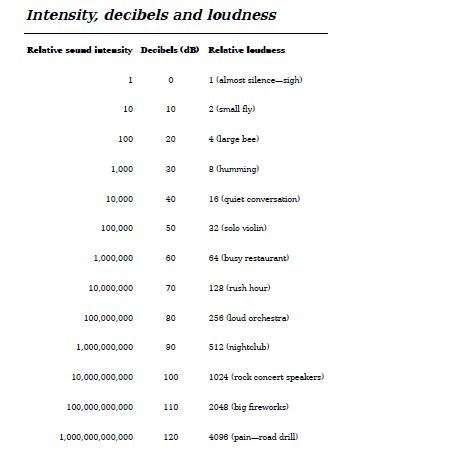
Powell also mentions that a pentatonic scale can be easily played, by using the black keys of a piano. I didn't know that before. Interesting...
The audiobook version I have also featured a few interludes between chapters, where a second narrator plays a few musical instruments, helping illustrate the points talked about in the previous chapter. This was a nice addition to the reading.
***********************
How Music Works was an interesting look into the topic.
Although it was a decent read, and very informative, the writing tended to be a little dry at times...
Still a good book that I would recommend.
3.5 stars.
Author John Powell is (from the book jacket) "a physicist and a classically trained musician, with naturally curly hair. He has given lectures at international laser conferences and played guitar in pubs in return for free beer. He prefers the latter activity. He holds a master’s degree in music composition and a Ph.D. in physics, and has taught physics at the universities of Nottingham and Lulea (Sweden) and musical acoustics at Sheffield University. He lives in Nottingham, England."
John Powell:
Powell opens the book with a good intro He writes with an easy style, and peppers his writing here with bits of cheeky humour throughout. A difficult talent to pull off effectively, I felt that it largely worked here (thankfully).
As its title implies, How Music Works is a largely scientific look into the topic. Powell covers the fundamental mechanisms of many popular instruments. The guitar, violin, piano, clarinet, pennywhistle, organ, and more are covered here.
Interestingly enough; he writes that there was no international standard for note specificity before 1939. Before then, what constituted an "A" could be markedly different, depending on where the music was produced.
He also talks about perfect pitch early on; telling the reader what it actually is, and is not.
Powell talks about the decibel system of measuring sound volume here:
"Now we have a system that can be used to measure loudness from the quietest noise to the loudest which only goes from zero to 120. But I’m afraid that even though the numbers are now simple, the use of this scale is complicated. The table shows that each time the loudness of the noise doubles, you add 10 decibels. This sounds simple enough until you realize that this means that not only is 20dB twice as loud as 10dB (which seems obvious) but also that 90dB is twice as loud as 80dB (which seems crazy, but it’s true—just look at the table).
At this point I must come clean and admit that I don’t like the decibel system of loudness measurement at all. It isn’t easy to use even if you have studied math or physics up to college level. Even a professional scientist would need a calculator and a few minutes to be able to tell you the difference in loudness between 53 decibels and 87 decibels. I have no proof of this, but I think the decibel was invented in a bar, late one night, by a committee of drunken electrical engineers who wanted to take revenge on the world for their total lack of dancing partners..."
Powell also mentions that a pentatonic scale can be easily played, by using the black keys of a piano. I didn't know that before. Interesting...
The audiobook version I have also featured a few interludes between chapters, where a second narrator plays a few musical instruments, helping illustrate the points talked about in the previous chapter. This was a nice addition to the reading.
***********************
How Music Works was an interesting look into the topic.
Although it was a decent read, and very informative, the writing tended to be a little dry at times...
Still a good book that I would recommend.
3.5 stars.

October 12, 2015
Perfect book to get to know music, except the attempts at humour were bit annoying, sort of pesky, cos they sounded kiddish but appreciate the author for trying to enliven the writing that way, probably he was scared it might be dry but it was not. Learnt many many things from the book. Thank you, Mr. Powell.
While not elaborate on the distinctions, especially liked the tidbits and references to Indian classical music. A sample:
"traditional non-Western music places far less emphasis on chords and harmony. Indian classical music, for example, tends to use one, or perhaps two, melodic instruments together with percussion and/ or rather static, drone-like accompaniments. Good examples of this type of music can be found on most recordings from the Indian sub-continent with the word ‘raga’ or ‘rag’ in the title. ‘Raga’ means colour or mood in Sanskrit – and is the name given to an improvised piece of music. Probably the most famous musician of this genre is the sitar player Ravi Shankar, and a great example is ‘Raga Anandi Kalyan’, which he plays with his daughter Anoushka, who is also a world-famous sitar player."
.."Improvisation is common to all musical societies. For example, Indian traditional music concentrates heavily upon it. The training of a Western classical musician involves lots of repetition in an attempt to play the notes written by a composer correctly. Traditional Indian musical training is all about how to compose your own music on your instrument as you go along. The idea is that you have a group of notes as your basic building blocks, and you use them to improvise a piece lasting several minutes. Each group of notes or ‘raga’ is associated with a mood and a time of day. The ability to improvise well is a highly respected talent and it can lead to some interesting interplay between the musicians" ... reference to the highly entertaining jugalbaandis.
I revere my country's rich, rich, and deep cultural heritage and grateful for it, it stands up with the best of the world art's tradition and knowledge, so while I do not know enough of it such notings help to increase that awareness for me
While not elaborate on the distinctions, especially liked the tidbits and references to Indian classical music. A sample:
"traditional non-Western music places far less emphasis on chords and harmony. Indian classical music, for example, tends to use one, or perhaps two, melodic instruments together with percussion and/ or rather static, drone-like accompaniments. Good examples of this type of music can be found on most recordings from the Indian sub-continent with the word ‘raga’ or ‘rag’ in the title. ‘Raga’ means colour or mood in Sanskrit – and is the name given to an improvised piece of music. Probably the most famous musician of this genre is the sitar player Ravi Shankar, and a great example is ‘Raga Anandi Kalyan’, which he plays with his daughter Anoushka, who is also a world-famous sitar player."
.."Improvisation is common to all musical societies. For example, Indian traditional music concentrates heavily upon it. The training of a Western classical musician involves lots of repetition in an attempt to play the notes written by a composer correctly. Traditional Indian musical training is all about how to compose your own music on your instrument as you go along. The idea is that you have a group of notes as your basic building blocks, and you use them to improvise a piece lasting several minutes. Each group of notes or ‘raga’ is associated with a mood and a time of day. The ability to improvise well is a highly respected talent and it can lead to some interesting interplay between the musicians" ... reference to the highly entertaining jugalbaandis.
I revere my country's rich, rich, and deep cultural heritage and grateful for it, it stands up with the best of the world art's tradition and knowledge, so while I do not know enough of it such notings help to increase that awareness for me

February 20, 2011
It's been a LONG time since I studied music theory, or history, or even played "one of the most difficult instruments to learn" (according to this author). By way of disclosure, I'm not a "trained musician" but I was pretty good: first chair in every band/orchestra I played in. And I'm one of those (probably rare) types that likes to follow a conductor's score while I listen to "classical" music. So it was with interest that I grabbed onto this book, thinking I would learn something new, if not about sound reproduction, but about the tease in the subtitle of the book, "the psychology of beautiful sounds."
Despite the author's best efforts to "dumb down" the physics and physiology of music production, reproduction, and hearing, I don't think he achieved that goal. While there was nothing that I could not (or did not) understand, this book's writing style is the first non-academic book for which I could say the word "pedantic" was coined. Boring. Beyond belief. I don't think you can explain concepts that fundamentally lie in the realm of physics (and anatomy) without using, if not big words, big concepts. Instead of wasting dozens of pages about, basically, frequency analysis, why not just go ahead and explain (or reference an explanation of) Fourier analysis? Even when I knew (or thought I knew) where the author was going, I was both bored sensless and amazed at his ability to really talk down to an audience which I think the author perceived as being technology- or science-challenged. What a waste of his mind and effort!
There's about 25 pages of good information in this ~240 page book that is interesting. I learned many facts that I have never before encountered. The rest is verbal embroidery for the supposedly dense or recalcitrant.
Unless you truly have the patience to deal with pedantic kingergarten-type instruction, avoid this book.
Despite the author's best efforts to "dumb down" the physics and physiology of music production, reproduction, and hearing, I don't think he achieved that goal. While there was nothing that I could not (or did not) understand, this book's writing style is the first non-academic book for which I could say the word "pedantic" was coined. Boring. Beyond belief. I don't think you can explain concepts that fundamentally lie in the realm of physics (and anatomy) without using, if not big words, big concepts. Instead of wasting dozens of pages about, basically, frequency analysis, why not just go ahead and explain (or reference an explanation of) Fourier analysis? Even when I knew (or thought I knew) where the author was going, I was both bored sensless and amazed at his ability to really talk down to an audience which I think the author perceived as being technology- or science-challenged. What a waste of his mind and effort!
There's about 25 pages of good information in this ~240 page book that is interesting. I learned many facts that I have never before encountered. The rest is verbal embroidery for the supposedly dense or recalcitrant.
Unless you truly have the patience to deal with pedantic kingergarten-type instruction, avoid this book.

February 21, 2022
Picked this up at the library on a whim, and golly, but it turned out to be a winner. The author is very well-informed, and funny, which I wasn't expecting, so the book was both informative and a great pleasure to read, hence five stars (I can learn a lot from a great deal of books, but they aren't often as much fun along the way).
I learned some startling things, considering I'm a singer who's played piano since age 6 and composes musicals in my spare time. He's confirmed some of my suspicions, and completely flummoxed me in other ways, and it's all science-based and true, which is reassuring. (I'm not one of those people who thinks Science is only good for building useful appliances and technology but otherwise I should get angry at it and prefer the wisdom of Cousin Jeb from two towns over).
Did you know two flutes aren't twice as loud as one flute? I'd never thought to question that, but they aren't, not remotely, for a very clear reason. (Hypothetically two flutes could under the right conditions play their loudest at you and you'd hear nothing, but the right conditions are rare, like when the water molecules in your cup of water separate so you have frozen molecules below and boiling water above, which never happens).
It's just interesting information piles upon more interesting information, but in a jocular yet clear tone that can't fail to educate while entertaining. Perfection! I wonder if he's written anything else? I'll read it. I promise.
(5* = amazing, terrific book, one of my all-time favourites, 4* = very good book, 3* = good book, but nothing to particularly rave about, 2* = disappointing book, and 1* = awful, just awful. As a statistician I know most books are 3s, but I am biased in my selection and end up mostly with 4s, thank goodness.)
I learned some startling things, considering I'm a singer who's played piano since age 6 and composes musicals in my spare time. He's confirmed some of my suspicions, and completely flummoxed me in other ways, and it's all science-based and true, which is reassuring. (I'm not one of those people who thinks Science is only good for building useful appliances and technology but otherwise I should get angry at it and prefer the wisdom of Cousin Jeb from two towns over).
Did you know two flutes aren't twice as loud as one flute? I'd never thought to question that, but they aren't, not remotely, for a very clear reason. (Hypothetically two flutes could under the right conditions play their loudest at you and you'd hear nothing, but the right conditions are rare, like when the water molecules in your cup of water separate so you have frozen molecules below and boiling water above, which never happens).
It's just interesting information piles upon more interesting information, but in a jocular yet clear tone that can't fail to educate while entertaining. Perfection! I wonder if he's written anything else? I'll read it. I promise.
(5* = amazing, terrific book, one of my all-time favourites, 4* = very good book, 3* = good book, but nothing to particularly rave about, 2* = disappointing book, and 1* = awful, just awful. As a statistician I know most books are 3s, but I am biased in my selection and end up mostly with 4s, thank goodness.)

October 31, 2010
This book is so appealing on so many different levels. A lot of times, any book that deals with technical subjects become dry and boring. How Music Works is easy to read and very enjoyable. There is so much wonderful snarky, English humor that you don't even realize you are learning something. Even if you are a casual fan of music, you will find some eye opening facts in here, such as why you hear those discordant sounds at the beginning of an orchestral concert. They are tuning all of the instruments to the same key!
I have spent most of my life around musicians and I don't think even they could explain some of the things in this book. There are wonderful illustration as well as a lot of interesting facts. I mean, how else could you learn the true meaning of decibels or how loud is too loud? This would make an excellent gift for anyone who love music or thrives on trivia.
I have spent most of my life around musicians and I don't think even they could explain some of the things in this book. There are wonderful illustration as well as a lot of interesting facts. I mean, how else could you learn the true meaning of decibels or how loud is too loud? This would make an excellent gift for anyone who love music or thrives on trivia.

November 22, 2019
Jedním slov výborný! Nemám hudební vzdělání a aktuálně se zkouším naučit trošku hrát a protože se před hudební teorii už neschovám, stáhnul jsem po této knížce. Trefa! Autor má fyzikální i hudební vzdělání a základní pojmy vysvětluje vskutku bravurně. Vše dává smysl, kapitoly na sebe navazují a když jsem na konci sáhl po kytaře, měl jsem dobrý pocit z toho, že řadě věcí rozumím. Knížka neučí číst z not, ale vysvětluje, proč notový zápis vypadá tak jak vypadá. Největším plusem je ono "proč", neboť hudba se vyvíjela tisíciletí a noty, ladění, tóniny,... vše je výsledkem dlouhého vývoje, ze kterého jsem ještě nedávno viděl jen nesrozumitelnou a nelogickou změť symbolů.
July 15, 2013
Why do some authors insist on inserting really stupid dad jokes into books nowadays? Everytime Powell discusses something that could grab my attention, he ruins it by adding a really dumb one-liner that adds no value to his story. I get trying to be light-hearted about a subject, but it felt like every second paragraph was an attempt at a joke and i just got fed up with it.
It could have been a good book.
It could have been a good book.

September 11, 2011
This book takes a fascinating and complex thing and breaks it down into overly simplistic, repetitive drivel. The author is occasionally funny, though I recommend skipping this one if you have any knowledge of music at all. The frustration of waiting for him to get to the real meat of it never subsides.

December 21, 2016
Kind of like taking a Music Appreciation class taught by a funny physics professor. Good way to learn about the science of music. With jokes.

May 16, 2021
A delightful read on the basics of music theory and structure.

March 9, 2026
It wasn't until I was almost finished with this book that I read the back cover that told that the author had a masters degree in music composition and a PhD in physics. So that explains the heavy emphasis on physics in this book and I'm not a fan of physics. It was because of the detailed emphasis on physics about halfway into the book, that I had difficulty moving on and hence, it took me forever to complete this book. There was too much information about the physics of music in this book for my taste. I wanted more about the psychology of music than what was provided.

December 28, 2023
Really fun and informative read. I liked the author and thought he should have read the entire audiobook. They had a few clips of him and those were my favorite sections. I learned some things and had fun doing it. I laughed out loud many times during this book. I’m a musician and that’s why I was interested in the book, but I think everyone would find the book interesting.
Displaying 1 - 30 of 283 reviews