Jump to ratings and reviews
Rate this book

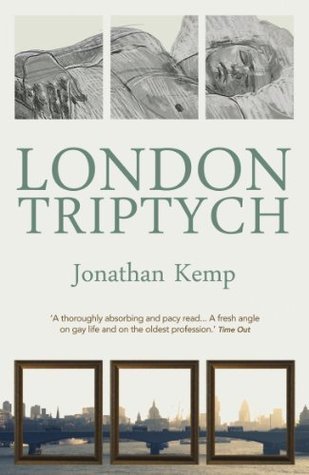
London Triptych

Rate this book
Jack Rose begins his apprenticeship as a rent boy with Alfred Taylor in the 1890s, and finds a life of pleasure and excess leads him to new friendships — most notably with the soon-to-be infamous Oscar Wilde. A century later, David tells his own tale of unashamed decadence while waiting to be released from prison, addressing his story to the lover who betrayed him. Where their paths cross, in the politically sensitive 1950s, the artist Colin Read tentatively explores his sexuality as he draws in preparation for his most ambitious painting yet — ‘London Triptych’.

Rent boys, aristocrats, artists and felons populate this bold début as Jonathan Kemp skilfully interweaves the lives and loves of three very different men across the decades

239 pages, Paperback

First published January 1, 2010

79 people are currently reading
1983 people want to read

About the author

Jonathan Kemp

24 books99 followers

Ratings & Reviews

What do you think?
Rate this book

Friends & Following

Create a free account to discover what your friends think of this book!

Community Reviews

5 stars
371 (27%)
4 stars
561 (41%)
3 stars
319 (23%)
2 stars
94 (6%)
1 star
23 (1%)
Displaying 1 - 30 of 167 reviews
Profile Image for George Ilsley.
Author 12 books314 followers
August 2, 2024
Three slices of life at three different times— what could be better?

Beautifully written and engaging, although at times the voices of the three unreliable narrators tend to merge with an omnipotent overseer who lurks here and there in the text. That is, Kemp was unable to hold himself back, imposing his own beautiful prose onto his characters instead of developing each of their voices more clearly.

However, Kemp is not to be judged too harshly for that, and in fact, when I finished the book I wanted to read it again. And I am sure I will.
Profile Image for KL (Cat).
177 reviews128 followers
November 8, 2017
Never have I ever read a novel like this one, and never do I think I would ever again.

The feeling upon trailing off from the last word and flipping the page - to discover it blank and cold - is akin to finishing The Secret History. If not for the intrinsic differences that lay in the heart of the books that separate them from each other, I would say that both books are similar; but they are fundamentally not, so I will stop going down this tempting path and strike one out of my own making.

So. Where do I start.

Despite that Goodreads claims the ebook version is 245 pages long, I spent well over 4 hours - breaching almost over to 5 - reading this book. Which is unheard of, given that I am a fast reader. And at the risk of sounding pretentious, I do think that this book is meant to be slowly savoured, because it forces you to do so. You can not rush this book; you will be incapable of rushing it. The prolific beauty that Kemp strings, word after word, sentence after sentence, so that what sits in front of you is not merely a book (with a plot and characters and words) but quite frankly a product of divine inspiration. Like a rich feast laden on the king's table, you can gorge but you become full very quickly; thus, there is an almost subconscious control that wills you to go over every single word, carefully and slowly. Breathe it in and savour.

This book. This book. It is explicit and risqué, dark and dangerous. It is almost excessive in its decadence. It is gorgeous and heartbreaking and very much gay. At this rate I'll be adding an extra hundred words worth of adjectives by praising Kemp with poorly written prose, so I suppose I'll have to round it off with that I have printed roughly 20 quotes from the book with the very intention of hanging it in my room. I hope that this alone will be sufficient enough in coaxing your interest to, at the very least, read the book's summary, if the above does nothing for you.

My main (lone) criticism is the lack of "incepfiction" cohesiveness that the summary promises, but quite honestly I don't find myself giving a damn compared to what I have received from reading this book.
Profile Image for NicoleR.M.M..
674 reviews167 followers
April 11, 2024
Wow…this was just…
Wow. I don’t think I ever read anything like this before. Fascinating, erotic and very interesting characters. It was intriguing to see how it all came together in the end. I loved the historical settings.

This was quite a remarkable book. It tells the story's of Jack, Colin and David, all 3 living a life on the edges of society in a different era in London, all three ending up selling sex for money and how they got there. I loved the lyrical writing and the historical setting of all three men. It gives you an interesting look at queer life and history in the city of London. And it's, I must admit, quite unexpectedly erotic too at times!
Profile Image for od1_40reads.
280 reviews116 followers
August 31, 2022
Sex in the city. Dream, desire, despair, delirium, destruction, destiny & death… they’re all here.

The 19th century orgy scene is hypnotic!
Profile Image for Daniel Myatt.
988 reviews100 followers
January 4, 2023
Wow, what a read! Three timelines, One City and the oldest trade....

I found I was enthralled by the 1950's timeline more then the others, the story of Colin was less sexual but much more emotional, perhaps because it was told from someone's point of view who wasn't selling.

I found the variance of the clients in Jack's story to David's story fascinating too. And I loved that the harshness and glory of London shone out in both of these timelines.
Profile Image for Cristina.
Author 38 books108 followers
March 28, 2018
Love isn't meant to stand still.

This is one of many key sentences in Jonathan Kemp's wonderfully unsettling London Triptych, three stories set in London at three different moments in time that slowly come together through a series of subtle connections and recurrent characters.

In 1894, Jack Rose recounts his apprenticeship as a rent boy in Alfred Taylor's brothel and his encounter and relationship with Oscar Wilde in the months before the trial that eventually disgraced the poet's life and reputation.

In the mid-1950s, painter Colin Read - shy and repressed - starts opening up to his sexuality through his meeting with a bold young man who'll be the trigger of a surge in his artistic inspiration.

In 1998, David addresses his former lover Jake from prison in a long and painfully honest confession that looks back at his whole life with unblinking precision.

On these apparently simple and bare narratives threads, Kemp investigates the vagaries and mysteries of love, passion, self-discovery and sex. If Jack and Colin have to hide their sexuality from society, David embraces freely a life of hedonism and excess that leaves him drained and cold. His arc contrasts nicely with Jack's growing awareness of his feelings and with Colin's outgrowing of the shell where he's exiled himself throughout his life.

London Triptych is not a novel of major events or seismic emotions, it's more about small aftershocks and vibrations that slowly shift the characters' perspective on life reassessing their perception of themselves and their environment.

London itself - alive in a throbbing and painful sort of way, indifferent, glimmering in the night - is a mesmerising presence in the book, as important as its main characters. Kemp underlines the city's importance in the novel's afterword:
For all three men, their experience of London is, essentially, one of liberation. I repeated some locations to give a sense of different memories, different events, occurring within or upon the same geographical site, such as Highgate Cemetery or Barnes Common. The three men's lives unfold in a tandem, as if simultaneously, transcending concrete time. It is, in that sense, very much a triptych.
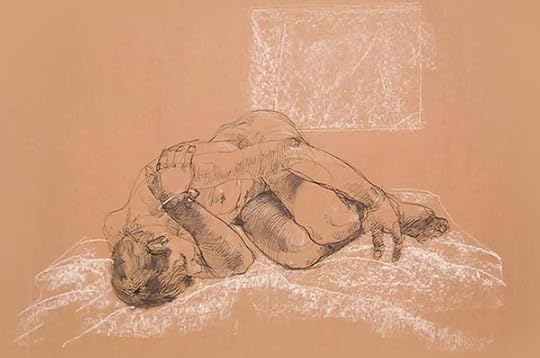

The idea of London as a site of liberation really resonated with my own experience of the city, despite my different circumstances and life details.

London Triptych is raw, touching and engrossing (and it made me discover George Cayford's beautiful drawings!). Highly recommended.

Profile Image for JOSEPH OLIVER.
110 reviews27 followers
September 23, 2015
What can I say? It's just a beautiful piece of writing. When you read in reviews that each word is `carefully crafted' I think they must have been thinking about this work because I was taken by how many of the descriptions in the book are so well conveyed in a few short colourful intense words. I found myself writing them down which I rarely do as I didn't want to interrupt the narrative. The plot is well described by others so I won't repeat it but it's the sense of time and place which is so well evoked - especially the 1950's which is conveyed in all its claustrophobia. The character Colin feels trapped in an open prison, which is probably an accurate description of the times.

One line that did stay with me was when Colin (1950's) chose not to pass judgement on his model for his prostitution work as 'he gives up his body for money and pleasure while I give up my soul for money and tedium'. Spoken for all civil servants.

I found the last character, the one in the 1990's, the least likeable. It is a walk through 10 years of gross sexual indulgence, prostitution (or escort work if you're a man) and drug fuelled encounters in the seedy side of London's gay world. Never having been in a gay club or even mixed with anyone who frequented them I will take the author's word on the realism. It sounds pretty real anyway. He tried to link Jack Rose's lifestyle in 1895 with contemporary London - or maybe contrast it. You decide.

I doubt you will be disappointed. I'm on my third reading in two years which is a record in itself. All three lives are subtly interwoven over time and a credit to the writer that he could make the link as they subtly touch hands as it were through the passage of time.

You will find a 4 page explanation of how the book came to be written and why it is written using three time periods 1895, 1950 and 1998 roughly 50 years apart.
Profile Image for Martin Belcher.
485 reviews36 followers
March 26, 2012
London Triptych is a time-spanning novel set in three time periods, the 1890’s, 1950’s and 1980’s. The three narratives are separate stories but subtly intertwined.

In the 1890’s, Jack Rose starts his tuition as rent boy with Alfred Taylor and learns to love a life of sex and pleasure servicing his well heeled clients amongst the decadence and hidden world of homosexuality in Victorian London. He meets Oscar Wilde during his work and is interestingly brought into his relationships.

In the 1950’s, Colin Read an artist who has a fondness for drawing male nudes and tries his best to hide and suppress his sexuality from his models. Eventually his desires lead to evermore bold and dangerous liaisons.

Finally we meet David in the 1980’s, his tale begins with him being in prison and how he ended up there through his exploits as a male prostitute on the London scene and a chance meeting with a beautiful man who he ends up in love with but ultimately this man betrays him.

This is a dark but enjoyable novel, its vivid portrayal of gay sex and the gay underworld normally hidden from view is startling in its excess and decadence. To be honest I don’t think this book is one for straight readers.
Profile Image for William.
448 reviews36 followers
November 27, 2013
I really wanted to like this novel, which relates the story of three gay Londoners in 1894, 1954 and 1998 respectively, linked by the pleasures and perils of the capitol. But I just didn't. The problem is that the author, who wrote this while apparently completing his PhD in comparative literature, couldn't get out of his own way and prevent his academic work from getting in the way of his fiction. There is just too much delight in words for their own sake, which--especially in the case of the teenage prostitute Jack, the protagonist of the 1894--sit oddly with their supposed narrators. Matters aren't helped by the author appending a lengthy afterword explaining his literary choices and his meanings. The most successful section is probably the 1954 section; the weakest is the 1998 one. Like I said, I really, really wanted to like this, but I just couldn't. If the author wouldn't have tried so hard to be literary, it would have come off so much better.
Profile Image for Gerhard.
1,304 reviews884 followers
March 15, 2012
Gorgeous evocation of changing gay identity over three distinct periods, focusing on three different characters in London: the time of Oscar Wilde, the 1960s and then the late 1990s. (I did find that the latter two periods are not as readily distinguishable from each other as they are from the Wilde period, and that the 1990s section seems the weakest or least impactful of the book). What I loved is that Kemp does not shy away from the pathetic, sordid and downright ugly sides of his characters -- this makes them all the more profound and universal. If you like Edmund White and Alan Hollinghurst, you will love this.
538 reviews25 followers
May 23, 2024
The concept of having three parallel stories of gay men from different periods of the London century (1894/1954/1998) is an ingenious idea.

Of the three segments, the early period featuring young rent boy Jack Rose, Oscar Wilde and the "hidden" life of homosexual activity in late 19th. Century England is the most colorful and great fun to read, but despite the author's obvious research of the times, some of the events seemed a bit dubious in parts.

I enjoyed the keenly observed and believable study of the closeted Colin, suffering in the repressed times of the 1950s and his gradual coming out to test the waters.

Thought the most recent tale of David and the more acceptable promiscuous lifestyle of the modern era, the least interesting of the three - and surprised there were only a couple of throwaway mentions of the AIDS epidemic, a subject which was still heavy on the minds and actions of gay men of the time.

Male prostitution is the linking theme in these three stories and some of the sexual situations described are quite graphic.
Overall, an original and interesting study of different aspects of gay life through the years and I was impressed by how the author cleverly connected the main characters in the novel's conclusion.
Profile Image for Gregory.
717 reviews79 followers
August 27, 2022
Engrossing and pacy and a singluar take on male prostitution. My favorites parts by far were the ones with Oscar Wilde. The only reasons this does not get 5 stars is that, for some reasons, I was aroused but never moved and also I found it weird that the 1990s section makes almost no reference to AIDS. In the end, though, I’m glad I read it.
Profile Image for Emmanuelle Maupassant.
Author 75 books1,274 followers
August 9, 2016
Jonathan Kemp explores hungers we cannot explain and paints images not only intensely erotic, but tender. Here, in London Triptych, he shows us the unfolding of three men’s lives, each an unravelling ribbon, fluid, twisting, looking back upon itself. Their stories are confessionals, inviting us to enter the nocturnal, hidden recesses of the psyche. Meanwhile, London’s shadows and secrets echo those within our protagonists, and remind us that we readers, too, have our untold stories.

Each of the tales within the ‘triptych’ takes place, primarily, in London, though separated by five decades. We see the details of the setting change, while the themes remain eternal: our desire for what we cannot articulate; our struggle to express ourselves freely; our eagerness to navigate the ‘geography of possibilities’; our delight in love, glorious, overwhelming and unexpected; and the vulnerability of that state.

1890s rent boy Jack Rose falls into an almost unwilling passion for Oscar Wilde, leading towards a path of disappointment and betrayal. 1950s artist Colin tentatively explores his sexuality, against a backdrop of prudery and prejudice. In the 1990s, David awaits release from prison, telling of the lover who deceived him.

With each interchanging narrative, we learn more of each protagonist’s history and motivations, and we see the ways in which their stories resemble one other. They do not go in search of love. Rather, it surprises them, catching them off guard. They experience transcendence and then misery: a change in their worldview.

Sex is central to the story, an enduring, irresistible force, with or without love. It is the engine driving each of our narrators to discover a version of the ‘self’ yet out of reach.

Jack Rose tells us: ‘I became a whore in order, not to find myself, but to lose myself in the dense forest of that name.’

However, love is the transformative emotion. Love enervates and destroys, bringing ultimate joy and torture. We are shown its ability to shed light on our restricted, repetitive paths.

Kemp explores what it has meant to be homosexual in a world which views those desires as dangerously inverted, and shows us the tension between pleasure and danger, when there are ‘no laws but those of the body’:

‘When you can be free, free to pursue any desire, acquire any knowledge… it’s the most terrifying place to live. It’s dangerously beautiful…’

As ever, Kemp’s storytelling goes beyond action and consequence, or the clever use of dialogue to reveal character, or the exploration of eternal themes. His talent lies in his use of language, probing words for their secrets, for their ‘blood-beat’, for their ability to reveal ‘meaning held within the contours of the skin’. He returns, again and again, to the inadequacy of language to express the erotic truths of the body, the ‘cannibal, animal hunger’ of desire.

And yet, he, as few authors can, animates the ‘universal language of lust written on the body and spoken by the eyes and fingers’.

He shows us that sex can take us to other destinations within the ‘self’, as if ‘opening doors that lead to other corridors, and other doors’: ‘I am here without knowing how. Suddenly, terrifyingly present. Here, now, lost and hot…’

Meanwhile, London itself embodies the elusive, enchanting paradox of existence. It is a place of anonymity, and simultaneous intimacy; London is the unseen, legion-faced (and thus faceless) listener, inviting the narrators to share their secrets. It is a place of judgment (all three stories bring to bear the presence of the law and prospective punishment for homosexual transgression) and of liberation. It is a place of contradictions, just as we are contradictory.
Profile Image for Erik.
331 reviews278 followers
August 27, 2022
Jonathan Kemp's London Triptych is a tale of London's queer history burdened by anachronistic, overwritten prose.

London Triptych is a story told in three marginally connected parts. Jack Rose is a working class hustler in late 19th-century London who finds himself falling in love with one of his clients, Oscar Wilde. A celibate, gay artist in the 1950s finds himself falling in love with a hustler he hired to pose for his paintings. And a young hustler in the 1990s sits in jail as he reflects on the love he had for a fellow hustler. Each of these three men reveals the beauty and pain that comes with queer love and sex, and the social risks involved with accepting who they are as gay citizens of a Victorian London.

Kemp's story is in itself an interesting and compelling way to explore the history of queer lives in a city like London and its various milieus. But there were two serious issues with London Triptych that ruined the book for me. First, Kemp's prose is incredibly ahistorical and rather than having his characters speak and think in the ways of a working-class hustler context, he had them speak like himself: a PhD candidate in comparative literature. The easiest way to correct this would have been for Kemp to write in third-person form instead of the first-person he used. But the bigger issue was with the near pornographic telling of many of these stories. Dozens of times Kemp would list off erotic things that his hustler characters did in a way that is completely disconnected from the reality of sex workers. And in many instances where his characters engaged in nonconsensual sex, his characters always enjoyed the sex adding to the dangerous stereotype that sex workers cannot be raped or sexually assaulted because they always enjoy sex. The unbelievability of the prose and the sex, made this story of sex work a let down.
Profile Image for Kevin Klehr.
Author 21 books150 followers
December 3, 2019
This was one of my 'to read' books and when I found it prominently placed in a Vancouver bookstore, I picked it up straight away. I'm so glad I did.

Three tales are told in first person from three very different broken gay men. One lives in the latter part of the nineteenth century, another tells his life from the 1950's and the last from the final decades of the twentieth century. All live in London. All we can identify with.

To say any more would spoil the wonderful journey I took with each of these characters. Each one is victim to unrequited love and each in a very different way. We identify. And each story, as we go back and forth to a different time in each chapter, travels at the same pace, each reflecting similar highs and lows the others are feeling.

Leading up to reading this book I read another fictional autobiography which felt like a random telling of events that didn't lead to an overall story arc. Several times I was frustrated with it and planned to ditch it but I carried on to find the main character suddenly finds love - out of nowhere, and we're expected to believe it. London Triptych does not suffer from any story structure flaws like this. These are all honest accounts of heartbreak, but this is not a bleak book.

It celebrates who we are and how far we've come, and all of us gay men have made some, if not all, of the mistakes Jack, Colin and David do.

Simply beautiful.
Profile Image for Christopher Moss.
Author 9 books26 followers
July 24, 2013
London in the 1890s, 1950s and late 1990s is the setting for three interlaced tales about life for same sex desiring men. Jack in the “Gay 90s” is a “rent boy”, a teen prostitute whose livelihood brings him into contact with Oscar Wilde. Colin, an artist in gay paranoid 1954 finds a nude model’s seeming openness about his sexuality a challenge for his own closeted life. David in the 1980s, telling his story from prison a decade and more later chooses to throw his life in front of the AIDS bus in order to live a life that Jack, a century before, could have risked more safely.

As soon as this reviewer realized that Jack’s meeting Wilde and the infamous Bossy was more than a cameo, he saw how the entire novel was a revisit of the tragic life of the well-known wit and playwright. The rent boy is a true hedonist, appealing to Wilde’s need for relaxing vigilance against the threat of public censure. When the Marquis of Queensbury finds witnesses to the truth of his allegations, Jack is called in to testify, and a war between his love for Wilde and his feeling of mutual betrayal informs his choices for the rest of his life.

Colin, an obedient son, gives up a desired career as an artist, returning to art as an avocation in his 50s. Gregory, his unashamed male artist’s model, starkly contrasts with Colin’s own repressed life, living as Colin does in a time when one well known homosexual after another is infamously tried and incarcerated for being caught at “the love that dares not speak its name”. Colin’s fascination with Gregory leads him to break through his isolation, as much in spite of as because of the lost opportunities they represent to him, and the title triptych is an oil painting three figures of Gregory.

David is the opposite of Colin, having walked out of his parents’ lives rather than conform to their wishes. He takes on a false name and proceeds to London in the 1980s to immerse him in the now liberated gay culture, becoming the same as Jack, a male prostitute. His first taste of love backfires on him, and he tells his tale from prison, where he is for quite another crime that “sodomy” and, in essence, sentenced to sodomy by other prisoners, certain he must have been infected by HIV/AIDS.

The author confesses that he wrote all three men’s stories separately, then spliced them together, an end he accomplished with incredible artistry. The author’s notes are as fascinating as the novel itself, though I suppose as a novelist ourselves we are bound to think so, but he verifies the reader’s sense that the three stories, the triptych, are all about what happened to Wilde. Whether literal or of one’s own making, prison is the character of all three men’s lives as it was for Wilde. Ironically Jack seems the freest of all the men, though in fact sodomy is illegal in his time. Kemp explains how he came to fashion the brilliantly woven story, each life enlightening the experience of the man in the others.

The novel will sneak up on you. The tone starts with an optimistic and fun-loving Jack whose experience loses its innocence as Wilde faces trial, then advances to Colin’s self-made prison with its sought after release dates, and finally the twisted repeat of Jack’s carefree life, with David making the least of his freedom by making the most of it. All three tales have love as the betrayer, along with the danger of placing trust in a fragile world.

This is definitely a novel you will want to reread to make sure you didn’t miss any of Kemp’s originality and depth.

That's all I Read http://kitmossreviews.blogspot.ccom
Profile Image for Bookmuseuk.
477 reviews16 followers
Read
May 30, 2016
This is Jonathan Kemp's debut novel and is a fascinating insight into gay history over the last 100 years. Whether you are straight or gay, it is an absorbing read. The characters are well-rounded human beings, with their strengths and imperfections. The book is set in London and links the lives of Jack from 1895, Colin in 1954, and David in 1998.

Jack is a rent boy with few inhibitions. He lives a life of hedonism and adventurous sex, meeting men from all classes in suppressed Victorian society, notably the soon to be famous Oscar Wilde.

Colin is an aspiring artist. He lives in the asceticism of post-war London and is filled with self-doubt and self-loathing. He tentatively explores his sexuality as he prepares for his most ambitious painting yet: London Triptych.

David is also a rent-boy, constantly seeking his next sexual high among the drug-partying crowds of the 90s.

The three stories are intertwined from chapter to chapter, in a series of apparently disparate episodes. It is only at the end that Kemp provides the surprising link between them.

This is a compelling read, a real page-turner. Kemp challenges his characters by throwing them at events and then watching them flounder and flail. It betrays their weaknesses and makes them real and three-dimensional. Too often in gay fiction, authors resort to stereotypes. This book is a commentary on the changes to the lives of gay men over the last one hundred years, and an insight into Kemp’s own views on gay men and love.

From a writer’s point of view it is a book that makes you stop and think, not just about the observations Kemp makes, but also about his prose style and his chosen structure. The book is ambitious and a very good first novel. Well worth reading.
Profile Image for Jack.
335 reviews37 followers
July 16, 2015
OK, one more from my Major Gay Authors category. Kemp's book is NOT for most mainstream readers; he explores the dark underworld of rent-boys across three generations of London. 1895, the footloose Jack Rose will do anything (and anyone) to escape the grinding poverty of his East London slum, and discovers the far lusher life of serving as object of desire to lords, politicians, and even Oscar Wilde. By 1954, a severe crackdown has led to a far more closeted world, in which a budding painter's fears of recrimination has trapped him in a stifled existence. His latest model opens his eyes, and much more. In the swirling hedonism of 1998, anyone with a mobile can begin an anonymous trade; what fells this hero is falling in love.

The stories are terrifically engaging; each time period is swiftly yet fully realized. They are quite risque; I was reading this during a flight, and half feared that my neighbor would think I was reading porn on the plane!
Profile Image for Greg S.
201 reviews
February 24, 2024
Three stories of male sex workers, 50 years apart. With London being the fourth character that links them all together. The characters are really well crafted and fleshed out. The writing is often frank and sexually explicit but due to the depth of the characters it never feels like erotica. There’s way too much pathos and humour for that. It also doesn’t shy away from the realities of sex work in any age, but particularly in the late 1800s and the 1950s when to be gay and/or a sex worker could land you in jail.

At just over 200 pages it felt a little bit short; there were definitely times where I thought some sections whistled past. But that’s a sign of a well written novel when it leaves you wanting more.
Profile Image for Rafael.
64 reviews9 followers
April 15, 2014
There's no need for gay-literature to be so... Gay. Obvious, inconsequential and boring.
Profile Image for Denise.
7,492 reviews136 followers
March 18, 2017
Jumping back and forth between three distinct narratives, this short novel explores the lives and loves of three gay men in London, decades apart. From Jack Rose, a rentboy in late Victorian times who gets caught up in the Oscar Wilde trials, via Colin, an aging artist infatuated with his model in the hostile climate of the 1950s, to David, who tells his story of sex trade and drugs while serving a prison sentence in the late 1990s, each of the stories captures what it was like to be a gay man in London at each of these points in time. I really liked the way the novel was constructed, and the way the three stories touched, just a little, that kept them connected.
Profile Image for Jonathan.
994 reviews54 followers
January 28, 2020
An entertaining and engrossing read. There are three narratives, one set in the 1890s, the second in 1954 and the third in 1998. They eventually link, other than thematically in that they all concern rent boys, the completion of which is rather subtly and surprisingly done. What is most interesting is the progress of gay men's lives over the 100 years or so in which the story takes place - or in some respect the lack of progress.
Profile Image for Alex Vogel.
Author 1 book22 followers
February 9, 2022
I really enjoyed the writing – sensitive and artful without being distracting. The protagonist that stuck out to me as the most well-rounded character was the one of the middle-aged artist. He felt like the most real of the three main characters, somehow as though Kemp was identifying with him the most. I was surprised though (and a tad disappointed) that the characters of the different storylines weren't interconnected more.
Profile Image for James.
Author 2 books21 followers
December 29, 2012
Sexy and interesting glimpse at the history of gay ho's in London.
Profile Image for Sidharthan.
330 reviews1 follower
May 7, 2020
An interesting read, that promised more than it could live up to.

I was gripped immediately by the prose when I started this book. Jonathan Kemp has a lyricism to his writing that brings alive all mundane imagery. He also revels in the language of the body. There has been no writer who has been so candid, so sordid and yet intensely poetic when writing about sex. This has to be one of the most sex-positive books I've ever read. The myriad kinks and fetishes of gay men through the ages are laid bare in the most non-judgmental way possible and sometimes the book absolutely revels in this. This is without a doubt where the book scores the most.

Where it perhaps falters is in the characters and how they develop through the book. The different arcs exist, and the movement that is inherent in the prose is not mirrored in the stories. The transformations that happen do not feel organic and sometimes even jar with the mood of the writing. Jonathan Kemp says that he wants to keep away from the idea that writing should reflect reality and I do agree with him on this. Not every work needs to reflect reality as it is commonly perceived. However, I do feel the need for a book to follow its own internal logic especially with its characters. This is where this book does not succeed as well as it could have.

The middle section, set in 1954 is without a doubt my favourite. The character of a repressed gay man in lovingly evoked and his slow blossoming into a form of acceptance of his own self is beautifully crafted. The unrequited love that is a common theme in all three narratives, find its full stride here and colours the borders of this section wonderfully. This book could've been a five-star read for me if I had managed to find this same emotion in the other sections as well!
Nevertheless, this is a beautiful and short read. Give it a go if only for the moving prose. Keep your highlighter handy as there are many many fragments that you'd want to lovingly revisit!
Profile Image for Abby Wallace.
105 reviews39 followers
December 2, 2024
Having read and being quite enthralled by The Picture of Dorian Gray at a young age, and later studying Wilde’s trial in a ENG100 class at uni, I found the chapters written by Jack the most interesting

Never had I considered the Wilde scandal from the perspective of one of the young boys involved. Kemp did a fantastic job of reimagining Wilde, offering insight into a figure I had only known through his literary prowess and posthumous studies.

This candid and risqué exploration of the ‘oldest profession’ is not something I would typically gravitate towards, but I found it very fascinating, albeit perhaps sometimes too provocative for my taste..!
Profile Image for Bill.
456 reviews
November 2, 2023
Three loosely connected stories set in London about the hidden lives of streetwalkers and their patrons. Set in three time spans roughly 50 years apart it's interesting to see how similar the experiences of the 3 main characters were. I found the 1890s storyline most interesting as it included more historical fiction including the author Oscar Wilde. My main issue with the story was while the time frames were clearly delineated at the start of each chapter that often was jarring.
Profile Image for David Gee.
Author 5 books10 followers
September 22, 2013
The stories of three gay men 100 years apart are interwoven in this highly original debut novel. In the 1890s East End lad Jack Rose is taken on as an apprentice rent-boy by Alfred Taylor, the gay 'madam' whose evidence will help send Oscar Wilde to Reading Gaol. In the 1950s, with homosexuality still against the law, inhibited artist Colin develops a consuming passion for Gregory, the rent-boy who poses for him. In the 1990s David becomes infatuated with a fellow rent-boy who puts him on a road that leads, like Oscar's, to prison. Jonathan Kemp allows these three stories small overlaps.

Each of the three tells his tale in the first person. The author gives them distinctive voices for their different times and differing moral climates. Cockney Jack's is initially the most enthralling narrative, casting a fresh perspective on the tragedy of Oscar Wilde's fall from the pinnacle. At his first encounter with the great man and his protege "Lord Muck", Jack finds that Oscar is "nothing but a fruity old sodomite" and Bosie "as rough as a navvy's ball sack beneath that hoity-toity exterior". Jack becomes fond of his new patron who showers him with gifts and free suppers, for which Jack happily 'sings' - but he doesn't hesitate to betray him in court.

100 years separate Jack from David, but they are cut from the same cloth: lascivious, hedonistic, venal. Colin is the exact opposite: introverted, self-loathing, desperately alone and lonely. The thread that runs through these three stories is London - with its tawdry temptations, its toxic allure.

Jonathan Kemp's first contribution to the canon of gay literature is as vivid and full of promise as Alan Hollinghurst's The Swimming Pool Library (1988) or Jake Arnott's The Long Firm (1999). Hollinghurst's subsequent novels have become a triumph of style over substance, and Arnott hasn't quite lived up to expectation. Let's hope that Jonathan Kemp goes from strength to strength. English fiction has yet to produce a gay writer with the power - and the staying-power - of James Baldwin or Gore Vidal.
Profile Image for Grant.
1 review
August 9, 2025
A fascinating look into 3 eras of gay sex work that are intertwined in a special way. Kemp’s descriptive prose gave me chills as I seemingly felt every touch in the book. One I’ll be excited to read again whenever I want to be held on edge by a storyline that marries the fragility of love with the intensity of raw male desire.
Displaying 1 - 30 of 167 reviews

Can't find what you're looking for?

Get help and learn more about the design.