Jump to ratings and reviews
Rate this book

Hyperborea

Rate this book
Science Fiction, Adventure, Fantasy.

Contents:

"Introduction" (Lin Carter)
Hyperborea
"The Muse of Hyperborea" (prose poem)
"The Seven Geases"
"The Weird of Avoosl Wuthoqquan"
"The White Sybil"
"The Testament of Athammaus"
"The Coming of the White Worm"
"Ubbo-Sathla"
"The Door to Saturn"
"The Ice-Demon"
"The Tale of Satampra Zeiros"
"The Theft of the Thirty-Nine Girdles"
The World's Rim
"The Abominations of Yondo"
"The Desolation of Soom"
"The Passing of Aphrodite"
"The Memnons of the Night"
"Notes on the Commoriom Myth-Cycle", by Lin Carter

205 pages, Mass Market Paperback

First published January 1, 1971

35 people are currently reading
1902 people want to read

About the author

Clark Ashton Smith

720 books994 followers
Clark Ashton Smith was a poet, sculptor, painter and author of fantasy, horror and science fiction short stories. It is for these stories, and his literary friendship with H. P. Lovecraft from 1922 until Lovecraft's death in 1937, that he is mainly remembered today. With Lovecraft and Robert E. Howard, also a friend and correspondent, Smith remains one of the most famous contributors to the pulp magazine Weird Tales.

His writings are posted at his official website.

Ratings & Reviews

What do you think?
Rate this book

Friends & Following

Create a free account to discover what your friends think of this book!

Community Reviews

5 stars
325 (42%)
4 stars
321 (41%)
3 stars
105 (13%)
2 stars
17 (2%)
1 star
1 (<1%)
Displaying 1 - 30 of 85 reviews
Profile Image for Oscar.
2,236 reviews580 followers
December 10, 2014
Tras la extraordinaria ‘Zothique, el último continente’, la editorial Valdemar nos vuelve a regalar otra joya de Clark Ashton Smith. En este caso, ‘Hiperbórea, y otros mundos perdidos’ transcurre en el mundo prehistórico de Hiperbórea, en el Marte (Aihai) de la ciencia ficción más pulp, y en un mundo galáctico lejano llamado Xiccarph. Lo que hace grandes los relatos de Smith es su atmósfera, más que sus personajes. Smith gusta de utilizar una prosa recargada, barroca casi, con palabras cultas y términos extraños. A destacar de nuevo la magnífica traducción de Marta Lila Murillo, así como la interesante introducción de Jesús Palacios. Otra característica son los finales, no exentos de un cierto humor negro.

Clark Ashton Smith, uno de los Tres Mosqueteros de la revista Weird Tales, junto a sus amigos y colegas H.P. Lovecraft y Robert E. Howard, escribió sus relatos fantásticos en los años 20 y 30 del siglo pasado. Sin motivo aparente (tal vez debido a la muerte de sus padres y amigos en pocos años), abandonó definitivamente la escritura de relatos fantásticos a finales de los años 30.

Estos son los quince relatos (y un poema) incluidos en ‘Hiperbórea, y otros mundos perdidos’:

HIPERBÓREA

La musa de Hiperbórea. La antología da comienza con un breve poema en prosa.

Los siete geases (The Seven Geases). Ralibar Vooz sale de caza con sus mejores hombres hacia las montañas Eiglofianas, sin saber la odisea a la que se ha de enfrentar. Impresionante relato. (*****)

El sino de Avoosl Wuthoqquan (The Weird of Avoosl Wuthoqquan). El avaricioso prestamista Avoosl Wuthoqquan se enfrenta a una profecía terrible (y merecida). Otro gran relato. (*****)

La Sibila Blanca (The White Sybil). El poeta Tortha cae rendido ante la belleza de la Blanca Sibila de Polarion, cuya aparición suele presagiar la desaparición de ciudades. Gran relato. (****)

El testamento de Athammaus (The Testament of Athammaus). El viejo Athammaus, que fuera verdugo jefe de Uzuldaroum, nos relata cómo tuvo que enfrentarse a la sentencia de muerte contra el bandido Knygathin Zhaum, que según se rumora tiene una conexión con el maligno Tsathoggua. Gran relato. (****)

La llegada del Gusano Blanco (The Coming of the White Worm). Evagh el hechicero es hecho prisionero en la ciudadela flotante de Rlim Shaikorth. Muy buen relato. (****)

Ubbo-Sathla. Paul Tregardis encuentra por casualidad un extraña piedra esférica, de la que cree recordar se hacía referencia en El Libro de Eibon. Magnífico relato, muy lovecraftiano. (*****)

La puerta a Saturno (The Door to Saturn). El sumo sacerdote Morghi al fin tiene pruebas para apresar al mago Eibon, adorador del dios pagano Zothaqquah. Pero al llegar a su casa no hay señal de Eibon. No obstante, parece que encuentra una pista de su paradero. Buen relato. (***)

La historia de Satampra Zeiros (The Tale of Satambra Zeiros). Satambra Zeiros se dispone a narrar lo acaecido a Tirouv Ompallios y a él mismo, ambos diestros ladrones, en el templo dedicado a Tsathoggua. Otra grandísimo relato. (*****)

El demonio de hielo (The Ice-Demon). Cuenta la leyenda que el rey Haalor y el mago Ommum-Vog, junto a multitud de soldados, siguen congelados en un glaciar, junto a sus preciosas joyas. Quanga el cazador, junto a dos joyeros, se disponen a averiguarlo. Muy buen relato. (****)

El robo de los treinta y nueve cinturones (The Thieft of Thirty-Nine Girdles). El viejo ladrón de Uzuldaroum, Satambra Zeiros, nos relata la aventura que vivió junto a su amada Vixeela, en lo que fue el robo de los treinta y nueve cinturones de castidad de oro y piedras preciosas. Buen relato. (***)

AIHAI (MARTE)

Vulthoom. El piloto de crucero estelar Bob Haines y el escritor Paul Septimus Chanler llevan tiempo en Marte, sin posibilidad de encontrar nada mejor. Es entonces, ante tal dificultad, cuando son convocados por Vulthoom a visitar Ravormos, el submundo de Marte. Allí encontrarán pistas sobre los planes de este. Buen relato. (***)

El morador del Abismo (The Dweller in the Gulf). Ante una tormenta de arena, un trío de aventureros terrícolas decide buscar refugio en una cueva. Allí hallarán un gran abismo, que decidirán explorar. Muy buen relato. (****)

Las criptas de Yoh-Vombis (The Vaults of Yoh-Vombis). Un grupo de arqueólogos decide inspeccionar una antigua ciudad de Marte. El horror les espera. Gran relato. (*****)

XICCARPH

El laberinto de Maal Dweb (The Maze of Maal Dweb). Que narra la incursion del cazador Tiglari a la terrible e inaccessible morada de Maal Dweb, el hechicero que ha raptado a su amada Athlé. Magnífico relato y genial la imaginación de Smith para crear mundos y paisajes. (*****)

Las mujeres flor (The Flower-Women). Ante el aburrimiento, Maal Dweb decide visitar uno de los mundos que gobierna, Votalp, donde observó un acontecimiento que le llamó la atención. Buen relato. (***)
Profile Image for Keith Azariah-Kribbs.
Author 6 books8 followers
November 2, 2011
This is an absolutely glorious collection of short stories centered loosely around the doings and goings-on in the lost land of Hyperborea, which lies in the general vicinity of Greenland not long before the last ice age buried the place under the snow, but while the country is still covered with forests and jungles and men and women capable of the most extraordinary passions and obsessions and adventures. Now, be mindful--you won't hear a lot about those passions and obsessions in this story cycle--not the passion or the obsession part, anyway. You'll see them, but you won't feel them, if you take my meaning. Watching characters anguish is not what the Hyperborean cycle is really all about.

The series of stories fits comfortably in alongside Robert E. Howard's Hyborean stories about Conan and his gang, but Smith's wizards and forlorn lovers and minor deities are playing a different game, and in many cases for much higher stakes than Howard's. For Smith's mystics, and they pretty much are all mystics, the wizards and the warriors and the lovers alike, hacking and slashing and the glory that comes from it and a good bard to make sure everyone hears about it just isn't enough. To some extent, that affects his characters, who tend to be passive, often more acted upon than acting on their environment. Modern readers may chaff at the lack of anguish the victims of his horrors express.

But Smith's Hyperborean cycle isn't really about the characters. Although several of these stories share characters, there's not really very much progression to their story--they don't evolve, they don't grow, they don't follow much of an heroic or anti-heroic arc. Finally, the stories aren't really about them. The stories are about Hyperborea, and what it means to you, the reader. Because Smith's greatest contribution here reminds me more of Rowling's than Howard's in one important respect. The chief attraction of the Potter universe is the place itself. It's a marvelous sandbox, one of the few alternative reality stories that I've seen in years that was actually interesting, and not just another tiresome dystopia. Who wouldn't want to hang around Hogwarts for a bit? Same thing with Smith's Hyperborea. If you are immune to the urge to stand in the chill breeze that blows across the summit of some Hyperborean peak and gaze out under the golden sun towards the violet horizon that stretches across a plain dotted with lost cities filled with cursed treasures and wizard's towers and haunted forests, then these stories are not for you.

But if you like a good sandbox, you won't find a better one than Smith's Hyperborea.
Profile Image for Anabel Samani.
Author 4 books57 followers
October 8, 2023
4.5

La mayoría de los relatos de esta antología, Hiperbórea, y otros mundos perdidos, pertenecen al denominado ciclo de Hiperbórea, pero Valdemar ha recogido también los tres relatos pertenecientes al ciclo de Marte (Aihai) y otros dos que conforman el ciclo de Xiccarph.

Si bien las historias son variadas (algunas juegan con el absurdo y el surrealismo, otras son profundamente aterradoras y gores, otras son picarescas…), la mayoría comparten determinados rasgos. La prosa es ornamentada y las descripciones prolijas y ricas. La ambientación es siempre lo más importante, más que los personajes, y sobresaliente: imaginativa, diferente, exótica. Los protagonistas, siempre hombres, no son, a diferencia de los de Lovecraft y Robert E. Howard, intelectuales al borde de la locura o bárbaros con espada, sino pícaros, hechiceros o villanos. No hay héroes, y, si alguien se acerca a la figura de héroe, el desenlace no es en ningún caso heroico. De las historias se desprende nihilismo y decadencia; al final todo se pierde, nada se salva.

― (…) y vosotros, que osasteis interferir, yaceréis a mi lado convertidos en un montoncito de polvo… y el polvo será arrastrado por el viento.

La mayoría de los relatos destilan horror cósmico, pero con la impronta de Smith: sus dioses son grotescos, sin grandeza ni en su forma ni en su motivación.

Los cuentos de Hiperbórea

Estos relatos están ambientados en el continente de Hiperbórea, en una era prehistórica donde convivían humanos y dioses antiguos primigenios, donde había hechiceros, pícaros ladrones y sacerdotes de cultos olvidados. Pero es un mundo en desaparición, que está sucumbiendo bajo una glaciación extrema. Historias decadentes en un mundo decante.

Aunque la ambientación predominante de Hiperbórea nos lleva a pensar en las tierras de Conan, algunos relatos emanan tal exotismo que, si me hubieran dicho que formaban parte de Las mil y una noches, me lo hubiera creído. Los personajes son algo pasivos (el más pasivo, sin duda, el hombre de Los siete geases), porque, como mencioné, lo primordial es la ambientación, en este caso, la tierra de Hiperbórea. Los cuentos son de una oscura fantasía, pícara y sin final feliz, con un humor algo perverso en ocasiones.

La verdad es que disfruté de todos los relatos; del que menos, Los siete geases, uno de los más alabados del autor, pero se me acabó haciendo repetitivo.

Marte y Xiccarph

En cuanto a las historias de Marte (llamado aquí Aihai), estas resultan bastante lovecraftianas y, si bien para muchos lectores son de las más destacables, la única que me ha dejado asombrada ha sido la última, Las criptas de Yoh-Vombis, que parece el germen de la película de Alien; solo por eso merece la pena acercarse a ella.


Las dos historias de Xiccarph están entres mis favoritas. El protagonista es un villano y se ambientan en un exótico sistema planetario.

Resumiendo…

Unos cuentos muy variados en los que no abunda la acción, ni los giros dramáticos, por lo que, si prefieres historias veloces, puede que no los disfrutes tanto como yo; pero, si te deleitas con la imaginación exuberante o paseando por tierras lejas con pícaros ladrones, buscando tesoros malditos, haciendo arqueología extraterrestre o con los finales inciertos, si disfrutas de la prosa algo barroca y de la atmósfera de la fantasía oscura, C. A. S. será uno de tus mejores anfitriones.
Profile Image for Rodrigo Tello.
343 reviews24 followers
December 5, 2017
Habiendo leído su anterior antología, Zothique, Smith mantiene aquí toda esa increíble sensación de maravilla, extrañeza y lejanía, con sus ciudades malditas y perdidas, sus criaturas extraterrestres y sus magos y brujos campando a sus anchas y haciendo de las suyas. Todo un ambiente onírico y apabullante de fábula surrealista y siniestra, a niveles literarios extremadamente barrocos y románticos, mezclados con un pulp bastante perverso y pícaro, que muy pocos deben haber conseguido emular. Paso ahora a comentar algunos relatos:

"Los siete geases", donde conocemos la historia de Ralibar Vooz, un noble ciudadano de Commoriom que se internará en las montañas eiglofianas y descenderá a unos abismos brutales e inimaginables.

"El testamento de Atthamaus", en el que un renombrado verdugo de Commoriom presencia de primera mano los hechos fatídicos y aberrantes que llevaron a la destrucción de la ciudad.

"La llegada del gusano blanco" es una crónica del brujo Eibon, que narra el demoníaco advenimiento de un gigantesco glaciar que congela todo allí por donde pasa. Aquí ya se advierte que el hielo es el principal elemento maligno y ominoso de todo el ciclo.

"Ubbo-sathla", un clásico no sólo del ciclo mítico de Commoriom sino de los Mitos de Cthulhu, en el que el inglés Paul Tregardis consigue una esfera de cristal que perteneció al brujo hiperbóreo Zon Mezzamalech. Este relato tiene unas descripciones completamente delirantes y alucinantes. Obra maestra.

"La puerta a Saturno", dónde nos enteramos del extraño y retorcido destino que recae sobre los magos adversarios Eibon y Morghi,

"La historia de Satampra Zeiros" y "El robo de los treinta y nueve cinturones" cuentan las peripecias y desventuras del maestro ladrón Satampra Zeiros, una especie de Robin Hood de Commoriom, en su enfrentamiento con el Dios sapo Tsathoggua y su aciaga sociedad para el delito con el mago Veezi Phenquor.

Como broche de oro a todo este delirio malsano, Valdemar nos deleita con dos ciclos más de cinco relatos en total:

El ciclo de Aihai, el Marte de Clark Ashton Smith: tres relatos de ciencia ficción al estilo de Bradbury, donde destaca "Las criptas de Yoh-Vombis", con un argumento parecido a la película Alien pero evidentemente escrito mucho tiempo antes,

y el ciclo de Xiccarph, un extraño planeta dominado por un no menos extraño rey llamado Maal Dweb. Son dos relatos, en uno conocemos el demencial y repugnante laberinto al que son arrojadas las víctimas del monarca, y en el otro asistiremos, entre abismos infinitos y ángulos imposibles, a un viaje al planeta Votalp, donde moran unas inconcebibles y vampíricas mujeres flor que necesitan desesperadamente de las artes taumatúrgicas de Maal Dweb. Este último cuento es puro espada y brujería, un deleite absoluto.

Todo esto precedido por un soberbio prólogo de Jesús Palacios que hace de este un volumen imprescindible para cualquier lector. Ahora, a esperar ansioso el tomo dedicado al mundo perdido de Averoigne.
Profile Image for Jerry.
Author 10 books27 followers
September 20, 2016
Reading this was a huge disappointment. I’m disappointed that I didn’t read it during the heyday of my fantasy role-playing.


The sand of the desert of Yondo is not as the sand of other deserts; for Yondo lies nearest of all to the world’s rim; and strange winds, blowing from a gulf no astronomer may hope to fathom, have sown its ruinous fields with the gray dust of corroding planets, the black ashes of extinguished suns. The dark, orblike mountains which rise from its wrinkled and pitted plains are not all its own, for some are fallen asteroids half-buried in that abysmal sand. Things have crept in from nether space, whose incursion is forbid by the gods of all proper and well-ordered lands; but there are no such gods in Yondo, where live the hoary genii of stars abolished, and decrepit demons left homeless by the destruction of antiquated hells.

What I could have done with that, and it is just one paragraph among two hundred pages of weird fantasy.

Clark Ashton Smith was part of the Lovecraft/Howard circle, and in his Hyperborean stories it definitely shows. They had similar ideas about ancient gods and ancient lands; Smith’s is more fantasy-oriented than Lovecraft’s, and more weird than Howard’s.

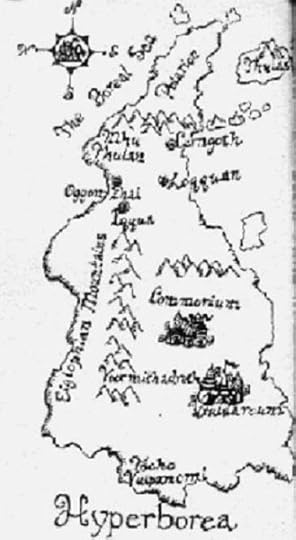
Lin Carter also provides a guess at a map of Hyperborea; and an attempt at the chronological order of the stories; if I have any quibble with the book it is that I prefer stories presented in order of when they were written, but that’s a pretty minor complaint.
Profile Image for K.T. Katzmann.
Author 4 books106 followers
January 5, 2016
In my review of The End of the Story, I mentioned how someone as varied as Smith is best anthologized with an eye to keeping a theme. This is the perfect example.

Hyperborea is Smith's doomed prehistoric kingdom, a place where the advancing ice age is a backdrop for self-aggrandizing thieves, heroic executioners, and poor, doomed cursed warriors. Smith’s heroes are always a touch of dark fun, very much in the vein of Fritz Leiber’s swashbuckling tales of Fafrd and the Grey Mouser.

The creatures inside have a bit of Robert E Howard and a touch of Howard Lovecraftinside the uniqueness of Smith. There’s a few names that have hit the big time in the monster business: Ubbo-Saltha, Atlach-Natcha, Tsathoggua etc. Still, they’re painted with the dark whimsy of Smith. If you ever wanted to see a sword-and-sorcery comedy, the last two critters participate in the wonderful game of “Pay it Forward with the Mind-Controlled Sacrifice” of the Seven Geases, whose protagonist if half Conan and half Arthur Dent.

This is a world sometimes horrific, sometimes funny, and sometimes involving knights riding dinosaur-skin saddles. This is fun.

Two other web sites of note for this one:
 photo tsathoggua_zpsyysxemrm.jpg
First, there's some excellent sketches of these creatures at Yog Blog Sothoth. Be aware: some are NSFW.

Also, many of these have been excellently covered at the dearly missed
Double Shadow podcast.
January 29, 2012
This guy was a contemporary of H.P. Lovecraft and gets barely any attention compared to the HPL phenomenae. Not sure why, Lovecraft uses Smith's gods to torment his characters after they became pen pals. The stories are more richly carved whale bones dipped in vein striped tar. Maybe its a little less linear of an 'easy' read than Lovecraft? Hell if I know. This guy doesn't get lazy like Howard P. though. He takes you right up to the creature, shoves your hand in, describes the tongue and toothies, then the frostbite saliva, the rich room with dark designs festered with rot, and doesn't back off. You also have some smells going through your mind when the decisive hand is going to be eaten.

Hyperborea is an area of his short stories (shorties he wrote constantly without committing to a whole book) that has mostly frog and liquidy glop creatures that eat humans (unless they are full or disgusted by 'em). Two stories stand out and you can read those here and quit fussing with this review.

http://eldritchdark.com/writings/shor...

You can read a ton of his stuff on this website:
http://eldritchdark.com
And...you should! NOW!
Profile Image for Daniel.
123 reviews22 followers
October 26, 2014
Por el principio: Clark Ashton Smith es uno de los escritores más importantes de la literatura fantástica del XX. No uno de los más destacados del círculo lovecraftiano. Tampoco alguien que en la foto salga detrás de los pesos pesados. Los relatos de Hiperbórea van más allá de la aventura exótica: componen un entramado del que sólo vemos los puntos sueltos, juntos forman una totalidad dinámica en la que quedan integrados. Ese tapiz abierto a la imaginación del que forman parte se sitúa en un paisaje tan colorista y tóxico como el dibujado en Avatar, pero sin las ñoñerías azules. Las narraciones poseen a veces una fuerte carga simbólica. En otras la potencia salvaje está más a la vista, a un palmo de una naturaleza encantadora. Avatar con aliens y gemelas en los pasillos.
El prólogo de Jesús Palacios transmite -como siempre con él- pasión por el contenido. Sólo una puntualización: las mujeres-flor del último relato están abiertamente emparentadas con las muchachas-flor de Parsifal de Wagner (no en vano el mago Klingsor llama a Kundry, la más excitante y venenosa, Rosa del Infierno).
Uno de los volúmenes más recomendables de Gótica. Mejor de uno en uno, respirando, que del tirón.
Profile Image for Little Timmy.
7,389 reviews59 followers
November 15, 2015
Nice collection of the fantasy stories from this pulp era writer. While i am not a big Ashton fan he has a very vivid imagination for plots, If you like H. P. Lovecraft you should like this writer as well. Recommended
Profile Image for Philip of Macedon.
311 reviews89 followers
February 22, 2016
Included here are the eleven stories and two poems that make up Clark Ashton Smith's Hyperborea cycle. A great collection. The stories are ASTOUNDING ADVENTURES taking place in a fantasy world barely related to Lovecraft's Cthulhu mythos (the only relation being the brief mention of Abdul Alhazred, hinting at shared gods... though these gods are never mentioned), but ancient, foreign, and altogether less familiar than the world of Lovecraft. Through these stories, most of which are overflowing with archaic myths and romantic grandeur and violence and detail, we see a vibrant world come to life that's more fantastical than most fantasy, and teeming with imagination in pretty much every word. Smith's vocabulary is impressive, with unheard of and forgotten words on every other page. Each story is atmospheric and immersive, colorful, fast moving, and a total escape from reality. Although one tale is merely an unfinished fragment, what little it does in those 3 pages is enough to get your cheeks wet. Perhaps two or three of the tales are not UTTER DESTROYERS of epic power, being overly detailed in heavy exposition and with slow moving development. But the rest, all of the rest, are mini-epics, microcosms of delusion and fantasy and nightmare and adventure. Unique and exciting even eighty years later. This is like nothing that has been done before or since.

Profile Image for Ignacio Senao f.
986 reviews54 followers
October 28, 2014
Un autor excelente. Su principal características: la primera vez que se lee algo de él no gusta, la 2º vez es un orgasmo de imaginación.

Como bien es dicho, es una clara mezcla de Lovecraft (por sus seres de un planeta extraterrestre) y Robert E. Howard en las acciones violentas. Ha cogido lo mejor de cada uno de estos.

Te sumerge en un lugar siniestro, oscuro y diferente. Que bien podría ser el mismísimo infierno.
Profile Image for Craig.
6,333 reviews179 followers
December 6, 2009
Smith, while not as well-remembered as his peers Robert E. Howard and H.P.Lovecraft, was a member of the classic Weird Tales circle, and a master of the fantasy genre. While occasionally baroque and florid, Smith's best work evoked compelling alien lands and characters, and is well worth re-sampling from time to time. HYPERBOREA was one of his best.
Profile Image for Leonora Abril.
105 reviews19 followers
June 2, 2019
El libro contiene una serie de 10 relatos escritos por Clark Ashton Smith entre 1929 y 1957, los cuales tienen en común su ambientación en la “pre humana” Hiperbórea.

Luis Gámez (editor y traductor) nos explica que decidió usar el titulo concebido originalmente por el propio autor para la recolección de los relatos de su ciclo de Hiperbórea, y los relatos están ordenados en relación a como fueron completados, aparte de incluir en forma anexos, algunos textos inacabados o que se han relacionado con este ciclo de alguna manera; aquí incluiré una pequeña reseña con una “calificación” personal en función de los relatos que más me gustaron, pero para mí el libro es un 10 de 10.

El libro de Hiperbórea.

1. La historia de Satampra Zeiros. * * * *
Satampra Zeiros y su compañero de robo se encuentran con un ser desconocido y horrible cuando intentan robar en un templo dedicado a Tsathoggua.

2. La puerta a Saturno. * * * /*
En este relato podemos apreciar el conflicto entre los adoradores de la diosa Yhoundeh y aquellos devotos del oscuro dios pagano Zhothaqquah (o Tsathoggua). Aquí se nombra al antiguo hechicero Eibon, el cual escribe un libro donde describe su vida y varios hechizos, conjuros e invocaciones prohibidas. Las menciones a este libro no se limitan al ciclo hiperbóreo, sino que es nombrado en algunas narraciones de H. P. Lovecraft.

3. El testamento de Athammaus. * * * /*
El protagonista, el verdugo Athammaus de la ciudad de Commorion, nos relata la verdadera razón por la que esta espléndida capital hiperbórea fue abandonada.

4. El sino de Awoosl Wuthoqquan. * * * *
En este relato podemos observar un poco de humor irónico que caracteriza muchas obras de Clark Ashton Smith. Un avaro comerciante encuentra su destino en medio de la persecución de riqueza.

5. Ubbo-Sathla. * * * * *
Este es mi relato favorito, es uno de los más cortos de la selección, pero me gustan bastante los relatos que empiezan con un personaje que vive en tiempos modernos, y como su vida se encuentra conectada con la de algún ancestro por medio de algún artefacto encontrado de forma fortuita, dándole oportunidad de ser testigo de extrañas y atávicas visiones.

6. La Sibila Blanca. * * * /*
Aquí nos cuenta como un poeta que viajo durante muchos años buscando una belleza que nunca se le concedió contemplar, hasta que regresa a su ciudad natal y por casualidad se encuentra con la Sibila Blanca de Polarion, de la cual queda prendado de inmediato. Su vida no vuelve a ser la misma después de subir hasta las más altas y heladas cumbres de Cerngoth en la búsqueda de su musa.

7. El demonio de hielo. * * * *
Quanga el cazador, en compañía de los dos joyeros Hoom Feethos y Eibur Tsanth, se enfrascan en la búsqueda de los rubíes del Haalor en un mundo en el que la maldición del hielo ha acaecido varios siglos atrás e Hiperbórea.

8. La venida del Gusano Blanco. * * * *
En este relato se nos narra la verdad detrás de la maldición del hielo que había de acaecer en toda Hiperbórea.

9. Las siete geas. * * * * *
Lord Ralibar Vooz, un cazador que por una clase oscuro azar se encuentra con el hechicero Ezdagor, es aprisionado dentro de un hechizo a seguir la voluntad de este último, y se ve precipitado en un oscuro viaje en las entrañas de la tierra. Este es otro de los relatos más irónicos de Clark.

10. El robo de los treinta y nueve cinturones. * * * * /*
Otra aventura protagonizada por Satampra Zeiros, pero en este caso es acompañado por su amada Vixeela.


Anexos:

1. La casa de Haon-Dor (fragmento).
En este, es una lástima que haya llegado a completar el relato, me estaba gustando mucho.
2. Final alternativo de “La Sibila Blanca”.
Es un final más bonito y amable, pero creo que sigo prefiriendo el final original.
3. La musa de Hiperbórea.
Un hermoso poema en prosa.
4. La sombra antigua / La sombra del sarcófago (sinopsis).
5. La ciudad Hiperbórea (sinopsis).

Estas dos últimos anexos, son sinopsis que aparecen El libro negro ( The black book), pero jamás llegaron a ser escritos.
Profile Image for Michael.
261 reviews
July 27, 2016
"I, Satampra Zeiros of Uzuldaroum, shall write with my left hand, since I have no longer any other, the tale of everything that befell Tirouv Ompallios and myself in the the shrine of the god Tsathoggua, which lies neglected by the worship of man in the jungle-taken suburbs of Commoriom, that long deserted capital of the Hyperborean rulers." And thus begins the Clark Ashton Smith's "Book of Hyperborea, first story being "The Tale of Satampra Zeiros".
Smith was certainly a "wordsmith" no pun intended. He was a brilliant writer and his names of people and places were certainly unique. This book is devoted to his stories that take place in a mythical or fantasy realm of Hyperborea. In Greek mythology, Hyperborea was a mythical land and people that lived beyond the North Wind. Not sure if this should be confused with that land. It is full of thieves, sorcerors, warriors, and old gods and monsters. He was somewhat influenced by H P Lovecraft and vice versa, although Clark Ashton Smith created his old gods and supernatural horror with more humor and irony than Lovecraft. You can see CAS' influence on writers like Ray Bradbury and Jack Vance. For sure in Vance's "Tales of the Dying Earth" stories. I particularly love his take on sorcerors in great stories like "The Coming of the White Worm", "The Door to Saturn", but my favorite I think is "The Seven Geas" and "The Theft of the Thirty Nine Girdles" both have very ironic endings. Highly recommend.
Profile Image for Gregg Wingo.
161 reviews23 followers
August 4, 2019
Clark Ashton Smith's work is a wonder to behold if not a perfect read. "The Book of Hyperborea" is a collection of his Cthulhu stories based on the inspiration of Bierce, Chambers, and Lovecraft. Yet as Will Murray quotes Smith in the postscript these stories are driven by 'the demon of irony'. But even more Clark is writing poetry in prose like this piece from "The White Sybil":

"Of all that followed, of that supreme and inenarrable hour with his divinity, much was forgotten afterwards by Tortha. It was like a light too radiant to be endured, a thought that eluded conception through surpassing strangeness. It was real beyond all that men deem reality; and yet it seemed to Tortha, at moments, that he, the Sybil, and all that surrounded them, were part of an after-mirage on the icy deserts of time; that he was poised insecurely above life and death in some bright, fragile bower of dreams."

It can't get further from Lovecraft than this but somehow still end with horror and death. There are only two or three somewhat happy endings in the book but even they still have the demon of irony lurking there. The real bonus of this collection, beyond having all the Hyperborean tales in one place, is the inclusion of the unabridged version of "The Coming of the White Worm" for the first time in print. With twelve stories and one actual poem it is a quick and interesting read. But be forewarn this will be like nothing you have ever experienced before....
Profile Image for Fantasy boy.
497 reviews196 followers
November 4, 2024
Hyperborea by Clark Ashton Smith is a fantasy short stories collection. It was published in Ballantine adult fantasy series. It is a highly imaginative fantasy book, with Lovecraft esque monsters, gods or entities were living in a realism of a far north place. Some stories have very intriguing settings and concepts such as The Door to Santurn, The Coming of the White Worm, The Seven Geases. All the short stories and poems were selected in the book which they are high quality of writing. It is difficult not to notice his writing and the use of the words which portray the stupendous scenery as intricate tapestries to telling a bizarre and perilous world.

Unfortunately, the only problem I can see is that Smith’s characters are not quite matched to the grand world building and the settings. It’s a shame that such a stunning masterpiece lack of characterization even though the purpose of writing those short stories are intentionally not creating a believable character or the like in the stories, but I still hope the it would be better to see his characters in the book are not just a mere plot device.

Personal Rating: 8.5 out of 10.
Profile Image for Kars.
410 reviews55 followers
December 23, 2024
Every time I finished a CAS anthology I go “this is my favorite of his worlds.” I dig the prehistoric or Bronze Age vibe of Hyperborea. And as usual I just adore the mix of horror, comedy, florid prose, and world building that goes on here. This is also probably the most Lovecraftian of CAS’s cycles. Highly recommended for fans of pulp fantasy. Out of the three big names, REH, HPL, and CAS, Smith remains my favorite.
Profile Image for Temucano.
562 reviews21 followers
July 4, 2022
Uno de mis favoritos máximos de todos los tiempos es Clark Ashton Smith, el autodidacta ermitaño de la Weird Tales. Sus obras mezclan la fantasía y el terror en dosis perfectas, con toques de humor negro incomparables, fantasía oscura llena de nombre exóticos, de seres malvados y perversos hasta la médula.

Durante los 90 fue mi principal búsqueda, encargué un ejemplar de Hyperborea en inglés de la Necro Press, (de cuya contratapa extraje mi gato avatar), me hice de casi toda su producción en e-book, y finalmente me hice de esta edición de EDAF que leí apenas pude, volviendo a enloquecer de gusto.

Mis relatos favoritos: "El testamento de Athammaus", "La puerta de Saturno", "El relato de Satampra Zeiros", "Las siete pruebas", "La llegada del gusano blanco" y "Las abominaciones de Yondo", pero en general disfruté por igual todas sus narraciones. En la mayoría de ellas hace gloriosa aparición Tsathoggua, el principal aporte del sacerdote loco Klark-Kashton a los Antiguos lovecraftianos.

Ya caerá la edición de Valdemar, nunca es tarde para volver a releer esta joya.
Profile Image for Jordan.
689 reviews7 followers
October 15, 2021
Clark Ashton Smith is rapidly becoming my favorite pulp/Appendix N (-ish) author. Phantasmagorical, alien, haunting, and beautiful. Hyperborea shines brightly and darkly. Well worth tracking down the out-of-print Ballantine Adult Fantasy edition.
Profile Image for Javi Appreciates  Art.
79 reviews32 followers
January 28, 2022
Es mi primera incursión a la obra de Klarkash-ton y la verdad es que quedé gratamente sorprendido.

En esta obra se nos relatan historias variopintas con personajes variopintos, todas ellas ubicadas en el continente de Hiperbórea, el cual el autor consigue aprovechar para crear criaturas, escenarios y situaciones totalmente terroríficas.

Son muchas las ocasiones en las que se tratan temas relacionados con criaturas, deidades malignas, etc que pretenden poner fin a la vida de alguno de nuestros protagonistas.

Sin embargo, también se tratan temas como el amor, la no correspondencia o, simplemente, el intenso sentimiento de la melancolía y la pérdida, todos ellos tratados y redactados con una calidad literaria sublime, siendo evidenciado este hecho en cada una de las páginas de esta antología de relatos.

He disfrutado mucho leyendo estas historias, descubriendo a dioses y criaturas terroríficas tan bien descritas por nuestro autor.

Muy recomendado.
Profile Image for Zina.
534 reviews21 followers
March 24, 2024
Beyond wonderful!!!! Imaginative, well crafted stories. This book is difficult to find. I recommend attempting to order it from your local library via interlibrary loan. You can also find it online. This 1971 collection was arranged in the order of the stories, chronologically by Lin Carter. Highly recommend!!!
Profile Image for Octavio Villalpando.
530 reviews29 followers
March 13, 2018
A medio camino entre el estilo de Robert E. Howard, plagado de aventuras de espada y hechicería, y el horror cósmico Lovecraftiano, "Hiperbórea, y otros mundos perdidos" presenta una muestra del mejor trabajo logrado por Clark Asthon smith dentro de la "Yog-Sothotheria", y que destaca, como no, por sus muchos méritos propios más allá de su adscripción al Círculo de Lovecraft.

Sobre todo en el ciclo consagrado a Hiperbórea, las referencias a ciertos lugares comunes para el seguidor de los Mitos de Cthlhu son abundantes, Eibon y su siniestro libro hacen acto de presencia, y se nos presentan los degenerados protocultos del abisal Tsathoggua, contribución propia de Clarkash-Ton a la mitología Lovecraftiana. Muchos de sus textos contienen un tono irónico que logra reflejar muy bien la indiferencia de sus protagonistas no humanos ante las acciones de estos cuando se llegan a cruzar en su camino. Y en los textos donde se decanta por un tono mpas fantasioso, cierto ecos de Lord Dunsany están presentes, manejados de un modo que logran enriquecer bastante las historias donde están presentes.

Es muy interesante como, a pesar del paso del tiempo, muchos de los relatos siguen funcionando a la perfección, resultando algunos de ellos trepidantes y logrando una aurea de peligro y horror que puede recordar al lector moderno películas como "Alien" o "The Thing".

Definitivamente, sería importante revalorizar el trabajo de este autor, ya que calidad la tenía a raudales, y aunque en este punto sea imposible distanciarlo del Círculo de Lovecraft. en realidad tiene muchas virtudes que lo hacen destacable por si mismo.


Profile Image for Joseph VanBuren.
Author 19 books24 followers
April 21, 2024
Clark Ashton Smith is the most eloquent and imaginative pulp writer that I cannot believe I never read during my RPG and horror heyday. This short story collection is a stunning example of weird fiction done right. A perfect mix of dark fantasy and pulp subgenres, poetically written with dopamine-inducing word choice, fantastic world-building, vivid descriptions, and just the right touch of KJV English. This is the writer I want to sound like in my own fiction. If you enjoy weird/pulp short stories, I can't recommend this book enough.
Profile Image for Ferio.
698 reviews
March 3, 2021
El volumen incluye todos los relatos de Hiperbórea (un continente y cultura humana previos a nuestra Historia con ingredientes del subgénero de Espada y Brujería), los de Marte (pulp de ficción interplanetaria con sabor a la Trilogía del Espacio de C.S. Lewis), y los de Xiccarph (que mezclan los ingredientes de los otros y podrían haber creado un mundo muy original si se hubieran desarrollado).

He disfrutado la lectura a pesar de no haberme asombrado, y opino que la biografía del autor es más interesante que su obra. Su incursión en los Mitos de Cthulhu es, cuando menos, tangencial: apenas una referencia a algunas creaciones de H.P. Lovecraft al inicio de uno de sus relatos dedicados a Tsattogghua; todo lo demás es cultura pop a partir de los años 80, coincidencia temporal y editorial de ambos autores y, sobre todo, la amistad que les unió a Robert E. Howard y que les convertiría en los Tres Mosqueteros de la literatura pulp.

En mi opinión, y a pesar de haberlo gozado, solo es para completistas de los Mitos o para fanáticos del pulp.
Profile Image for Ευθυμία Δεσποτάκη.
Author 31 books239 followers
November 11, 2025
Έχω ακόμη στη στοίβα με τα αδιάβαστα τους υπόλοιπους τόμους της Night Shade Books, αλλά δεν μπορούσα να μην ακούσω αυτό το απόσταγμα κλαρκαστονσμιθίλας. Από τον ανήθικο μονόχειρα τυχοδιώκτη Σατάμπρα Ζίρος ως τον καημένο τον Αθαμαούς με τους στρατιώτες του και τον υπερφίαλο Ραλίμπαρ Βοοζ, μιλάμε για έντεκα ιστορίες να γλείφεις τα δάχτυλά σου. Ακόμα και το The Door to Saturn, που μου είχε φανεί κάπως βαρετό στην πρώτη του ανάγνωση (αν είναι δυνατόν), τώρα το καταφχαριστήθηκα, διότι ο αφηγητής, ο Ian Gordon από το κανάλι FantasyBabble στο YouTube, έδωσε το πρέπον βάρος στα πασπαλισμένα με το λεπτό, σχεδόν δυσδιάκριτο χιούμορ του Σμιθ, σημεία του κειμένου.

TL;DR Διαβάστε το. Όλο. Αν γίνεται μονοκοπανιά.
Profile Image for Dustin M..
79 reviews
September 18, 2023
Humorvoller als der Zothique-Zyklus, aber kein bisschen weniger kreativ oder poetisch.

Die Stories im Einzelnen:

1. "The Tale of Satampra Zeiros" (3/5)
2. "The Muse of Hyperborea" (2/5)
3. "The Door to Saturn" (3/5)
4. "The Testament of Athammaus" (4/5)
5. "The Weird of Avoosl Wuthoqquan" (4/5)
6. "Ubbo-Sathla" (5/5)
7. "The Ice-Demon" (5/5)
8. "The Seven Geases" (4/5)
9. "The White Sybil" (3/5)
10. "Coming of the White Worm" (5/5)
11. "The Theft of the Thirty-Nine Girdles" (4/5)

Macht insgesamt 3,8/5
Profile Image for Spikkee R  Djinn.
407 reviews1 follower
February 28, 2023
Agradable acercamiento a la obra de Ashton Smith. Recomiendo bastanta la coleccion sobre Marte de lejos lo mejor del libro. Quede fascinado con los misterios y horrores que habitan en los desiertos marcianos. Se nota la influencia o retroalimentación con Lovecraft. Incluso podria ser que el estilo o forma de escritura de Clark me agrada más que el HP. Quisiera agregar lo impecable de la edición y el buen trabajo de traducción.
Profile Image for Dan.
639 reviews54 followers
March 31, 2024
Hyperborea is a collection of short stories written mostly in the early 1930s by Clark Ashton Smith (CAS) that wasn't assembled until long after his death, and then by Lin Carter. This collection was published by Ballantine Books in 1971 and has never been reprinted. The ISBN for the book is 9780345022066. Purchased from the stands in 1971 the cost was 95 cents. Now the least expensive used copy goes for more than $50.

Another version of the book published in 1996, this time edited by Will Murray, ISBN 9780940884878, and titled The Book of Hyperborea. Published by Necromonicon Press, the stories are ordered by publication date instead of internal chronology. it too has been out of print ever since. No copy of this book can be found today for under $40.

There are no Kindle or e-book collections currently available in English that have all ten, or even most, of the stories that comprise the Hyperborea Cycle. Only a few collections have a few of the stories each. Some of the stories are available as single stand-alones in Kindle for 99 cents apiece. There is a reasonably priced Kindle version, a Spanish translation only though, of the collection if you’re comfortable with that language.

Nevertheless, there is some good news if you're on a budget but desperate to read these stories. They are now all in the public domain and therefore available somewhere on the Internet.

Ten stories comprise the heart of Hyperborea. I provide links to what I consider the best versions of the stories below. The other available works, not numbered are included for the sake of completeness, but add little or nothing to Hyperborea in my opinion. I recommend and list the stories in the internal chronological order set by Lin Carter in his 1971 collection. This is very different from the published or even the written order. In my opinion, internal chronological is the best order for reading the stories in because the stories span a large period of time, thus other orders would become very confusing, especially because there would only be story internal clues to rely on to make sense of the chronology.

1. The Seven Geases (1934)
https://archive.org/details/WeirdTale...
2. The Weird of Avoosl Wuthoqquan (1932)
https://archive.org/details/WeirdTale...
3. The White Sybil (1934)
http://www.eldritchdark.com/writings/...
4. The Testament of Athammaus (1932)
https://archive.org/details/WeirdTale...
5. The Coming of the White Worm (1941)
https://s3.us-west-1.wasabisys.com/lu...
6. Ubbo-Sathla (1933)
https://archive.org/details/weird-tal...
7. The Door to Saturn (1932)
https://archive.org/details/StrangeTa...
8. The Ice-Demon (1933)
https://www.luminist.org/archives/SF/... [April 1933]
9. The Tale of Satampra Zeiros (1931)
https://archive.org/details/WeirdTale...
10. The Theft of Thirty-nine Girdles (1958)
https://s3.us-west-1.wasabisys.com/lu...

For completists, other works that some believe form a part of the Hyperborea Cycle are the following:

The Muse of Hyperborea (prose poem) 1934
http://www.eldritchdark.com/writings/...
The House of Haon-Dor (story fragment) 1933/1984
http://www.eldritchdark.com/writings/...
Lament for Vixeela (poem) 1989
http://www.eldritchdark.com/writings/...
The Abominations of Yondo (1926)
https://archive.org/details/endofstor... [pages 3-8]
The Abomination of Desolation (prose poem) 1929
http://www.eldritchdark.com/writings/...
The Desolation of Soom (prose poem) 1938
http://www.eldritchdark.com/writings/...
The Passing of Aphrodite (prose poem) 1934
http://www.eldritchdark.com/writings/...
The Memnons of the Night (prose poem) 1917
http://www.eldritchdark.com/writings/...
The Hyperborean City (synopsis) 1984
http://www.eldritchdark.com/writings/...
The Shadow from the Sarcophagus (synopsis) 1979
http://www.eldritchdark.com/writings/...

Wikipedia has two excellent entries that describe CAS's Hyperborea. The first is about the Lin Carter collection itself: https://en.wikipedia.org/wiki/Hyperbo...
The second is on the world these stories and poems create:
https://en.wikipedia.org/wiki/Hyperbo...

Here is the map of Hyperborea that Lin Carter drew and included in his 1971 edited collection on page viii:


Some might think the land contours resemble England and Scotland, but CAS was a Californian, not British. Reproducing Greenland and Iceland, albeit upside-down, was clearly his intention. Hyperborea means literally "Beyond the North Wind."

Before reading any of the stories, I recommend Will Murray's extremely interesting and useful "Introduction to 'The Book of Hyperborea'. His essay introducing CAS's book appeared on page 7 of Murray’s 1996 edition of the book, and its author generously made it available online: http://www.eldritchdark.com/articles/...

If any of the links I provide stop working for some reason, http://www.eldritchdark.com/ has all of CAS's writing collected. Its story versions contain typos, lots of them, so I don’t recommend it for first choice if the original source is available, but it can serve as a backup in a pinch.

The Seven Geases (1934) ★★★★1/2

Wonderful! A famous big game hunter and his party of 26 men picked a fight with the wrong sorcerer who then whammied the protagonist. The protagonist was forced to undergo seven compelled missions or quests, called geases by CAS.

The word "geas" is apparently derived from Gaelic and is pronounced "gesh" except that short “e” sounds like it may be drawn out a bit, making it more like "gaysh." Maybe halfway between those two would be ideal, exactly the way an Egyptian would say their word for "army" in Arabic.

This story serves well as an introduction and first cursory look to many of the beings or characters that will appear in greater depth in the subsequent stories. This is longest story in the collection, though it didn't feel that way to me as I read it.

I found it necessary to read the story twice. CAS's writing is so ornate it can (and did) become a distraction on my first reading. I tried to ignore the beauty of his language to concentrate on the story more the second time and found it possible. The story is almost as rich as the writing.

The Weird of Avoosl Wuthoqquan (1932) ★★★★★

Wow! CAS has no trouble writing a scene. I pictured the entire story and all of its drama in my mind easily.

Avoosl Wuthoqquan is a miser who runs a pawn shop. He acquires two emeralds, but then has trouble holding on to them. I particularly enjoyed the return of Tsathoggua who was introduced in the first geas from the previous story. Now we know more of this mysterious entity of whom CAS drew but only briefly featured. CAS's hand-drawn illustration of Tsathoggua can be seen in the original Weird Tales magazine and is worth checking out online. I also liked the fleshing out of the capital city, Commorium. I'm picturing a somewhat medieval version of London.

The White Sybil (1934) ★★★★1/2

A story of love unrequited. Every man (I can't speak for women) who has met and yearned for a woman, tried to woo her without success, and had to face and then come to terms with disappointment in love can see themselves in this wonderful fantasy tale. Powerful stuff!

The Testament of Athammaus (1932) ★★★★★

Every story so far has been gold. I was glad to see the hunted Voormis from the first story feature again in this one, not to mention the cameo by our frog-like god Tsathoggua. But the heart of the story is the struggle between the villain, Knygathin Zhaum, and the protagonist, King Loquamethros's highly competent executioner, Athammaus.

This is the most horrifying story I have yet read written by CAS. It was not the ending I was expecting at all. ??? I can't imagine CAS is going to leave the situation at that by the end of the next story!

I think this is the first time I have ever read a story from a king's executioner's point of view, with that character being a sympathetic protagonist. Usually executioners have no personality, and we loathe them for beheading a character we like: one of King Henry's wives, for example.

The Coming of the White Worm (1941) ★★★★

I enjoyed the story immensely, but for the first time felt more words were used than necessary to tell it. My favorite part of the story was the "at first there were seven, then six, now five aspect.“ And so on. All the characters eliminared down to Evaugh, our hero.

I also enjoyed seeing the northern region Mhu Thulan for the first time. Apparently, it is the main part of Hyperborea for locating sorcerers.

We also see Eibon here for the first time (I think) in the last paragraph. He is our story's narrator, having obtained the account of the white worm from the spirit of a previous sorcerer, Evagh. It's a shame what happened to Evagh. Apparently, Smith never got the memo stating the rule that in every horror story there has to be a survivor at the end. Usually there's only one, but there is always at least one.

Ubbo-Sathla (1933) ★★★

I liked the characters, the setting, greatly appreciate that CAS now makes concrete that Hyperborea is pre-historic Greenland. I love the concept of the great sorcerer Eibon, and that he wrote The Book of Eibon, which can be found somewhere in modern times, according to Paul Tregardis, perhaps in a translation.

My only problem with the story is that it's really not. A story that is. Just like that last sentence wasn't really. A sentence that is. There is no antagonist, no clear blockage to a goal that Paul Tregardis (of our day) is trying to overcome. Nothing. I can see why CAS had difficulties placing this for publication. If he were collecting his stories in a collection, this could be a gap-bridger, a filler. How strange that CAS thought this a marketable story.

Even CAS’s failures, and I judge this story to be the one, the only one in this collection, are still interesting reading.

The Door to Saturn (1932) ★★★1/2

It is about sorcerer Eibon's trying to avoid high priest Morghi's prosecution of him for heresy. Eibon pays homage to an ancient god named Zhothaqquah who is probably an alien who came to Hyperborea by way of Saturn. Morghi, an Inquisitor who would make a 16th century Spanish one look compassionate, wants to bring Eibon to justice for his sacrileges. He therefore pursues Eibon through a portal leading to another world. They come to difficulties and find themselves having to team up to make it back to their home.

I enjoyed the story. It seems to me to be the one most like the literature found in the New Weird period of 1991-2010 of any story so far. It's basically a travelogue so that CAS can world-build and describe strange beings in this other dimension the two enemies find themselves transported into. That's similar in plot to many New Weird novels and stories I could name.

Many of CAS's rhetorical flourishes on this occasion seem to have been tamped down. Did he have to remove his wording choices in order to get this story published? I herein found myself sometimes able to go 300 or even 500 words before needing to consult a dictionary instead of the usual 100 to 150 words. Those who like New Weird fiction will find a lot to appreciate in this imaginative travel story.

The Ice-Demon (1933) ★★★1/2

A treasure hunt tale told in more words than I expected for what it was. Three men brave the northern wilderness in a hunt for precious gems only to discover that the gems are protected from acquisition by unexplained supernatural forces that set the land and environment against them. Their greed causes them to try to overcome these forces.

The pacing here was a bit slow for me. The ice, starting in the form of an encroaching glacier, is the antagonist. Men against the environment stories are common, especially in adventure stories, but seldom pulled off particularly well. This story was okay, but Jack London does them better. The story also didn't add much to our knowledge of Hyperborea.

What did not work for me in the story was the fact I really didn't like the protagonists. Who roots for people motivated solely by greed? So I didn't care about the danger they were in.

The Tale of Satampra Zeiros (1931) ★★★★1/2

This was a wonderful story describing the latter fate of the frog-like god Tsathoggua. This story was published in 1931, but clearly follows decades, perhaps even a century or two, after the events related in "The White Sybil" (1934). I see my earlier prediction that CAS would make the capital Commorium habitable again soon was completely wrong, since at the time of this story it still isn't.

Again, as in the last story, CAS's protagonists are greedy thieves I find difficulty sympathizing with. Nevertheless, the action here is more direct. The story does not suffer from the lack of sympathy most readers would have for the protagonist, though I wonder if we are supposed to care that he lost his right hand.

It occurs to me that the writing of these stories is mostly the early 1930s, the worst years of the Great Depression. Perhaps CAS is using desperate protagonists down on their luck who can only manage economic security by stealing because of what was happening in society around him. It's strange to see society at work in Smith's stories this way, if I am indeed right, because these tales are in no other way products of their time. CAS could be writing for future decades and centuries, so timeless is his artistry in terms of writing craft.

The Theft of the Thirty-nine Girdles (1958) ★★★1/2

This is another thief's heist story, and not particularly remarkable on its own. This time golden girdles are the loot rather than gems.

And with that the book can be said to have concluded. These ten stories read something like a novel with the land of Hyperborea being the linking protagonist between them, although many of the characters in the stories repeat.

The collected stories here are simply magic. This should be a recognized and acknowledged classic in fantasy literature every bit as worthy as anything Tolkien ever wrote. In addition, it is as well-crafted as anything Lovecraft ever wrote. The plots and world-building bear comparison to Robert E. Howard.

This book needs to be republished in a new edition, hopefully with the stories presented in Lin Carter’s (he was one of CAS’s editors during CAS’s lifetime) order.
Profile Image for Shawn.
744 reviews20 followers
October 6, 2025
Much like the sorcerers in his high fantasy tales, Smith is a wizard who with his distinct writing style and vivid imagination teleports you to a weird unknown age full of scoundrels and would be heroes. More often than not, the tales are a morality play, but the punishment for your sins is to be devoured by an ageless horror spawned with the Earth itself.

Borrowing elements from his homies Lovecraft and Howard but still having a very distinct voice (and a massive vocabulary of archaic words), Smith reveals a world of wonder one tale at a time. It could be a barbarian charmed by a wizard to do his bidding but keeps getting rejected and forced deeper into the core of the world where he is eaten and crapped out by phantasmic dinosaurs. It could be robbers being annihilated and hunted down by the embodiment of deadly cold. No matter what, the rich prose and intriguing (and sometimes comical) plots deliver a unique read.

While this kind of writing may not appeal to everyone, Smith is still one of the OGs of fantasy writing and his influence is still felt to this day. I think it's a must read for any would be dungeon masters for inspiration in writing their campaigns. Overall, it's a blast and truly I found it to be a wonderful piece of escapism where I felt like I was drawn into this world and it's strange ways.
Profile Image for Arisawe Hampton.
Author 3 books75 followers
August 30, 2018
I first enjoyed this book in High School, many years ago; heroic fantasy was always my favorite. The descriptive wordage and complex usage of long lost adjectives was a challenge but it made for the savory aspect of reading his work.

Anyone interested in the lure of lost worlds should avail themselves of Clark Ashton Smith. This volume is a must read for anyone reading this genre of books. It would be great to see this work transposed to film... maybe not. But I recall the various visions and images of these ancient continents and characters and will forever be anamored of this style that very few writers have ventured to master.
Displaying 1 - 30 of 85 reviews

Can't find what you're looking for?

Get help and learn more about the design.