It seems like that in YA right now, we’re getting a lot of dystopia, but nothing that’s anything like this book. It seems rare that YA gets anything virologically related, much less a 1st person POV to a mystery disease where we get to really delve into what happens when you have a tight-knit community breaking down into almost an animalistic society. “The Way We Fall” isn’t only well-written, but its facts are correct. Crewe really did her research here, and it’s really refreshing. And terrifying in ways that is rarely seen in YA.
Much like the way the film “Contagion” starts at day 2 and then works backwards to find patient zero, in a race against time and nature. We see what goes on through Kae’s eyes, and it’s not pretty. The letter/journal entry approach that Crewe took in this book was entirely appropriate and honestly, I can’t see any other way to tell a story like this one. We see the public health model of the 0knot (read as “R-knot”, or replication knot – the rate at which virii multiply and infect other people) being used, and that was REALLY awesome. It was subtle, and you have to look a little under the surface, but it’s there. We see things like foamites (common surfaces lots of people touch, like school desks) used to really make the threat of the virus known once Rachel gets sick and Kae (and to be fair, everyone else) is still in denial about the seriousness of the possible (and eventual) pandemic. It terrified me and made me want to shower in antibacterial gel.
For such a fast-paced story, I felt like the characters were pretty well rounded and full, and the only major issues I had with the plot was the still-unsolved question of finding a definite patient zero. It COULD have been Rachel’s dad, but then it also could have been a similar fever that struck the year before. I know that things like this are definitely not easy to find and are cut and dried in the real world, and the patient zero mystery doesn’t often get solved for a lot of smaller pandemics. So I do appreciate Crewe’s intensely realistic approach to that. But at the same time, I did want to know who was patient zero, what the virus was made up of, and stuff like that. But that’s just me – I’m into virology, and I like stuff like that. Even with my pickiness of the mystery of a definite patient zero, Crewe’s approach was the right and appropriate way to do it. The rest of it, on my part, is about preference.
This was a very masterfully done book. The pace was good, the details were awesome, and it was enough to make my heart race the entire time. The choice of wording in certain situations was also great and appropriate considering Kae’s age. There wasn’t a hair out of place, in that sense. Kae acted her age, and also stepped up to the plate when there was no one else to do the job of continuing to fight the virus. It might have been dangerous, but it also shows us that when social order is pretty close to completely breaking down, we have no other choices. The same goes for the romance – we weren’t suffocated with it, and the one that did happen in the book was so slow and gradual that it was completely believable and realistic in such a tense situation. Poor Kae needed someone to love, and I’m glad she got him.
Many have complained about the open ending, and I can see why it would frazzle some who like solid, defined endings. I liked it, because it gave us room to think about what might happen next. I’m still dying (no pun intended) to know if the virus made it to the mainland, or if it was safely contained. But perhaps the ending is proof of safe containment, though I won’t give it away. This definitely is a book to be read for 2012, if just to teach proper hand-washing techniques. It’s definitely done its job there.
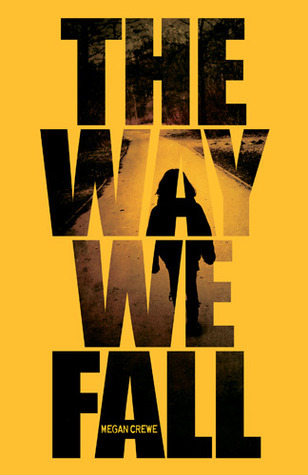
So for really doing her researching and creating a ridiculously believable story, Megan Crewe’s “The Way We Fall” is on my best of 2012 list so far. I can only hope we get a few more epidemic books like this in YA soon, because there’s not nearly enough. Be sure to pick up a copy of this book when it hits stores in North America on January 24th, 2012 (other places, check), or ask your local library to get a copy. It really is that good.
(posted to librarything, goodreads, shelfari, and witchoftheatregoing.wordpress.com)

 come to my blog!