
Garette Johnson's Blog
October 11, 2024
Plein Air Painting in Spain
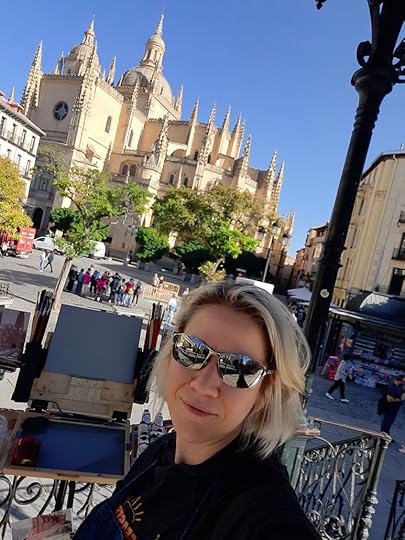 Spain Solo Sorolla Plein Air Painting Pilgrimage
Thirteen years ago, I went to Spain with a group of artists and discovered, among many incredible obsessions, the work of Joaquín Sorrolla. It was one of the most inspiring and creative trips of my life. I have always wanted to return to Spain and paint the Segovia Cathedral in plein air with oil paints. However, I never learned to paint in oils in art school. In fact, until November of 2022, I had always painted in watercolor or acrylic. This changed when l found alla prima bi-weekly classes at Chelsea Classical Studio in New York. By the time October rolled around, I was itching to take that trip!
.avia-image-container.av-m225zjfg-e5c95d11952ae8e4033733a4e5cde390 img.avia_image{box-shadow:none;}.avia-image-container.av-m225zjfg-e5c95d11952ae8e4033733a4e5cde390 .av-image-caption-overlay-center{color:#ffffff;}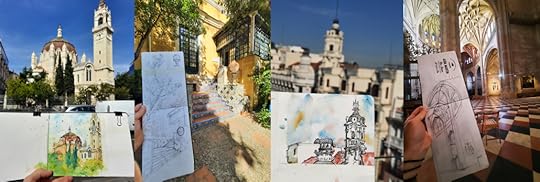 Traveling Solo
As a middle child of six, with a huge extended family, I have always traveled in groups. Even as an adult, I have always traveled with friends and co-workers. This usually means that I am always going with the crowd and not typically deciding on which activities, hotels, restaurants or events to attend.Given this, it was unfathomable to think of traveling alone to a country where I don’t speak the language or know anyone. As such, I invited every artist friend I thought might enjoy the trip. I even invited my non-artist siblings and friends (gasp!). No takers. I decided that the only thing worse than going alone was not going at all. So, I booked it.
.avia-image-container.av-m226asl8-7b9516ee24a373d5ab13e2a62ef9fbd1 img.avia_image{box-shadow:none;}.avia-image-container.av-m226asl8-7b9516ee24a373d5ab13e2a62ef9fbd1 .av-image-caption-overlay-center{color:#ffffff;}
Turns out, I am the best traveling companion I’ve ever had! I pick the best hotels, plan a stellar itinerary of locations and points of interest, wander into the best random encounters and make local friends who give thoughtful advice on great local food and bars. It ended up being a perfect trip. I mean, absolutely perfect! Well, except for when the jacuzzi and my suitcase blew up at 2 AM and I had to get to the airport by 7.
FLASHBACK!I found myself, at 1 AM, under a mirror ball and black lights for a party of one in what was clearly a room meant for at least a +1. The faucet trickled sub-warmish water into the massive tub. After what seemed like hours, the water level was still too low in the tub to cover the jets. I was freezing and naked in a glass cube rooftop tub. (Surely someone saw this fiasco and posted it to TikTok) I turned on the jets only for lukewarm, tepid water to blast in every direction as I rolled, slipped and sloshed around trying to find the ‘off’ switch. It was a mess to clean up before packing and heading to the airport. Then, the zipper on my suitcase split. It was too early to rush out and buy a new one, so I prayed to the heavenly lord above. With a forceful pull, the zipper slipped back into place, and I was out the door. There would be no sleep or hot water relaxation after all, but at least I was on schedule. Ironically, the “treat yourself” private jacuzzi room I booked for my final night’s stay ended up being the biggest disaster. But even that is a perfectly hilarious story!
Seven Learned ThingsAnyway, here are a few things I learned about traveling alone and painting in Plein Air with oils…
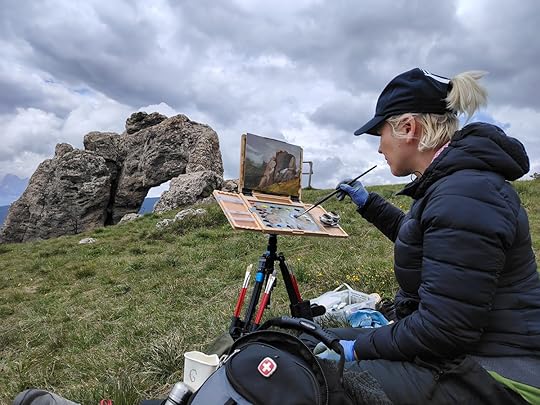
Persistence is key. When working through mistakes in a painting, it’s best to stick with it and make changes until it begins to work rather than starting over or undoing what you’ve done. Undoing and wiping out can be disruptive to creative flow. Since oil paints are so flexible, a painting can be a fluid performance of deduction, correction and revision. Like a dance, you can keep iterating- changing color, value, temperature, line, edges- until it works. Erasing and scrubbing reverses the mindset and disrupts observation. As my artist friend Joe Weatherly says, “erasing kills drawings dead”. The same can apply to painting. (that said, sometimes a fresh start is necessary to reframe the subject)Overcoming challenges is refreshing. Getting over the challenges of picking up a new medium, stretches the mind to think differently from watercolor or acrylic. Plein air demands that your first strokes carry the story. Painting in fewer, solid shapes of value and color instead of line and layering tones, forces the mind to simplify, making quick and broad decisions..avia-image-container.av-m226o9f7-f7837ccc2fad088f52e8ae8ef6b0d3bd img.avia_image{box-shadow:none;}.avia-image-container.av-m226o9f7-f7837ccc2fad088f52e8ae8ef6b0d3bd .av-image-caption-overlay-center{color:#ffffff;}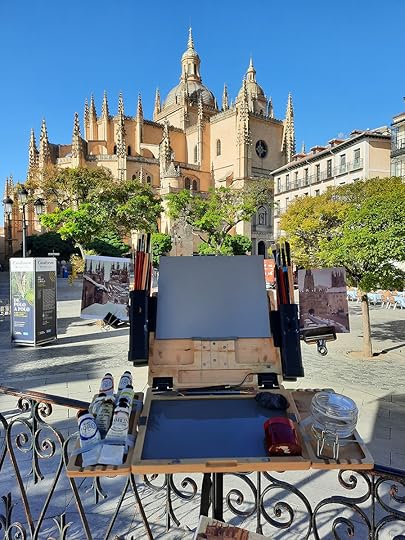 Staying with the work and holding the end goal in mind
I traveled 3,547 miles on a plane, 84 miles by train, 74 miles by taxi and dragged my gear up and around the medieval meandering streets to paint that cathedral! The first day didn’t go as well as I had hoped. I spent a lot of time drawing with the brush. When faced with the possibility of not getting the painting I wanted, I considered switching to a medium I know best. I then realized that I had to try, or I would not have done what I came to do. Ultimately, I ended up with a solid painting and broke the bad habit of defaulting to the known process.
Tapping into my own intuition. Usually, I default to the preferences of the company I keep. It’s the middle child tactic of getting along! With no one to default to, I had to rely on my intuition to choose the agenda, hotels, activities, and food. Using my design eye and spidey senses, I found the local vibes and quirky locations that resonated with MY best interests. Hey, better late than never!Don’t be a stranger. Holding space for making local friends who showed me the city as they live it, I met up with a UN Climate collaborator who lives in Madrid. We had a blast together as she showed me around the city she has called home since the same year I had last visited, 2010. We explored the small and local restaurants, wines, tapas and chocolate. She recommended neighborhoods, cathedrals, and parks to sketch. When I asked for the weirdest place in Madrid to visit, she delivered the hilarious Duck Church, which did not disappoint my penchant for the strange and surprising..avia-image-container.av-m226uv0p-f7b4ece2df73b3cc3cb002be7a65be74 img.avia_image{box-shadow:none;}.avia-image-container.av-m226uv0p-f7b4ece2df73b3cc3cb002be7a65be74 .av-image-caption-overlay-center{color:#ffffff;}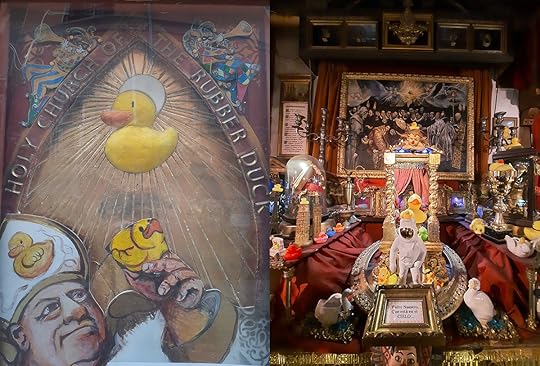 Play for chance.
Finding opportunities to receive gifts from random encounters is a joy. I felt so connected and curious about the culture and history during these random encounters. On a local friend’s recommendation, I stopped to see the Basilica of San Francisco and ended up waiting in line outside without really knowing what the line was for…To my delight, I filled one of the last publicly open seats and was treated to an organ performance premiere under the canopy of one of Europe’s most grand domed cathedrals filled with legendary murals, paintings and sculpture! I’m not particularly religious, but experiences like this do feel like a gift from the divine.
Paying Attention.Even in cases of language barriers, the experience of mutual understanding and sharing made me feel connected to culture and community. In one case, an “influencer” taxi driver shared his best practices for growing an audience on Instagram and TikTok through reels and videos. Turns out, his passengers are often unwitting subjects of entertainment, but he opted out of recording my terrible attempts to speak Spanish. Instead, we both fumbled to speak each other’s language to share our creativity. (In hindsight, I narrowly escaped being laughed at by 70.1k followers)
I dubbed my solo trip to Spain the “Solo Sorolla Plein Air Pilgrimage.” The Segovia Cathedral hangs on my wall as a reminder of these lessons, and the very best example of what a solo trip can do for creativity and inspiration. It might just be a trip I’ll take repeatedly for the rest of my life. At the commencement of my funeral, I hope there will be hundreds of Segovia paintings up for bid at the Sotheby’s Garrott Designs Estate Auction in New York City ;P
.avia-image-container.av-m227e2vj-4afcedea4167d0a16ab9865000665b16 img.avia_image{box-shadow:none;}.avia-image-container.av-m227e2vj-4afcedea4167d0a16ab9865000665b16 .av-image-caption-overlay-center{color:#ffffff;}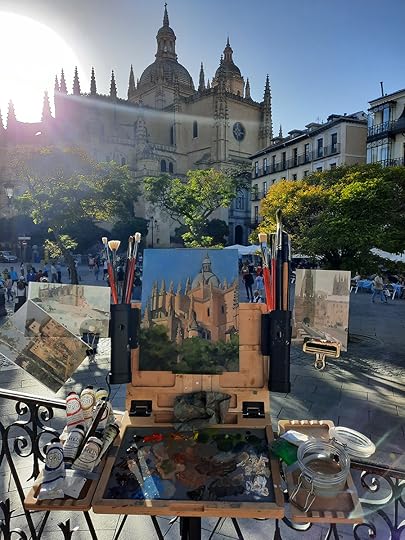 .avia-image-container.av-m227ewb4-ab09ea71dab948933b1fec5f11b90108 img.avia_image{box-shadow:none;}.avia-image-container.av-m227ewb4-ab09ea71dab948933b1fec5f11b90108 .av-image-caption-overlay-center{color:#ffffff;}
The post Plein Air Painting in Spain first appeared on Garrott Designs.


September 12, 2024
Drift and Call it Dreaming: Walking as Aesthetic Practice
Do you ever craft a soundtrack for your travels? A book to read? A concept to explore? A thing to learn? I did, on a recent trip to the French Alps. The book I chose ended up setting me on a path for an aesthetic drift that led to personal and professional discovery.
Instagram embed code generator.boxes3{height:175px;width:153px;} #n img{max-height:none!important;max-width:none!important;background:none!important} #inst i{max-height:none!important;max-width:none!important;background:none!important}The book: “Walkscapes: Walking as Aesthetic Practice” by architect Frencesco Careri. Concept: Artistic reflection through open ended discovery Learning: Plein air painting and urban sketchingSoundtrack: Train to ParisView this post on Instagram
Shared post on Time
Instagram embed code generator.boxes3{height:175px;width:153px;} #n img{max-height:none!important;max-width:none!important;background:none!important} #inst i{max-height:none!important;max-width:none!important;background:none!important}About the BookView this post on Instagram
Shared post on Time
According to the author, Frencesco Careri, “those who wander, walk, and drift make the city visible. The empty spaces of urban decay cross oceans and reach culturally different spaces and places, raising issues of identity, transforming it playfully, modifying it (and the self) on the journey.” As a plein air painter and urban sketch artist, I feel like Careri is talking about artists as much as architects.
The author develops his thesis through the artistic movements of Dada, Surrealism, Situationism and Futurism where each defines a manifesto. Each group took a different approach to the idea of absorbing the energy of a city by walking as a practice to bring impressions to the subconscious.Those impressions became the material and subject from which to create an authentic life, aesthetic art, and visual representation that express the essence of a city experienced.
Conceptually Thinking…For the Dadaists the expression was to elevate the banal, everyday life and mundane experiences as art. Dada was an anti-art movement, demanding a reset to the institution of art that had become predictable. The art was the people in a place as happening, rather than the place or object observed. Kinda like a flash mob without Tiktok.
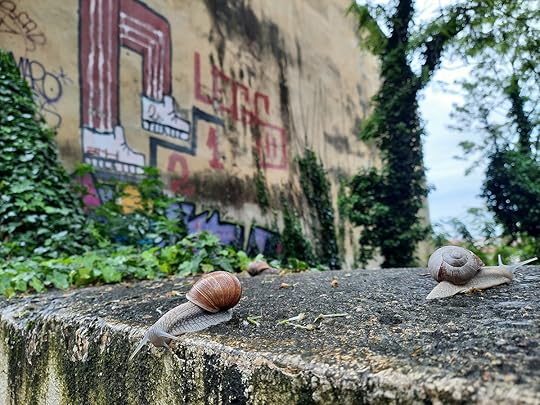
The Futurists were fascinated and enthralled by the speed, energy and vivaciousness that came with advances of technology and urban modernity. Walking was a vehicle to witness and absorb the frenetic sense of going, movement, vital force, energy, and the bustling all at onceness of the transient city. Think of their excitement like subway surfers but without the near death experience.
For the Surrealists, wandering aimed at evoking the sense of passage through the unconscious of a dream-like city experience. Similar to automatic writing in real space, the objective was to reveal the unconscious zones of space and repressed memories of the city, using them as artistic material. Think of it like the movie Inception except you’re Leonardo DiCaprio infiltrating your own dreams.
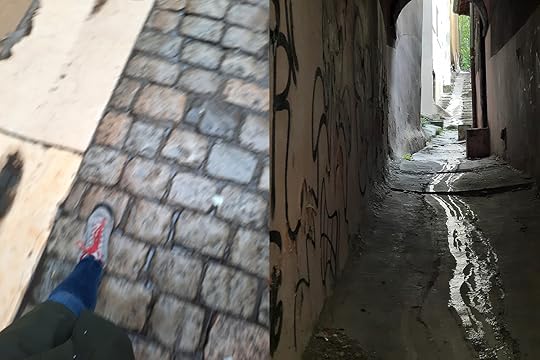
And the Situationists experimented in the city with playful creative behavior and environments by constructing situations for a better life experience. Something like what Bill Murray does when he crashes a party to wash the dishes. Don’t believe me? Read about it Here!
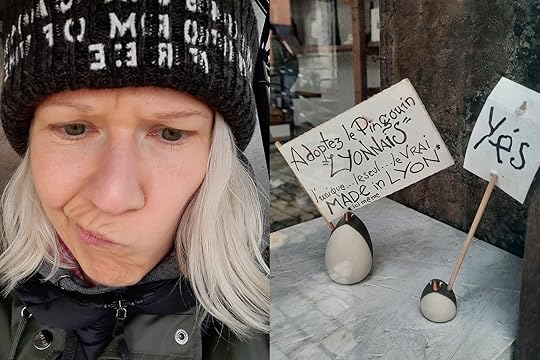
So when I picked up this book on Walkscapes and read about peripheral spaces, urban places, artistic drifting, situational encounters, and the obsession with the urban energy of futurism, it resonated with why my appetite for travel, sketching, plein air painting and endlessly wandering as essential to my creative process.
The reasons behind each of these movements, I learned, is something that I am trying to reach for in my visual work. To playfully transform a scene into a visceral experience that is received and understood by way of metaphor and taps into the memory of the viewer to form a unique impression that is both familiar and discovered.
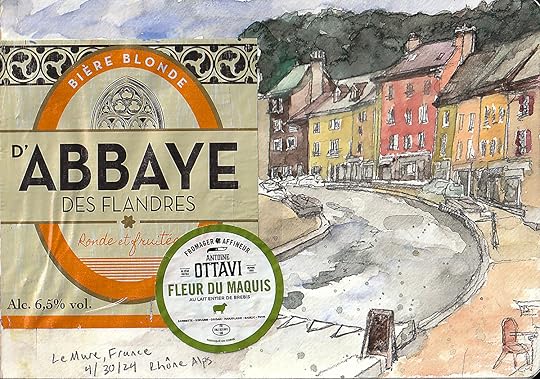
However, I also learned that walking as aesthetic practice was a creative right of passage with origins in primal and nomadic architecture. I never knew it was anyone else’s thing at all, but as Careri describes in Passaic County New Jersey it was even a thing in the 70’s and 80s. Artists have always been wandering and wondering.
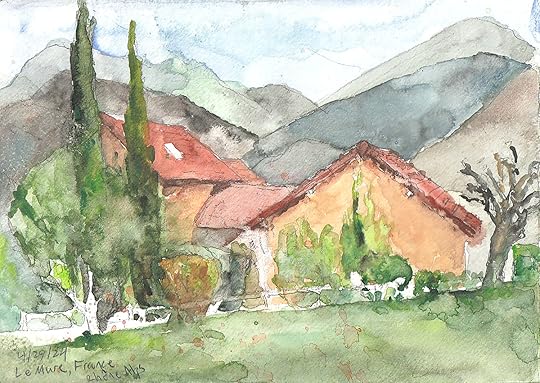
Journeying to the French Alps came with the intention of focusing on deep observation, being quiet, walking alone, and documenting the impression of my experiences. Not only in the sketches and paintings created on location but also in the music I listened to, the textures, smells and sounds. I wanted to internalize them in some dream-like form such that they become the material for greater works beyond these days of painting.
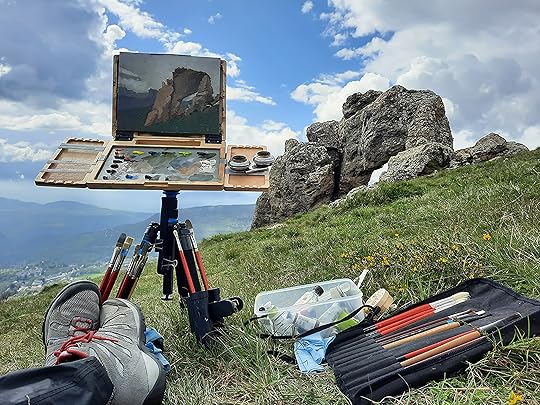
Some of my most significant travel experiences have jostled me out of what felt like a stuck place. The lucidity of space and exploring without structure or familiarity has opened creative connections that usually lead to new worlds, places and spaces well beyond the trip itself. New collections of work, moving area codes and even career changes have been the result of trips spent drifting in unfamiliar territories.

Places we visit often reappear in our dreams, more vivid and surreal than the places they represent. For example, I lived in Savannah, Georgia twenty years ago. Strolling among moss-covered trees and exploring the park squares inspired dreams where I lived inside a tree.
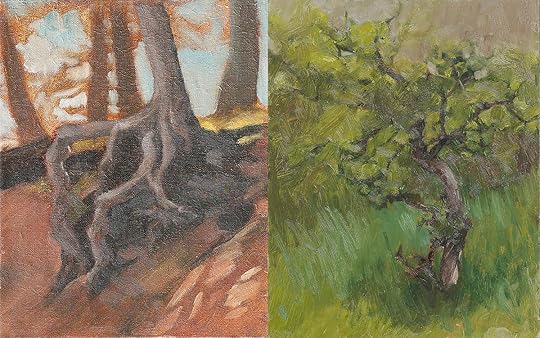
I still dream of climbing those tree tops, discovering secret doors, hidden rooms, abandoned historic sites, graveyards, and unknown neighborhoods— each as real as the ones I had once walked through. These impressions create worlds inside and outside of consciousness; ultimately informing the subjects of my work on paper and canvas.
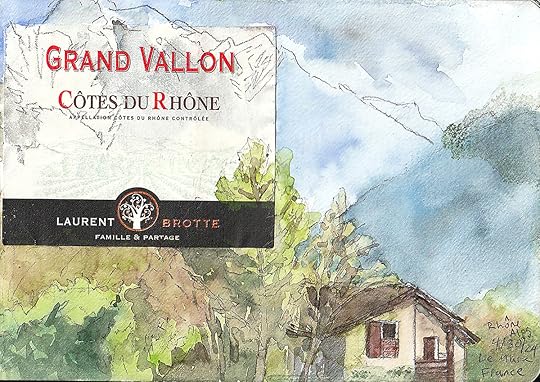
While I reflected on the closing chapter in one area of my life, the rain-soaked, ancient roman roads of Lyon echoed the melancholy optimism in my playlist. The rainwater streamed off my watercolor sketches and faded the saturated pigments before they could dry. The pen and ink spread like rorschach blotted inclinations.
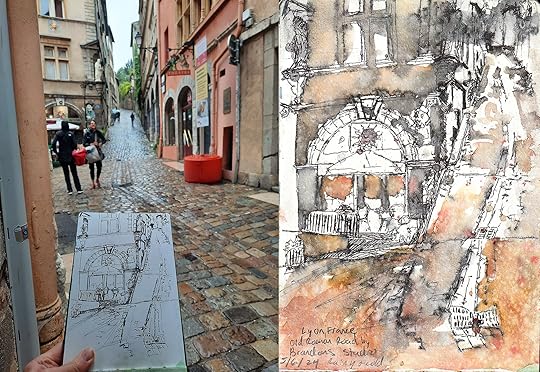
The rain slicked oil pigments dripped off the panel into my cold paint box tripod as I huddled under a covered relic in the city center of a former miner town. A nearby man verbally assaulted his dog like something out of “Waiting for Godot” while an elderly woman who passed by earlier on her bike returned with a book to tell us stories of the town and her youth.
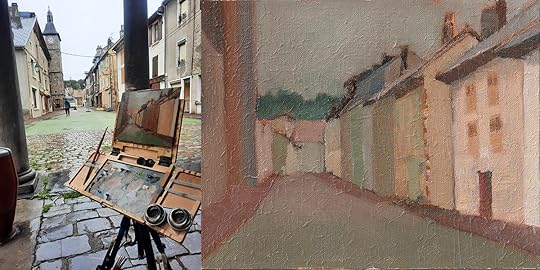
The paint was too wet and the afternoon too cold to finish, but the impressions are there. The memory of the afternoon are recalled to memory when I see that unfinished painting sitting in my studio. It has an Edward Hopper quality to it and will likely provide a dreamscape for later works.
WonderingThe power of Plein Air is that it is immediate, finished or not, it is the moment as it was in your purview. It provides the most vivid rearview mirror of a life lived in artistic motion as we hurl towards a discoverable future and movable feast. To lose time and gain space, get devoured by events and grow something new from fading vapor of impressions and share some inclination of the human experience with others, is the end game as much as the means of getting there.
Like the surrealists and the situationists, my goal is to achieve a union between art and life and to express it for others to know as true.
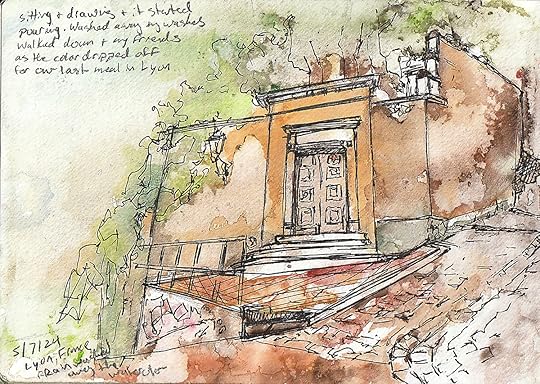
The post Drift and Call it Dreaming: Walking as Aesthetic Practice first appeared on Garrott Designs.
Walking as Aesthetic Practice
Do you ever craft a soundtrack for your travels? A book to read? A concept to explore? A thing to learn? I did, on a recent trip to the French Alps. The book I chose ended up setting me on a path for an aesthetic drift that led to personal and professional discovery.
Instagram embed code generator.boxes3{height:175px;width:153px;} #n img{max-height:none!important;max-width:none!important;background:none!important} #inst i{max-height:none!important;max-width:none!important;background:none!important}The book: “Walkscapes: Walking as Aesthetic Practice” by architect Frencesco Careri. Concept: Artistic reflection through open ended discovery Learning: Plein air painting and urban sketchingSoundtrack: Train to ParisView this post on Instagram
Shared post on Time
Instagram embed code generator.boxes3{height:175px;width:153px;} #n img{max-height:none!important;max-width:none!important;background:none!important} #inst i{max-height:none!important;max-width:none!important;background:none!important}About the BookView this post on Instagram
Shared post on Time
According to the author, Frencesco Careri, “those who wander, walk, and drift make the city visible. The empty spaces of urban decay cross oceans and reach culturally different spaces and places, raising issues of identity, transforming it playfully, modifying it (and the self) on the journey.” As a plein air painter and urban sketch artist, I feel like Careri is talking about artists as much as architects.
The author develops his thesis through the artistic movements of Dada, Surrealism, Situationism and Futurism where each defines a manifesto. Each group took a different approach to the idea of absorbing the energy of a city by walking as a practice to bring impressions to the subconscious.Those impressions became the material and subject from which to create an authentic life, aesthetic art, and visual representation that express the essence of a city experienced.
Conceptually Thinking…For the Dadaists the expression was to elevate the banal, everyday life and mundane experiences as art. Dada was an anti-art movement, demanding a reset to the institution of art that had become predictable. The art was the people in a place as happening, rather than the place or object observed. Kinda like a flash mob without Tiktok.
The Futurists were fascinated and enthralled by the speed, energy and vivaciousness that came with advances of technology and urban modernity. Walking was a vehicle to witness and absorb the frenetic sense of going, movement, vital force, energy, and the bustling all at onceness of the transient city. Think of their excitement like subway surfers but without the near death experience.
For the Surrealists, wandering aimed at evoking the sense of passage through the unconscious of a dream-like city experience. Similar to automatic writing in real space, the objective was to reveal the unconscious zones of space and repressed memories of the city, using them as artistic material. Think of it like the movie Inception except you’re Leonardo DiCaprio infiltrating your own dreams.
And the Situationists experimented in the city with playful creative behavior and environments by constructing situations for a better life experience. Something like what Bill Murray does when he crashes a party to wash the dishes. Don’t believe me? Read about it Here!
So when I picked up this book on Walkscapes and read about peripheral spaces, urban places, artistic drifting, situational encounters, and the obsession with the urban energy of futurism, it resonated with why my appetite for travel, sketching, plein air painting and endlessly wandering as essential to my creative process.
The reasons behind each of these movements, I learned, is something that I am trying to reach for in my visual work. To playfully transform a scene into a visceral experience that is received and understood by way of metaphor and taps into the memory of the viewer to form a unique impression that is both familiar and discovered.
However, I also learned that walking as aesthetic practice was a creative right of passage with origins in primal and nomadic architecture. I never knew it was anyone else’s thing at all, but as Careri describes in Passaic County New Jersey it was even a thing in the 70’s and 80s. Artists have always been wandering and wondering.
Journeying to the French Alps came with the intention of focusing on deep observation, being quiet, walking alone, and documenting the impression of my experiences. Not only in the sketches and paintings created on location but also in the music I listened to, the textures, smells and sounds. I wanted to internalize them in some dream-like form such that they become the material for greater works beyond these days of painting.
Some of my most significant travel experiences have jostled me out of what felt like a stuck place. The lucidity of space and exploring without structure or familiarity has opened creative connections that usually lead to new worlds, places and spaces well beyond the trip itself. New collections of work, moving area codes and even career changes have been the result of trips spent drifting in unfamiliar territories.
Places we visit often reappear in our dreams, more vivid and surreal than the places they represent. For example, I lived in Savannah, Georgia twenty years ago. Strolling among moss-covered trees and exploring the park squares inspired dreams where I lived inside a tree.
I still dream of climbing those tree tops, discovering secret doors, hidden rooms, abandoned historic sites, graveyards, and unknown neighborhoods— each as real as the ones I had once walked through. These impressions create worlds inside and outside of consciousness; ultimately informing the subjects of my work on paper and canvas.
While I reflected on the closing chapter in one area of my life, the rain-soaked, ancient roman roads of Lyon echoed the melancholy optimism in my playlist. The rainwater streamed off my watercolor sketches and faded the saturated pigments before they could dry. The pen and ink spread like rorschach blotted inclinations.
The rain slicked oil pigments dripped off the panel into my cold paint box tripod as I huddled under a covered relic in the city center of a former miner town. A nearby man verbally assaulted his dog like something out of “Waiting for Godot” while an elderly woman who passed by earlier on her bike returned with a book to tell us stories of the town and her youth.
The paint was too wet and the afternoon too cold to finish, but the impressions are there. The memory of the afternoon are recalled to memory when I see that unfinished painting sitting in my studio. It has an Edward Hopper quality to it and will likely provide a dreamscape for later works.
WonderingThe power of Plein Air is that it is immediate, finished or not, it is the moment as it was in your purview. It provides the most vivid rearview mirror of a life lived in artistic motion as we hurl towards a discoverable future and movable feast. To lose time and gain space, get devoured by events and grow something new from fading vapor of impressions and share some inclination of the human experience with others, is the end game as much as the means of getting there.
Like the surrealists and the situationists, my goal is to achieve a union between art and life and to express it for others to know as true.
The post Walking as Aesthetic Practice first appeared on Garrott Designs.
August 7, 2024
Design Diplomacy: Shaping Global Public Affairs through Creative Solutions
Lars Løkke Rasmussen, The Minister of Foreign Affairs of Denmark wore a grass-juice shirt to the airport after the Sustainability Summit held during the 78th UN General Assembly at Climate Week in New York City. He was seen with designer Henrik Vibskov, who collaborated with Pond, a biomaterials textile company in creating the grass juice shirt. The shirt made a second appearance on New Year’s Eve when Lars Løkke posted a selfie viewing the fireworks in Denmark on Instagram.
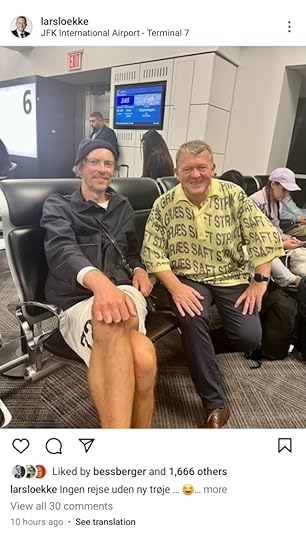

You are probably asking why that matters? Design is a crucial part of spreading ideas and engaging active change.
At the intersection of commercial trade and global political affairs, I brought together three very different companies that focus on both product design and the development of new systems and sustainable manufacturing resources: Pandora, Henrik Vibskov, and Pond.
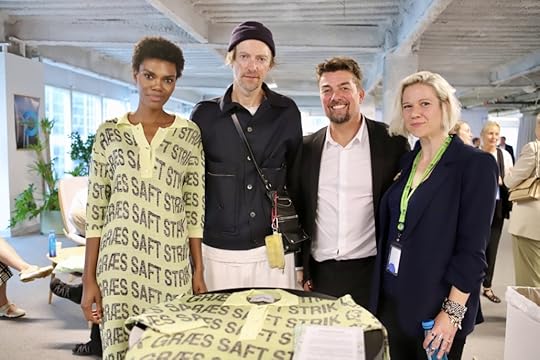
This was an unusual collaboration between the world’s largest jewelry company, a world renowned artist and fashion designer, and a bio-materials start-up that is crafting knit fiber from grass juice. Together, they showed a level of responsibility in the private sector that is driving the innovation needed to fulfill changing policies towards the green transition.
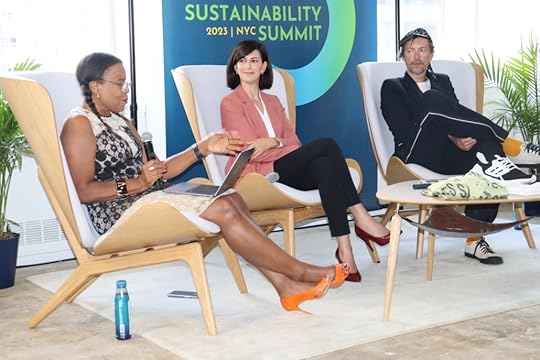
On the three-day agenda, where conversations concerning wind energy, life-science, and climate change, knit shirts may seem like a non-priority. However, design is needed to further each of these agendas as tangible, visible solutions thus providing necessary development for implementation and scalability.
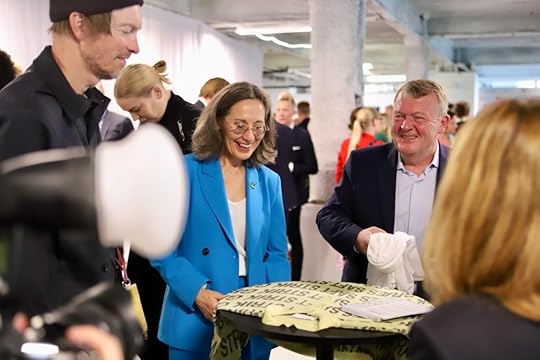
Something interesting happened when the dust settled and the frenetic energy of NYC Climate Week had ended. What delighted delegates was the presence of designers, artists and objects that engaged and supported the high-level dialogue. Those experiences were personally shared with excitement across their social media networks as well as Vogue Scandinavia.
Interestingly, these moments turn a physical object into a symbol of progressive policy. Political leaders can address and support agendas on social media by showing up with the object of design. The visual understanding of what political initiatives and innovations mean for everyday life can increase advocacy from high level dialogue among political leaders to street level customers choosing to support sustainable innovation.
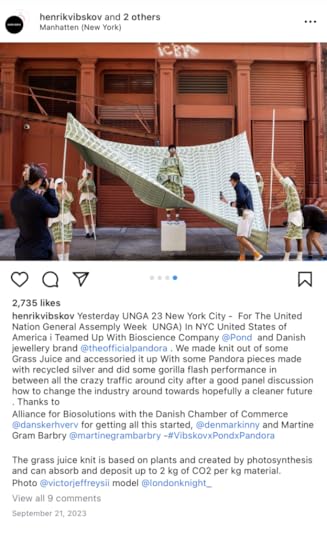

Photo Credit @victorjeffreysii model @londonknight_
@Pandora @HenrikVibskov
Design has the power to bring policy into action. Design makes tangible and physical experiences that deliver on the promise of proposed political agendas. Design can iterate to evolve the needed solutions to unforeseen challenges once policy is set in place. Above all, design puts policy in the hands of the people so they can see and feel what change means for them. Design bridges high-level dialogue and translates political language into experience and tangible understanding.
Join us at this year’s Sustainability Summit NYC and let’s design the future together at UNGA79 in September. Check out the program and register your interest in attending here.
For more on this topic, check out my previous article Creativity to Solve Problems: Storytelling to Bring Change – Garrott Designs
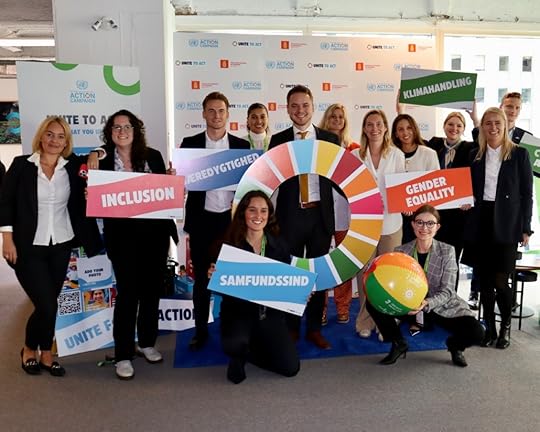
The post Design Diplomacy: Shaping Global Public Affairs through Creative Solutions first appeared on Garrott Designs.
July 9, 2024
Creativity to Solve Problems: Rethinking Business Models
Psst…Your business model is 200 years old, maybe that’s why it’s not working properly!
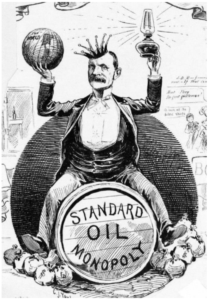 One of my biggest pet peeves is how often creativity and innovation are undervalued because outdated or traditional metrics are used as the principal measure of success.
Often, productivity is viewed as an assembly line system where butts in seats, time spent, and volume outputs are the primary markers of a job well done. This approach works on paper, but falls short when it comes to recognizing the results of outside-the-box thinking in creating sustainable growth.
It is important to establish tangible measures of success; but, our knowledge-based, value-creation, and innovation-driven industries require greater nuance. The traditional business model can be a rigid framework that often overlooks exponential value streams for long-term growth. This rigid structure also stifles workflow and innovation rather than accelerating it.

Because we live in a world where markets are unstable, and factors like climate change and global conflicts impact the value chain, it is essential that we leverage creativity to be more agile and resilient as a business strategy. In fact, a recent article in Harvard Business Review finds that an analytical framework alone won’t reinvent a business:
“ If we want to teach students—and executives—how to generate groundbreaking strategies, we must give them tools explicitly designed to foster creativity.”

Below are three examples of how Nordic companies establish metrics tied to the UN’s Sustainable Development Goals and ultimately diversify the portfolio to be more agile and resilient in an ever-evolving economy. These companies deliver returns beyond the bottom line.

Photo credit: Vestre
Vestre- Triple Bottom LineVestre is a Norwegian company that makes outdoor furniture for public spaces–you may have experienced their designs in Times Square NYC, a waterfront park in Oakland California, rooftops in Chicago or other pedestrian spaces around the world, like Berlin, London, and Oslo.
When Vestre talks about the “Triple Bottom Line,” they are referring to the Nordic way of doing business that not only measures and accounts for economic growth, but also the social and environmental impact. By threading Vestre’s business model to nine of the UN’s seventeen Sustainable Development Goals, the company can set strategic goals and measure social, environmental as well as financial impact. This strategy also guides the model for innovation and scaling.
Environmental ImpactThe Vestre PLUS factory which opened in 2022 and was built during the Covid-19 pandemic when companies were likely to be scaling back innovation and risk. The factory was designed by Bjarke Ingles Group (BIG) and is the first industrial building to hold the highest BREEAM – Outstanding rating. It is currently known as the world’s most environmentally-friendly furniture factory.

Photo credit: Vestre
The integration of circular systems supply energy through solar panels on the rooftop, capture heat from the production process with geothermal heat pumps as well as clean and reuse 90% of the water used in production. The PLUS factory shows the beginning of what could scale into solutions for textile manufacturing, one of the biggest industries negatively impacting the environment.

Photo credit: Vestre
In a profit and loss-driven economy, the renewal of resources and social as well as environmental impact are not considered areas of growth. However, like Vestre, businesses such as Patagonia and R.E.I. have shown us how building for growth across these areas can be good for business as well as growing the economy. This triad collaboration between Vestre, Hydro and BIG further shows how the ‘triple bottom line’ and SDG guided innovation can scale a circular economy. As they used to say in Reaganomics Theory, “a rising tide lifts all boats”.
You can read more about social impact and how Vestre connects SDG’s to their business model for economic growth here.
Hydro- This Company is So Metal!Just like the stock market, energy is a form of currency that can be traded, which begs the question, what else could be traded? With the correct systems in place, the waste streams of industrial products could be on the market, resulting in streamlined processes and cleaner practices.

Photo credit: Hydro

Photo credit: Hydro
Norway-based Hydro is a company that also thrives on an innovative and sustainable business model by holding a diverse portfolio offering.
Would you say Hydro is a steel and aluminum manufacturer or an energy company? Sure, they manufacture industrial aluminum and steel, but they also generate their own energy source and supply the energy consumption equivalent to 900,000 Norwegian households a year through 15 long-term contracts.

Photo credit: Hydro
The overage of power Hydro generates is traded daily using the Nord Pool, a commercial, multinational power exchange cooperative that integrates many forms of power, including renewable resources, into the energy market. Hydro has also become a significant market player in the Brazilian energy sector. With a wider portfolio of investment and revenue in energy and metal, Hydro is as creative and resilient as it is profitable. If you guessed that Hydro and Vestre would make likely bedfellows, you’d be right! Hydro supplies aluminum for Vestre’s PLUS Factory and furniture products.

Photo credit: Vestre
Which gets me thinking, would it be out of the scope of reality for Procter & Gamble to work with a plastics recycling facility and develop a supply of recycled plastics for its single use items and distribute the overages to other plastic product manufacturers? I know, I picked on P&G in my last article too. I promise I don’t have beef but they are good examples of a big company that could invest resources and innovate for long term growth. I promise I’ll pick on someone else next! :P
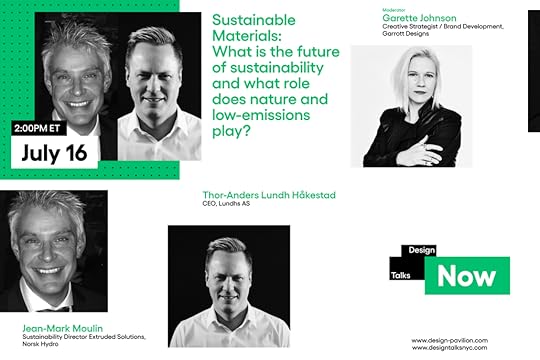
Learn more about Hydro by watching my 2019 interview with Hydro for Design Pavilion Design Talks, with CEO, Jean-Marc Moulin.
Is it OK to be selfish if you use it to design better things?
While Denmark is known for being a flat country, it’s home to a rather impressive ski hill called CopenHill, designed by Bjarke Ingels Group (BIG). CopenHill is a waste incineration plant that generates energy for surrounding neighborhoods and doubles as a recreation center providing snow sports (without snow), a rock-climbing wall, rooftop bar, and hiking trails.

Photo credit: Hydro
Bjarke Ingles himself describes his approach to solving problems for livability as ‘hedonistic sustainability.’ I saw him speak at the UIA World Architecture Congress last summer where he described how his company takes this creative approach to designing solutions for people, economy, and planet.
By thinking “hedonistically” about sustainability, the business model is able to combine disparate ideas of waste treatment with entertainment and tourism. The connection of two different types of business brought together as one experience is a “peak” (no pun intended) creative moment for using creativity to rethink business models.
In an evolving world where ‘business as usual’ is disrupting our ecosystem and rapidly depleting the planet’s resources, using creativity to rethink business models is critical.
This approach can help establish a more comprehensive way of measuring value that looks beyond short-term profitability and considers long-term, and sustainable growth. What does your business consume and produce? Where might those streams be perceived differently? What could be the channels of distribution if both were part of the business portfolio?
If you liked this topic, Check out the first of this series: ‘Creativity to Solve Problems using Storytelling’.
The post Creativity to Solve Problems: Rethinking Business Models first appeared on Garrott Designs.
April 15, 2024
BIG Mushrooms & The NYC Public Realm
Hey New York, how about we settle our disagreements outside?! That’s right, we all want a more livable city– a place that is greener, healthier, more affordable, a sense of community, more resources, less traffic, better spaces and places to go. We just disagree on how to get there.
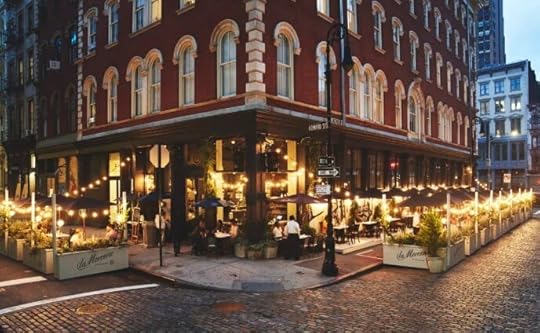

Photo Credit: Consulate General of Denmark in New York Used with Permission
At New York Build Expo, the largest construction conference in North America held March 12th- 13th, I had the pleasure of moderating a workshop with the City of New York Mayor’s Office of the Public Realm, architecture firm, Bjarke Ingles Group (BIG) and the Consulate General of Denmark in New York to talk about the future of outdoor dining, greening public spaces, and innovative building materials. There were mushrooms involved and the visions were fantastic! (More on that later)
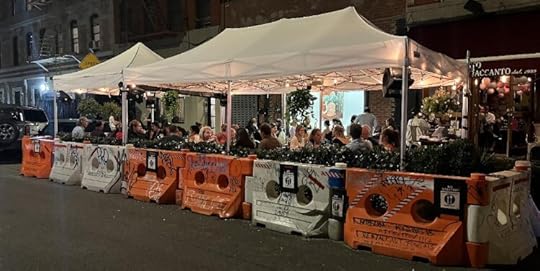
Outdoor dining has been a controversial topic post pandemic in New York City. The prolonged shut down forced people outdoors in order to be safely social and turns out, we kinda liked it! New Yorkers generally have embraced European style outdoor dining, even during winter months.
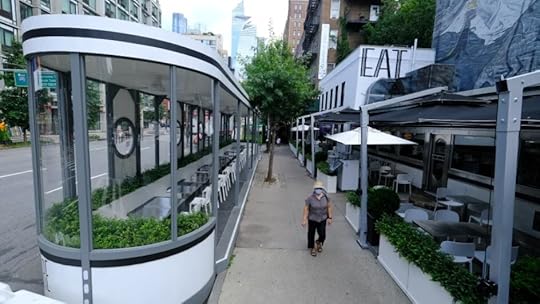
Subsequent policy extensions have ensured that New Yorkers can continue to enjoy that goodly neighborhood feeling and the fresh air. However, moving the concept and policy to permanence has had its challenges. From traffic congestion, ugly deteriorating structures to increased rat populations, the City has heard its share of complaints.
Open to the PublicBut maybe love can save the day, or rather, ‘Hygge’. The NYC streets may be about to get a hygge makeover, thanks to the newly appointed public realm team at the Mayor’s Office of New York.

Photo used with Permission: Mayor’s Office for Public Realm
For those unfamiliar with the word ‘Hygge’, it’s a Danish word that roughly translates in English to “cozy”. It’s used to describe a style of design or lifestyle that evokes the feeling of gathering and enjoying good things in good company.

Photo used with Permission: Mayor’s Office for Public Realm

Photo Credit: Consulate General of Denmark in New York Used with Permission
Sonia Guior, Senior Policy Advisor for the Public Realm shared a vision for more sophisticated yet practical and standardized renderings of what could be possible.
She and her team are working with organizations such as the American Institute of Architects (AIANY) to address the discomforts of outdoor dining, create legal standards, and health code guidelines to develop and offer tools to keep the open venue, at the very least, as a seasonal perk to living our (hashtag) best city life.

Photo used with Permission: Mayor’s Office for Public Realm
This could be an opportunity for architecture firms to collaborate with the City of New York to design modular kits for local businesses and restaurants.

Photo Credit: Consulate General of Denmark in New York Used with Permission
Hygge in the HoodSpeaking of Hygge in the neighborhood, Kai-Uwe Bergmann, Partner at BIG, shared several visionary projects to serve as models and innovative materials that could be tested in the public realm as temporary spaces, and scaled for commercial use. Here is where the mushrooms come in!

Photo Credit: Garette Johnson
BIG MushroomsIn collaboration with Danish AM Hub, the I AM MSHRM project was designed and constructed of a 3D printed framework using plastic waste, locally sourced sugar cane and cornstarch (future iterations could be entirely printed with biomaterials).

Photo Credit: Garette Johnson
The open areas of the arches are filled with mycelium, a naturally grown fungi to further reinforce the structure. Mycelium can be grown in approximately 20 days and is compostable, lending to the rapid deployment and end of life economy of temporary structures.

Photo Credit: Garette Johnson

Photo Used with Permission: Bjarke Ingles Group
The model has been designed to be used as a quick and easy to assemble temporary emergency structure. However, the concept could scale for hospitality and commercial use.
If you geek out about biomaterials as much as I do and want to explore more about mycelium and the I AM MSHRM project, check out my article about biomaterials at the UIA World Architecture Congress last summer in Copenhagen.
Primordial Printing
Photo Credit: Jordan Vonderhaar Used with Permission: Bjarke Ingles Group
In that same article, I also wrote about biomaterials and modernizing traditional forms of primitive shelter making. Imagine a primordial language of architecture made possible and more resilient with 3D printing technology?
That is exactly what BIG created in the form of an amphitheater at SXSW in collaboration with Austin based technology company ICON and hospitality visionary Liz Lambert.
The concept will be further realized in the form of a luxury camping hotel compound in Marfa, Texas called El Cosmico. The project is expected to break ground in 2024. Talk about scalability!

Photo Credit: Jordan Vonderhaar Used with Permission: Bjarke Ingles Group
Modular Mega BloksAnother large-scale example he shared is the Serpentine Project, which explores a basic architectural element of a brick wall, when pulled apart, creates a sloped dimensional checkerboard. The simple construction of modular fiberglass boxes slide inward and outward via aluminum tracks. Visually, the shelter appears to “unzip” to an opening and provides spatial interest with an undulating interior, path and views through the translucent open-faced boxes.

Photo Credit: Iwan Baan Used with Permission: Bjarke Ingles Group
The scalability of a shelter like this could provide modular event space for city festivals, parks and recreation events, corporate receptions, art exhibitions, and even outdoor weddings.

Photo Credit: Iwan Baan Used with Permission: Bjarke Ingles Group
It’s inspiring to think about the opportunity to test and innovate with materials, structural shapes and construction on a temporary and modular playground such as outdoor dining. The endless potential for creating interesting and conceptual, branded dining experiences can also accelerate the viability of biomaterials while creating smart, and versatile structures capable of recycling and reuse. It’s an exciting playing field to watch and I hope we’ll begin to see BIG ideas happen in the BIG Apple.
The post BIG Mushrooms & The NYC Public Realm first appeared on Garrott Designs.
March 26, 2024
Creativity to Solve Problems: Storytelling to Bring Change
Only artists, writers and actors are creative, right? Not so fast! Creativity is increasingly becoming a high demand business skill at Fortune 500 companies. According to a 2010 IBM study, about 60% of CEOs cited creativity as the most important leadership quality, compared with 52% for integrity and 35% for global thinking.

That’s right, in 2010, creativity became the most important leadership quality for success in business according to 1,500 corporate heads and public sector leaders across 60 nations and 33 industries when asked what drives them in managing their companies in today’s world!
In 2023, a LinkedIn study found that 92% of hiring managers believe that creativity is an important skill and that 75% of hiring managers are more likely to hire a candidate who demonstrates problem-solving skills. That is a seismic paradigm shift for American businesses and recruiters. Hey, creativity, it’s not just for artists anymore!
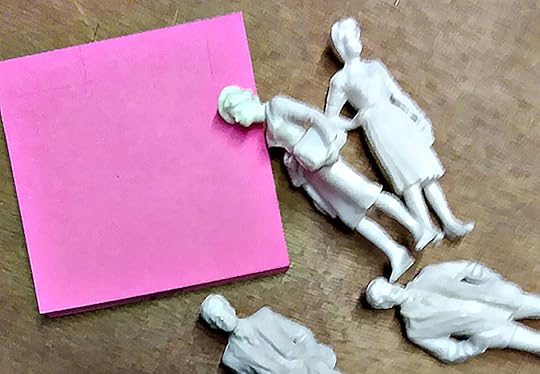
Scandinavian countries don’t necessarily relegate creativity to a limited cohort in the same way. I’ve been working at the Danish Embassy in New York over the past 3 years and have worked with Nordic countries in the US over the last 5 years. In Denmark, for example, creativity is a fundamental application used across disciplines to solve problems. In fact, creativity can be observed as an inherent quality in the layout of the city of Copenhagen, everyday language, education and culture.

Circle Bridge -Copenhagen, Denmark
You may be thinking, sure, ‘Danish design is legendary’, and maybe you envision the classic Arne Jacobsen chair and the Mid-Century Modern style that still define sophisticated spaces to this day. However, you may not realize that design isn’t the only discipline in Denmark where creativity is highly effective.

Fritz Hansen iconic Egg chair deconstructed to show process and quality.
In the white paper, “Creativity as a Driver for the Green Transition,” Creative Denmark offers valuable insights into the crucial role that creativity and innovation play in advancing problem-solving for sustainability.

Creative Denmark
Creative Storytelling to Affect Change:Creativity through storytelling democratizes information so that everyone can participate in a potential solution. The white paper explains how creativity is important to communications and understanding because not everyone responds to economic or scientific language. Someone has to translate academic resolutions to tacit concepts and action points and distribute that understanding to gain momentum.
(Image Simpsons)
American marketing and advertising campaigns do this very well. A few examples of campaigns that actually changed behavior and ultimately policy, produce some intriguing examples of creativity to solve problems.

Truth in Tobacco Campaign
Truth in Tobacco Campaign 1998-2003Do you remember the “Truth in Tobacco” campaign of the early 90’s?
According to Wikipedia, the anti-tobacco Truth campaign was made national by the American Legacy Foundation and ran from 1998 to 2003 with the aim of changing social norms and reducing teenage smoking by highlighting deceptive practices of tobacco companies and facts about the deadly effects of tobacco use.
The campaign designers took a creative storytelling approach to building the strategy by combining marketing with social science research. Their findings revealed that teens were aware of the dangers of smoking but that they aspired to the rebellious and empowering reputation smoking gave them. The campaigns then encouraged teens to rebel against the duplicity and manipulation exhibited by the tobacco companies.

Truth in Tobacco Campaign
The most notable TV commercial for the campaign shows an expanse of teens walking up to a major tobacco company building, then suddenly collapsing as if dropping dead to the ground. A teen standing with a sign reads, “Tobacco kills 1,200 people a day. Ever think about taking a day off?”

Truth in Tobacco Campaign
In studies later evaluating the campaign, lower intentions to smoke as well as anti-tobacco attitudes with higher ad awareness were indicated. It’s no coincidence that in these same years states began to ban smoking in the workplace, restaurants and bars. Currently 29 states in the U.S. have smoking restrictions on public places. It’s a strong case for how storytelling can affect change and ultimately support policy to enable better health for people and the planet.

Truth in Tobacco Campaign
Plastics Make it Possible Campaign 1992-1999Do you remember the “Plastics Make it Possible” campaign?
According to Plastics Today, “plastics faced a public relations nightmare in the early 1990s, with the material targeted by more than 500 pieces of legislation at the local and state level that sought to reduce its use or ban the material outright. To combat the negative public sentiment that fueled the legislative onslaught, the American Plastics Council (part of the American Chemistry Council) launched a $30 million national advertising and public relations campaign in 1992, with the first television ads on air in 1993 ending with the soon-familiar tagline, ‘Plastics Make it Possible.’” A New Industrial Revolution for Plastics | USDA

Plastics make it Possible Campaign
The video includes a little girl floating over a blue cloud filled sky, holding a plastic bag like a balloon. The child narrator optimistically describes how plastics carry things like groceries, protect eggs and the kneecaps of child skateboarders from breaking. The commercial ends with a tear-jerking hug between a child and an elder who received a lifesaving prosthetic made from plastic. The campaign was incredibly effective.

Plastics make it Possible Campaign
More than 25 years later, we see the results of that campaign’s ability to intercept the limiting policy and escape being banned. Plastics are everywhere, including our oceans. On December 6th, 2017, the UN acknowledged that we have a ‘plastic crisis’ and adopted a (non-binding) resolution calling for an end to plastic entering the sea. See how powerful storytelling can be? Boy, are we really sorry about that one!

Plastics Make it Possible Campaign
Make Due and Mend 1929-1945And lastly, You may not remember this one, but your great-grandparents’ might. The “Make Due, and Mend” campaign entered its height in 1943 during World War II urging people to repair, reuse and reimagine their existing clothes and textiles.

Make Do and Mend Campaign
I remember my great-grandma asking my Mom to send her boxes of our worn out socks to darn and send them back to us. Yeah, socks! Hard to imagine in the world of Amazon isn’t it? She would do that all through the 1980s when textile shortages were clearly no longer an issue. It’s proof that slogans and storytelling make behavioral change possible and, possibly even long lasting!

Make Do and Mend Campaign
Historic campaigns like “Make-Do and Mend” to “Plastics Make it Possible” and the “Truth in Tobacco” have had the power to change policy as well as societal and economic behavior norms around use and adoption, for better or worse. As we know now, the impact of ubiquitously rolling out plastics in every consumable form is a new problem that will take similar campaigning and policy to correct. Creativity can help us begin to solve the problem of circularity in plastics, textiles and other consumable products.

Make Do and Mend Campaign
Circular systems are not even a new concept: There used to be a time when milk and Coca-Cola came in bottles that were washed and returned to the bottling company. Coca-Cola still has a returnable bottle program in Mexico, why not in the US?
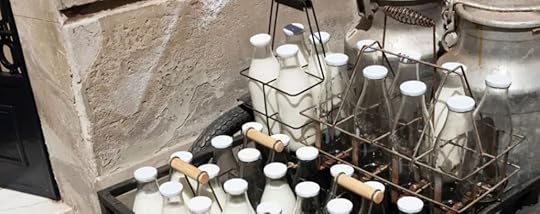
There was a time when cloth diapers were picked up, washed and returned to homes for reuse. There was a time when many households composted food waste with biodegradables and, in some cases, grew their own vegetables. These systems are still being applied in Nordic countries like Denmark, and in Japan.
We need to work towards resolving the world’s problems through creativity and reimagine old solutions for the modern lifestyle where time, price and convenience determine our behavior. Creativity can look at these disparities and build cohesion and innovation around them to drive a path forward and adopt change.
What if companies like Procter & Gamble, Johnson & Johnson and General Mills Inc. committed to circular single use products with refillable bio-materials vessels that are biodegradable but also reusable? How would a mega power like that begin to affect change and advocate for policy through storytelling?

Submission Beauty- No Plastic Body Products
It is challenging, but not impossible for large companies to make circular shifts. For example, Pandora, the world’s largest jewelry company, based in Denmark, has recently committed to using strictly lab grown diamonds made with renewable energy and 100% recycled metals in its products by 2025.

Pandora Lab Grown Diamonds
These are just a few examples of how ‘creativity makes problem solving possible’. How do you use creativity to solve problems? I’d love to hear your story in the comments below.

“Creativity IS the Red Thread to One of Many Possible Solutions” – Garette Johnson
The post Creativity to Solve Problems: Storytelling to Bring Change first appeared on Garrott Designs.
April 10, 2022
ShopTalk 2022: Post-Retail Apocalypse & Five Strategies for SME’s to Leverage BIGcommerce
Retail in the US has faced numerous challenges long before Covid-19. Since 2010 the industry has undergone closures of physical, brick and mortar stores while shopping slowly shifted online and consumers abandoned traditional retail stores. The phenomenon was dubbed industry wide as the “Retail Apocalypse.” Certainly, the pandemic has exacerbated conditions creating the perfect storm, from store closures, supply chain woes to inflation. Retail continues to adapt, technology makes shopping on-line increasingly convenient. During the shutdown, however, consumers realized they missed going to the store.

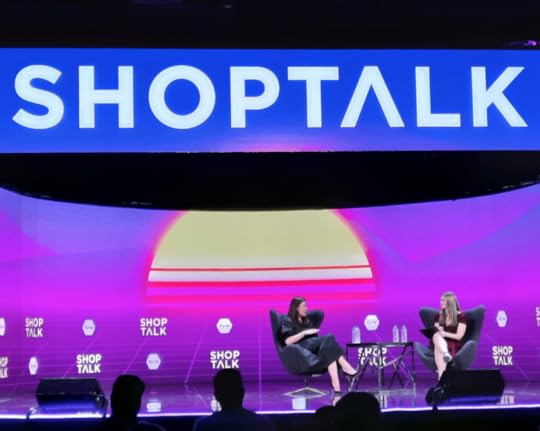
This year is retail’s “Big Reunion,” as the Shoptalk conference returns to Las Vegas. With 250+ speakers, two thirds of which were executive leaders at C-Level or higher. The conference offered an opportunity to hear first hand how retail is evolving. Here are my three top takeaways from the conference and how small to medium sized brands (SME’s) can develop winning strategies with limited resources and funds in the current marketplace.
 Social Commerce
Social commerce is an emerging trend hailing from China where technological platforms enable a seamless experience. One of the most highly attended panels at ShopTalk, “China and the World’s Most Innovative Retail Experiences” included panelists Connie Chan, General Partner at Andreessen Horowitz, Jordan Berke, Founder & CEO of Tomorrow Retail Consulting, Liyia Wu, Founder & CEO of ShopShops and Tony Shan, Head of Tmall Global, the Americas, Alibaba. The panelists agreed this movement towards shoppable, live stream videos are highly engaging among consumers. This media channel will develop in the US as connectivity bandwidth, technology and seamless payments become more advanced.

Shifting consumer behavior points to growth. According to Coresight Research’s survey of US consumers (February 2021), which found that 32.7% of consumers had watched a shoppable livestream in the past year, and over half (52%) of livestream viewers made purchases during a livestream. Further, 23.5% of consumers under 45 have purchased products on shoppable livestream.
Holden Bale is responsible for leading the global commerce practice at HUGE. Bale presented insights on The Future of Marketplaces. The report observes that social commerce is 44% of the $109B Southeast Asian eCommerce market, and accounts for 13% of digital commerce in China. With ‘huge’ growth potential in China, American consumers mirror similar behaviors. The implications of which are inspiring.
Both the China based panel and the presentation from HUGE highlighted social selling on apps like NTWRK and VeriShop, along with platforms like HypeBeast and BuzzFeed to have engaged audiences in a way that eludes traditional department stores. With limited edition drops, collabs and exclusives, the attention of the customer is constantly engaging, chatting and sharing purchases within the platform, and on social media. Social commerce is able to respond more quickly to consumer demands and interests. On-line festivals and exclusive collaborations that are promoted alongside sports and music events are converting faster than traditional retail can stock shelves.

An example of an SME that can leverage an affluent social commerce community is Copenhagen Watch Group, a design oriented timepiece brand with PICTO, a contemporary watch brand and Arne Jacobsen, a legacy timepiece brand among the group’s portfolio. PICTO watches offer an art driven, design minded picture of time that is abstract in concept. For the creative driven, curatorial minded influencer, social content could be the channel supporting consumer discovery for a style minded demographic that can also envision an abstraction of time and artful collaborations such as Yayoi Kusama as experience in the 3WEB stratosphere.
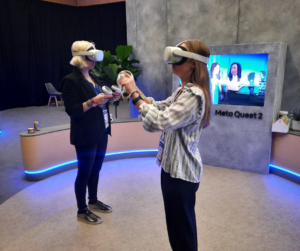
Playing in the MetaverseDuring the “Rapid-Fire Analysis: Emerging Digital Technologies that Live Up to the Hype” panel, Liz Bacelar, Executive Director of Global Tech Innovation at Estée Lauder, championed marketing in the Metaverse from the ground up.

Bacelar described the Decentraland metaverse Fashion Week activation pop-up which promoted the top selling Advanced Night Repair skin care product. The wearable NFT gave users’ avatars a virtual golden glow that went Viral.
On a seperate Keynote, Brieane Olson, President of US apparel brand PacSun similarly described their Roblox campaign offering users’ a pair of PacSun golden wings as a fashion accessory. Both examples provide implications of great potential for fashion and beauty market in the metaverse. Bacelar prescribes that brands need to be playing in the metaverse now if they are going to succeed when it really hits the mainstream. “You have to be thinking about it or you’re already late,” said Bacelar.
Meanwhile, Anshu Bhardwaj, SVP, Technology Strategy & Commercialization for Walmart Global Tech and Meera Bhatia, Chief Operating Officer at Fabletics took a more focused approach to point-of-sale and frictionless technologies. Concerning ‘innovation for innovation’s sake,’ Bhatia indicated that for Fabletics, the metaverse is at an experimental phase and sees it as non-essential for the time being.

Debate around investment vs. innovation continued to heat during the panel. Advice from Estée Lauder‘s Global Tech Innovation CEO may seem a bit out of reach for SME’s when bandwidth and mind share is stretched day-to-day. The pressures dealing with supply chain and consumer demand alone can be overwhelming. Small and medium sized businesses simply don’t have an entire team and funding dedicated to innovations beyond immediate scalability.
So, how can SME’s get in the game? Cool brands have cool friends who also run cool businesses. If brands partnered with innovative digital media companies to develop mutual interest in portfolio expansion and innovative activations in the metaverse, both brands can seriously benefit from authentic engagement and community participation.

Submission Beauty is an example of a cool beauty brand tapped into the zeitgeist of LGBTQ ethos towards inclusivity and self expression for all, with a sustainability commitment and creed that “plastic is poison”. While they are raising seed fund capital, they already have a cult following and wildly enthusiastic participation from fashion week to music festivals.
If Submission were to partner with an up-and-coming digital fashion tech start-up like Mannd at South by Southwest (SXSW) for example, they could co-create a digital and physical activation like those created by PacSun and Estée Lauder with viral potential and scalability. Such an action could attract or even accelerate the seed funding process.
Quick & Seamless Check-OutIn addition to social selling, discovery on digital platforms was a major topic of discussion. While impulse purchasing at the checkout counter and in physical retail stores has been perfected by the likes of Sephora and Nordstrom Rack. The greatest potential point of friction for on-line shopping is the check-out.
As retailers strive for the one-click checkout, they also want to increase impulse purchases. Up-selling and cross-selling is evolving towards in-cart recommendations, as well as “private-traffic” tactics like SMS texts, recommending additional products or services after the purchase. Of course, a brand’s ecom game is only as good as the machine learning that supports it’s platform. It’s important for SME’s to invest in the right support.

It was inspiring to attend this year’s event and see how the industry has evolved significantly and, in some positive ways, as a result of COVID-19. Lock down has significantly changed consumer behavior, while new creative and innovative services have flourished. I find in particular social commerce, immersive VR, and rapid check-out solutions very interesting and I look forward to following the development and identifying the gems of opportunity amidst the chaos.
Action Points for SME’sKeep ownership of your brand by selling on-line and through social media. While traditional retail can be profitable, D2C (direct-to-consumer) is the best strategy for small and medium sized brands right now. Leverage social commerce platforms, participate in digital festivals and invest in live shopping hosts to further your brand in the form of limited edition, exclusive and collaborative drops.Start playing in the Metashpear with your digital start up counterparts. You have a creative community of collaborators in the industry already. Partner with digital creatives who love fashion, beauty or furniture to create new experiences in the digital worlds they know and love. Frictionless payment is delightful but so is discovery. Invest in your shopable platforms and website to make paying quick and painless. But, also, foster discovery through the check out, SMS. Test newer vehicles of discovery beyond the recommendation bar at the bottom of the page or cross selling tags on the product page. Be authentically social. Show up in video, reels and on podcasts sharing your love of design and creative community with adjacent entities and creators. Engage creatively with your audience enabling them to co-create with you. You’ll offer more reasons to come back than any big box department store could ever scale.
The post ShopTalk 2022: Post-Retail Apocalypse & Five Strategies for SME’s to Leverage BIGcommerce appeared first on Garrott Designs.
ShopTalk 2022: Post-Retail Apocalypse & Five Strategies for SME’s to Leverage BIGcommerce
Retail in the US has faced numerous challenges long before Covid-19. Since 2010 the industry has undergone closures of physical, brick and mortar stores while shopping slowly shifted online and consumers abandoned traditional retail stores. The phenomenon was dubbed industry wide as the “Retail Apocalypse.” Certainly, the pandemic has exacerbated conditions creating the perfect storm, from store closures, supply chain woes to inflation. Retail continues to adapt, technology makes shopping on-line increasingly convenient. During the shutdown, however, consumers realized they missed going to the store.
This year is retail’s “Big Reunion,” as the Shoptalk conference returns to Las Vegas. With 250+ speakers, two thirds of which were executive leaders at C-Level or higher. The conference offered an opportunity to hear first hand how retail is evolving. Here are my three top takeaways from the conference and how small to medium sized brands (SME’s) can develop winning strategies with limited resources and funds in the current marketplace.
Social Commerce
Social commerce is an emerging trend hailing from China where technological platforms enable a seamless experience. One of the most highly attended panels at ShopTalk, “China and the World’s Most Innovative Retail Experiences” included panelists Connie Chan, General Partner at Andreessen Horowitz, Jordan Berke, Founder & CEO of Tomorrow Retail Consulting, Liyia Wu, Founder & CEO of ShopShops and Tony Shan, Head of Tmall Global, the Americas, Alibaba. The panelists agreed this movement towards shoppable, live stream videos are highly engaging among consumers. This media channel will develop in the US as connectivity bandwidth, technology and seamless payments become more advanced.
 Shifting consumer behavior points to growth. According to Coresight Research’s survey of US consumers (February 2021), which found that 32.7% of consumers had watched a shoppable livestream in the past year, and over half (52%) of livestream viewers made purchases during a livestream. Further, 23.5% of consumers under 45 have purchased products on shoppable livestream.
Holden Bale is responsible for leading the global commerce practice at HUGE. Bale presented insights on The Future of Marketplaces. The report observes that social commerce is 44% of the $109B Southeast Asian eCommerce market, and accounts for 13% of digital commerce in China. With ‘huge’ growth potential in China, American consumers mirror similar behaviors. The implications of which are inspiring.
Both the China based panel and the presentation from HUGE highlighted social selling on apps like NTWRK and VeriShop, along with platforms like HypeBeast and BuzzFeed to have engaged audiences in a way that eludes traditional department stores. With limited edition drops, collabs and exclusives, the attention of the customer is constantly engaging, chatting and sharing purchases within the platform, and on social media. Social commerce is able to respond more quickly to consumer demands and interests. On-line festivals and exclusive collaborations that are promoted alongside sports and music events are converting faster than traditional retail can stock shelves.
 An example of an SME that can leverage an affluent social commerce community is Copenhagen Watch Group, a design oriented timepiece brand with PICTO, a contemporary watch brand and Arne Jacobsen, a legacy timepiece brand among the group’s portfolio. PICTO watches offer an art driven, design minded picture of time that is abstract in concept. For the creative driven, curatorial minded influencer, social content could be the channel supporting consumer discovery for a style minded demographic that can also envision an abstraction of time and artful collaborations such as Yayoi Kusama as experience in the 3WEB stratosphere.
During the “Rapid-Fire Analysis: Emerging Digital Technologies that Live Up to the Hype” panel, Liz Bacelar, Executive Director of Global Tech Innovation at Estée Lauder, championed marketing in the Metaverse from the ground up.
 Bacelar described the Decentraland metaverse Fashion Week activation pop-up which promoted the top selling Advanced Night Repair skin care product. The wearable NFT gave users’ avatars a virtual golden glow that went Viral.
On a seperate Keynote, Brieane Olson, President of US apparel brand PacSun similarly described their Roblox campaign offering users’ a pair of PacSun golden wings as a fashion accessory. Both examples provide implications of great potential for fashion and beauty market in the metaverse. Bacelar prescribes that brands need to be playing in the metaverse now if they are going to succeed when it really hits the mainstream. “You have to be thinking about it or you’re already late,” said Bacelar.
Meanwhile, Anshu Bhardwaj, SVP, Technology Strategy & Commercialization for Walmart Global Tech and Meera Bhatia, Chief Operating Officer at Fabletics took a more focused approach to point-of-sale and frictionless technologies. Concerning ‘innovation for innovation’s sake,’ Bhatia indicated that for Fabletics, the metaverse is at an experimental phase and sees it as non-essential for the time being.
 Debate around investment vs. innovation continued to heat during the panel. Advice from Estée Lauder‘s Global Tech Innovation CEO may seem a bit out of reach for SME’s when bandwidth and mind share is stretched day-to-day. The pressures dealing with supply chain and consumer demand alone can be overwhelming. Small and medium sized businesses simply don’t have an entire team and funding dedicated to innovations beyond immediate scalability.
So, how can SME’s get in the game? Cool brands have cool friends who also run cool businesses. If brands partnered with innovative digital media companies to develop mutual interest in portfolio expansion and innovative activations in the metaverse, both brands can seriously benefit from authentic engagement and community participation.
 Submission Beauty is an example of a cool beauty brand tapped into the zeitgeist of LGBTQ ethos towards inclusivity and self expression for all, with a sustainability commitment and creed that “plastic is poison”. While they are raising seed fund capital, they already have a cult following and wildly enthusiastic participation from fashion week to music festivals.
If Submission were to partner with an up-and-coming digital fashion tech start-up like Mannd at South by Southwest (SXSW) for example, they could co-create a digital and physical activation like those created by PacSun and Estée Lauder with viral potential and scalability. Such an action could attract or even accelerate the seed funding process.
Quick & Seamless Check-OutIn addition to social selling, discovery on digital platforms was a major topic of discussion. While impulse purchasing at the checkout counter and in physical retail stores has been perfected by the likes of Sephora and Nordstrom Rack. The greatest potential point of friction for on-line shopping is the check-out.
As retailers strive for the one-click checkout, they also want to increase impulse purchases. Up-selling and cross-selling is evolving towards in-cart recommendations, as well as “private-traffic” tactics like SMS texts, recommending additional products or services after the purchase. Of course, a brand’s ecom game is only as good as the machine learning that supports it’s platform. It’s important for SME’s to invest in the right support.
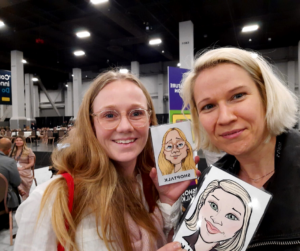 It was inspiring to attend this year’s event and see how the industry has evolved significantly and, in some positive ways, as a result of COVID-19. Lock down has significantly changed consumer behavior, while new creative and innovative services have flourished. I find in particular social commerce, immersive VR, and rapid check-out solutions very interesting and I look forward to following the development and identifying the gems of opportunity amidst the chaos.
The post ShopTalk 2022: Post-Retail Apocalypse & Five Strategies for SME’s to Leverage BIGcommerce first appeared on Garrott Designs.
March 20, 2022
Build Expo NYC: Sustainable Cities & Workplace
How can cities be built and designed more sustainably? At Build Expo NYC, conversations emphasized the importance of the construction industry reducing CO2 emissions with innovative and smart sustainable solutions. Additionally, workplace interior design was thought of in sustainable frameworks that raise the work culture, making work itself more efficient and sustainable.

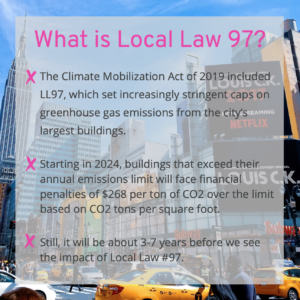
In 2019, NYC had set new sustainable codes to lower emissions by 2024, this included Local Law #97 (LL97). Unfortunately, the pandemic crisis would interrupt those ambitions. This year, it was great to see an even stronger commitment to sustainable initiatives. Conversations around carbon embodiment and high performance building case studies, Intelligent buildings, barriers to implementation, digital disruption, retrofitting design against climate change, and workplaces of the future to name a few.
 What is Local Law #97
The Climate Mobilization Act of 2019 included LL97, which set increasingly stringent caps on greenhouse gas emissions from the city’s largest buildings. Starting in 2024, buildings that exceed their annual emissions limit will face financial penalties of $268 per ton of CO2 over the limit based on CO2 tons per square foot. Still, it will be about 3-7 years before we see the impact of Local Law #97.
For the purposes of this article, we’ll explore the barriers to implementation, intelligent buildings and ultimately how the workplace is being redesigned to improve efficiency, deliver value as well as quality of life for clients and employees.
Barriers to Implementation
There are many barriers to implementation. While Covid-19 presented its own challenges, financing and outdated investment models were highlighted among them. It was mentioned that the high performance building is one that is already built. Knocking down and rebuilding is perhaps one of the least sustainable things we can do. However, retrofitting existing buildings holds a financial burden while different types of buildings require different types of solutions.
Cost effective and use-financing is feeling pressure by the city codes to upgrade. However, investors also have pressure to sell quickly as opposed to investing for the long term future. The buy low, sell quickly model passes along the risk while much needed improvements become increasingly more expensive and less likely to be addressed. Sooner or later, it will be crucial to flip the building or knock it down. Sustainable improvements will require a long term investor willing to create an asset for future owners.

Kenneth Lewis, Managing Partner at Skidmore Owings & Merrill (SOM) and former President at the AIA NY Chapter, called for new financial models created in a different way to rate capital spend by separating operational and capital in the form of pace modeling and pace financing.
I’ve talked about new business models in relation to the fashion industry in my previous article, Sustainable Fashion from Copenhagen to New York: Going Big on Going Small. It’s a sign of the times that new models of short term and long term investment, development, and measures of Return on Investment (ROI) will be necessary to designing a more sustainable and circular future.
The conversation at Build Expo reminded me of the business models inherent to the Nordic ways of doing business. Known as the “Triple Bottom Line,” Nordic businesses measure and account for investment in the following three areas:

Focusing on “bottom line” only is a model left over from the industrial age of measurable inputs and outputs. While it’s been a successful model for the last century, new conditions require evolved solutions. Naturally, advancements in technology, knowledge working and diminishing resources require new models and design thinking to advance outdated concepts of profit.
Smart BuildingsThe City of New York aims for carbon free electric grind by 2040 requiring a shift for renewable sources capable of closed loop circular energy to modulate according to needs based on the grid. Power over ethernet, reconversions, motion sensors and Internet of Things (IoT) can reconvert to low frequency and redistribute energy, climate controls and air flow resources. Smart buildings may be the only way to get to Net Zero and even generate back into the grid.
Workplaces of the FutureThe application of hybrid work is still evolving and the stigma from management around remote work is changing. NYC post Covid-19 has seen only 1-2 percent footprint reduction in workplace real estate. Other experts expect the workplace to have the next major design overhaul initiative much like we saw residential take during the pandemic.
During the Future of Workplace Panel at Build Expo NYC, Nikhita Iyar, Head of Product Marketing, Strategic Business at Moxtra, emphasized the importance of workflow framework and efficiency to first value delivery to clients.

Similar sentiments were echoed by Kelly Bacon, Principal & Global Practice Lead, People + Place Advisory at ACOM. Bacon focused on the tech and operational side of hybrid work and need for establishing a new set of behaviors around mixed use working. Bacon described the effect of how quickly tech evolves and the pace in which people adopt tech as incongruent. These “Pace Layers” hold a resistance to change that need to be addressed by organizations when adopting new technology or systems of communication and project management.
The panel also agreed that the future of work is too fluid for schedules. The choice between going to the office or working remotely is going to be about the work, not because it’s Tuesday. People will come and go and use the space for what they need to do. For this reason, organizations and workflow systems need to be agile and office spaces need to be modular.
It was said earlier that redesigning the workplace will be the next movement in design. The new workplace will need to be equal parts functionality and beauty to attract employees back to the office.
The feel of the space will have to be better than at home for employees to choose a place workers want to go to, not a place they have to go to. From air quality to lighting, design and especially culture, organizations will have to test solutions. Designing for the future will require flexibility, infrastructure and materials to transform spaces for comfort, culture, efficiency and safety.
Circular City WeekI was inspired to hear these conversations and see a greater engagement around circular and sustainable solutions. From a design and modular perspective, I work with some of the most sustainable brands in the world. With respect to workplace and residential modular solutions, I am excited to invite you to explore Danish design solutions at Circular City Week. In partnerships with Danish CleanTech Hub and The Consulate General of Denmark, the program will feature sustainable and circular furniture brands for the workplace and home. Join me, May 3rd-5th at 200 Lexington New York Design Center for 3 days celebrating sustainable Danish design. RSVP here.


The post Build Expo NYC: Sustainable Cities & Workplace appeared first on Garrott Designs.


