

What do you think?

Fireflies
How do we even begin to narrate the history of the world? Where do we start, and where do we end? Fireflies is Sagasti’s bold and original attempt to answer these questions. Taking an eclectic array of influences and personalities from modern history, he teases out events that at first glance seem random and insignificant and proceeds to weave them together masterfully, entertaining as he enlightens. Joseph Beuys, Antoine de Saint-Exupéry, Stanley Kubrick, Neil Armstrong, Wittgenstein, Glenn Miller and the Beatles; poets and authors, priests, astronauts and Russian sailors all make an appearance, and Sagasti finds common threads to bind their stories together.
The fireflies themselves perhaps provide the key to understanding this book. They become a metaphor for the resistance of certain luminous moments, certain twinkling fragments of history, to the passing of time. They remind us that events do not always disappear neatly into the darkness, but rather remain, floating in the air, lighting up the night sky for years to come. Sagasti shows us that the present moment, like this novel, is a tapestry woven of a multiplicity of times.
Using his unique, poetic and keenly observant style, Sagasti turns the accidents of history into a single, lyrical constellation, and for the reader it’s an extraordinary sight.
The fireflies themselves perhaps provide the key to understanding this book. They become a metaphor for the resistance of certain luminous moments, certain twinkling fragments of history, to the passing of time. They remind us that events do not always disappear neatly into the darkness, but rather remain, floating in the air, lighting up the night sky for years to come. Sagasti shows us that the present moment, like this novel, is a tapestry woven of a multiplicity of times.
Using his unique, poetic and keenly observant style, Sagasti turns the accidents of history into a single, lyrical constellation, and for the reader it’s an extraordinary sight.
96 pages, Paperback
First published May 1, 2011
About the author
Luis Sagasti
18 books38 followersLuis Sagasti, a writer, lecturer and art critic, was born in Bahía Blanca, Argentina in 1963. He graduated in History at the Universidad Nacional del Sur where he now teaches. From 1995 to 2003 he was Curator in charge of Education and Cultural Outreach at the Museum of Contemporary Art, Bahía Blanca, authoring numerous art catalogues for exhibitions. Including Fireflies (known in Spanish as Bellas Artes, 2011), he has published four novels: El Canon de Leipzig (Leipzig's Canon, 1999), Los mares de la Luna (Seas of the Moon, 2006), and Maelstrom (2015). He also has a book of essays Perdidos en el espacio (Lost in Space, 2011). His new novel, Una ofrenda musical (A Musical Offering) came out in early 2017.
Ratings & Reviews
Friends & Following
Create a free account to discover what your friends think of this book!
Community Reviews
Displaying 1 - 30 of 88 reviews

Read
April 26, 2021Fireflies tells of a number of unusual things that happened to inspiring individuals in different parts of the world at different points in time, known things, recorded by others originally, yet when described by Luis Sagasti, becoming new, as if Time had cracked op en especially for him, offering a vision of all these happenings at the same moment so that he might register the patterns that link them, patterns of connection not unlike those we see in constellations, though the individual stars that make them up may have burned themselves out long since, like the gifted people Sagasti writes about, many of whom, for one reason or another, plunged from a height, themselves so many falling stars.

May 15, 2022
An encyclopedia like work on narratives around famous philosophers, artist and explorers. The imagery is at times poetic, meditative and associative
There is a giant, unalterable and illegible haiku above our heads every night.
Reminded me a lot of When We Cease to Understand the World and of Slaughterhouse-Five.
An erudite work of essay like pieces that move in an associative way from Yuri Gagarin, Ludwig van Wittgenstein, Kurt Vonnegut, Basho, Stanley Kubrick and the writer of The Little Prince.
Looking back it is hard to say what exactly the message of Fireflies is. Most of the essays turn around the topic of storytelling and how humans throughout history have embellished facts to form narratives, which have proven supremely powerful in our thinking and shaping of the world. Even if the stories are not necessarily true, like fireflies and the night sky, the facts can't not be interpreted by humans seems to be one of the overarching messages of Luis Sagasti. Along the way he manages to express feelings of wonder, awe and an appreciation for serendipity. An accomplished, smart and interesting short work, warmly recommended!
There is a giant, unalterable and illegible haiku above our heads every night.
Reminded me a lot of When We Cease to Understand the World and of Slaughterhouse-Five.
An erudite work of essay like pieces that move in an associative way from Yuri Gagarin, Ludwig van Wittgenstein, Kurt Vonnegut, Basho, Stanley Kubrick and the writer of The Little Prince.
Looking back it is hard to say what exactly the message of Fireflies is. Most of the essays turn around the topic of storytelling and how humans throughout history have embellished facts to form narratives, which have proven supremely powerful in our thinking and shaping of the world. Even if the stories are not necessarily true, like fireflies and the night sky, the facts can't not be interpreted by humans seems to be one of the overarching messages of Luis Sagasti. Along the way he manages to express feelings of wonder, awe and an appreciation for serendipity. An accomplished, smart and interesting short work, warmly recommended!

Read
May 7, 2021Did Primo Levi fall, or did he let go? That is the style of thinking Sagasti engages in. Stories in books seen from multiple angles with threads using a few words and connections to other events and stories. This referential writing owes as much to WG Sebald as it does to Montaigne. More essay than novel. We live in the age where a book, a web search and a curious mind can create literature in new forms to stimulate and illuminate us. It's easy to lump authors and books together that don't conform to known forms, Sebald and Sagasti work connections not concrete forms. Montaigne too broke forms.
By asking the question of Primo Levi’s last moment in such an open way, we might also want to think of this book as a never ending set of possibilities. Text has new meaning for each person who reads it Derrida once told us after he killed the author. Sagasti perhaps rose from the ashes to start again, saying this text is not fixed, go ahead, get a cup of coffee, go online find out more and then come back and finish reading it, using what you now know. So each one of us reading this is both free of the text and bound by an agreement to do as we please. After all, Sagasti can’t stop me looking things up. When he writes about Joseph Beuys (the artist whose plane crashed in Crimea in 1944 and was saved by Tartar shamans using animal fat and animal pelts) I already had a store of deep affection for the artist to refer to while I read about him. But there is also conjecture as to whether he feverishly hallucinated the story of his plane crash. Beuys’ story reminds us that it matters less that something is quantifiably true than the compelling myths and understanding that can be fashioned out of it. Trauma can have catharsis for instance. Trauma victims are stuck telling their stories over and over again, and only when they can form a coherent narrative are they free of it, by living with it in a new form. Beuys made art from his trauma and delivered education in a unique style to his lucky students. I wish I had a chance to experience it.
When I studied poetry at university, I always found myself listing the words I read to look up all their possible meanings. Shakespeare always offered many nuances of meaning so that if I accepted the meaning of any word he uses too precisely I would miss the remaining possibilities he might also like us to imagine. Words always connect with others, it's how books are propagated. So I had to test Shakespeare's words with the myriad of meaning and imagery I could draw out of them and form links between them. Even if those meanings I came up with were different to anyone else’s.
Writing about the Chinese philosopher who will go up in space with the first Chinese astronauts, Zhang Yun, Sagasti has him balancing on train tracks with his son teaching him to look ahead rather than down. After the train goes by and:
disappears into the distance, running along those parallel tracks, that strictly speaking should only be possible in theory
we see in miniature the work of the writer bringing disparate ideas, events, images together that can only exist in literature. Literature can do what physics and mathematics imagine.
Sagasti will take you on the road with a Brazilian priest who used not much more than party balloons – a 1000 of them - to ascend towards a new record for blow-up balloon flight to raise money for a truck driver’s roadside chapel. He lost his life. That’s not giving the story away, it’s on the Internet, just look up Adelir de Carli who from the time of his death in 2008 is forever associated with a failed balloon record flight. For a moment as we read about him he illuminates our minds and brings about a fresh consciousness about human efforts and failures. We are captivated by the priest’s endeavour so he becomes a strange little light for a moment in the mind. Alongside Sagasti we also have our trusty guide – The Internet. The novel, group of essays, whatever this is reminds me of those books in a box written on loose cards that can be shuffled in any order and put back in the box to create a fresh story. So The Internet, combined with Sagasti’s book becomes an open ended story. Montaigne did that too, over four hundred years ago with his library, memory and time. An essay never knows exactly where it is going, like a story some writers say should never be too well planned from the beginning, it has its own path in mind.
This book isn’t like WG Sebald’s Rings of Saturn, the story of a walk around East Anglia following a hospital discharge. But, it too, freely connects what is seen with what is imagined using the immediate landscape and history organised around a period of morbidity. The only connections the narrator there can make is to turn the world into a parallel of his own internal landscape of death and destruction.
Sagasti is free of Sebald’s morbidity, except to say human trauma is high on his list of connections too – Kurt Vonnegut’s survival of the Dresden fire-bombing as a prisoner of war, Wittgenstein’s war time acting out of his family’s penchant for suicide and so on. Though this is not a book about trauma. It simply happens that as I write this, that is the theme on my mind that draws connections in the work. Sagasti has other themes, too. If some stars in the sky form constellations, others do not. A morbid subject like the falling man on 11 September 2001 becomes an investigation into space that leads us to the philosopher astronaut and the literary disappearance of parallel tracks in the distance.
Fireflies light up the night sky in similar ways to form pathways for us in the darkness. I have never seen fireflies by the way. There are so many depictions of them in art and literature that there is already an archive of their meaning. So, you can come to Sagasti’s Fireflies without any prior knowledge of what he chooses to use as an illustration of his ideas. Besides, you can sneak online and brush up along the way. As I did.
As I read over this, I realise how oppositional the work is to Sebald’s. His narrator is rooted to the earth as he walks, while cliffs erode into the earth and sea, monolithic buildings and old families crumble into dust and how rooted people are in misery; Sabasti’s imagery is more often airborne drawing dots between ideas and extracting meanings from space like forming the outlines of constellations.
There is a tension between intent and happenstance running through this book. By forming a string of connections between people and history, Sagasti offers questions that delight in possibilities. Did Fr. Adelir de Carli intentionally not use his GPS up there to allow himself to die? Did Saint-Expurery author of the Prince, intentionally fly through enemy territory to be shot down? Did the falling man take an opportunity? Did Levi allow himself to fall carrying all that weight of the concentration camp down with him into the abyss? Sagasti loves what is possible and imagined in human actions. If it's not clear, he can draw a thread for us. And we can continue using our own imaginations.
Thanks to GR reader of infinite possibilities Fionnuala for finding this terrific book.

Read
February 26, 2023As a writer, I've come across my share of "rules for writers," as if writing were as neat and packaged as Moses and his tablet of ten. Still, the less shared ones resonate most, and one of those is both cryptic and fraught: Take risks.
OK. Risky writing is easy, but it's also like egg salad left out in the sun on a summer's day. Often bad before you know it.
That said, when writers take risks and they work, or even come damn close to working, or at the very least are interesting as hell, you get little books like Argentinian Luis Sagasti's Fireflies. Supposedly it's a "novel," but your quotation marks will work overtime to carry that genre. Me, I wanted to shelf it as "essays" because it certainly reads more like an essay collection than a novel.
The technique is similar to a memoir's, where the "truth" required by biographies melds into "truthiness," a sort of fact with creative flourishes to add entertainment value. Thus, Sagasti starts with interesting anecdotes from history, almost all of them weird, almost of them somehow connected to the writer's ultimate Muse, Death. Priests going up in balloons without a way to come down, Russian sailors going down in a sub that suffers an explosion and strands them on an ocean floor, the author of The Little Prince flying up into airspace patrolled by German planes during wartime, a man jumping out of one of the burning twin towers on Sept. 11th, residents of Dresden and newly-freed zoo animals running (or eating) for their lives during the Allied bombing, etc.
We are all connected, after all, by the constellations of Death. Stars like fireflies. And what's most interesting is how Sagasti steals a page from Bach comma Johann Sebastian, who was famous for his counterpoint (though he certainly didn't invent it), the combining of melodies that repeat themselves. Unlike most essay collections, then, in Fireflies a topic never goes away. Each death comes back as a refrain in another melody. Different, but the same. Like humans.
At under 100 pp., a neat little package and interesting to read. As it takes risks, the book might frustrate some readers and turn off others. For me, though, it mostly worked. I don't see as many fireflies in the summer as I used to as a kid, but they're still out there in Maine come July and August. Some call them lightning bugs, but you get the idea. They light up briefly, on and off, as if they sometimes had a great notion. Sounds a lot like our shorter-than-short allotments of life, no?
OK. Risky writing is easy, but it's also like egg salad left out in the sun on a summer's day. Often bad before you know it.
That said, when writers take risks and they work, or even come damn close to working, or at the very least are interesting as hell, you get little books like Argentinian Luis Sagasti's Fireflies. Supposedly it's a "novel," but your quotation marks will work overtime to carry that genre. Me, I wanted to shelf it as "essays" because it certainly reads more like an essay collection than a novel.
The technique is similar to a memoir's, where the "truth" required by biographies melds into "truthiness," a sort of fact with creative flourishes to add entertainment value. Thus, Sagasti starts with interesting anecdotes from history, almost all of them weird, almost of them somehow connected to the writer's ultimate Muse, Death. Priests going up in balloons without a way to come down, Russian sailors going down in a sub that suffers an explosion and strands them on an ocean floor, the author of The Little Prince flying up into airspace patrolled by German planes during wartime, a man jumping out of one of the burning twin towers on Sept. 11th, residents of Dresden and newly-freed zoo animals running (or eating) for their lives during the Allied bombing, etc.
We are all connected, after all, by the constellations of Death. Stars like fireflies. And what's most interesting is how Sagasti steals a page from Bach comma Johann Sebastian, who was famous for his counterpoint (though he certainly didn't invent it), the combining of melodies that repeat themselves. Unlike most essay collections, then, in Fireflies a topic never goes away. Each death comes back as a refrain in another melody. Different, but the same. Like humans.
At under 100 pp., a neat little package and interesting to read. As it takes risks, the book might frustrate some readers and turn off others. For me, though, it mostly worked. I don't see as many fireflies in the summer as I used to as a kid, but they're still out there in Maine come July and August. Some call them lightning bugs, but you get the idea. They light up briefly, on and off, as if they sometimes had a great notion. Sounds a lot like our shorter-than-short allotments of life, no?

Read
October 31, 2021
Fireflies by Argentine author Luis Sagasti is a book of profound depth and beauty, bringing to mind Lao Tzu's Tao Te Ching in the sense one can repeatedly meditate on the words and images as if they are fireflies providing soulful nourishment with each sparkle.
What's the connection between Joseph Beuys and Kurt Vonnegut, between Coca-Cola and Master Basho, between you as reader and this collection of eight Luis Sagasti artful essays that could be taken as prose poems? Such provocative questions shouldn't be spoiled by anything resembling answers.


January 24, 2018
As long as there’s a fire there will be a story waiting to be told. And then we’ll open our mouths wide and swallow all that we can of the night.
Fireflies, translated by Fionn Petch from the original Bellas Artes by Luis Sagasti, in my 4th of the 5 books to date released by the wonderful new Charco Press, and perhaps the strongest to date.
It begins (see https://booksfromscotland.com/2018/01... for a fuller excerpt)
The world is a ball of wool.
A skein of yarn you can’t find the end of.
When you can’t, you pluck at the surface to bring up a strand and then break it with a sharp tug. Once you find the other end, you can tie the two threads of yarn together again. One of grandma’s little tricks.
Some people think the world is a ball of wool from a lamb that sacrificed itself long ago so everyone could stay warm.
And they find this idea comforting.
And there are others who think that, in fact, the world is held up by threads. As if the ball of yarn were elsewhere. So headlines appear that try to explain things like who pulls the strings of the world.
Magazine covers: two threatening eyes against a black background. And there are writers who write whole books about this. Conspiracy theories. An explanation that arises from intellectual laziness: the idea that a shadowy group has chosen to weave the plots of all of our lives. Just like that. Because: a.) they are pure and good; b.) they want to keep hold of their wealth; c) they are evil, really evil; or d) they hold a secret that would be the end of all of us if we were to find it out – and of them too, of course. For those who see the world this way, any conspiracy – because there have always been conspiracies – is just the visible result of a greater conspiracy. And the smaller conspiracies are all interconnected. Man never reached the moon. Paul McCartney died in 1967 and was replaced by a lookalike. Christ descended from the cross and had twins with Mary Magdalene. Shakespeare’s works were actually written by Francis Bacon. The Lautaro Lodge was a branch of the Freemasons, who are a branch of the Rosicrucians, who are a branch of the Gnostics, and the tree proliferates so wildly that not only does it leave us unable to see the wood but it also fills everything with shadows, making way for those two threatening eyes that want us to understand that there’s something out there it’s better we don’t know about.
[...]
And there are still others who believe that these threads in fact sustain the world from the inside, as if the world were the great ball of wool and we were insects, like ants or flies, crawling or flying around it. A ball of wool someone is using to knit something. Or perhaps no one is knitting anything at all. There’s just a great shroud with no Penelope, growing without purpose in the eternal silence of infinite space.
One thing we can be sure of is that, for hundreds of thousands of years, the ball of yarn has been revolving without pause.
In all this, the knitting needles and the resulting scarf or pullover don’t look particularly great in the end [...] every now and then phosphorescent insects - something like fireflies - appear on the revolving ball of yarn, or one side and then the other, as if they could move through it. Traverse it, yes. From side to side. Except these fireflies seem to flee ahead of the needles. Or perhaps they are the needles.
[...]
Among people, we should seek out the fireflies.
Sagasti then proceeds to write a highly erudite mixture of fact and fiction, with shades of WG Sebald, Enrique Vila-Matas, Bolaño and (as per Gumble Yard's excellent review https://www.goodreads.com/review/show...) Jack Robinson.
For example in the second chapter, Haiku, he manages in 35 pages to draw together threads connecting a range of performance artists, authors, philosophers and poets including Joseph Beuys, Kurt Vonnegut, Antoine de Saint-Expury, Matsuo Basho, Jürgen Habermas, Giuseppe Ungaretti, Ludwig Wittgenstein and Lawrence Ferlinghetti.
Those common threads include flights and falls, particularly those ending tragically, and a penchant, as the opening of the novel suggests, for stories that have given rise to conspiracy theories - with, giving the common lack of evidence after aircrashes, an obvious interception between the two.
So he features the German pilot who claimed to have shot down Little Prince author Saint-Expury (except, in reality, others dispute his claim); the convicted kidnapper and murderer of Charles Lindbergh's wife and son (except many claim it as a infamous miscarriage of justice, and others, in turn regard those claims as classic conspiracy theories).
Perhaps one distinctive feature of Sagasti's approach is how he himself seems to play with the historic facts.
This start with dates: Joseph Beuys own seemingly invented story of how, after crashing his plane, he was rescued by Tartar nomads, is, in Sagasti's telling in 'Winter 1943': it actually took place in March 1944. Semantics perhaps - except the death of Kurt Vonnegut's mother is moved to February 1944, when Vonnegut was imprisoned in Slaughterhouse 5 in Dresden, rather than the actual date of May 1944, when he was still in the US.
And he relates a single-source story of how the greatest of haiku poets Matsuo Basho may have encountered, although the historic record suggests they never did, the greatest calligrapher of his time, Kioyi Hatasuko. Except Hatasuko, as far as I can ascertain, is a figure of Sagasti's own invention.
He also drops in a brief anecdote about the identity of the mystery 'man by the police van' on the famous Beatles' Abbey Road photo cover - a photo that itself has given rises to many conspiracy theories centered on the idea it encoded a message that Paul McCartney had died and was replaced by a lookalike (*): but again this story, attributed in the novel to George Martin (the Beatles manager not the dungeonsanddragons author), was I think invented by Sagasti (and certainly doesn't fit the facts).
(* The mystery man is marked as 4 on this photo of 'clues')
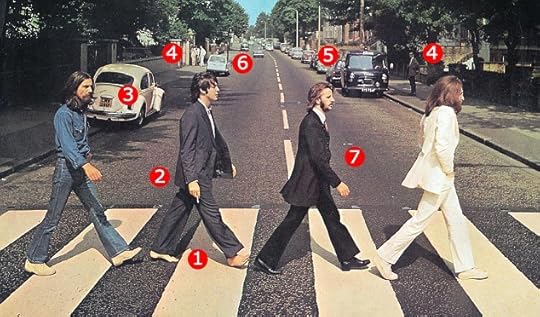
And the fireflies of the title feature in a poignant finale:
That’s why we have to make do with the stories of the these fireflies or lightening bugs that were never fully able to light up. Either they were consumed very quickly, or they never reached boiling point. Perhaps it’s better for them that way. Warm embers.
Fireflies, translated by Fionn Petch from the original Bellas Artes by Luis Sagasti, in my 4th of the 5 books to date released by the wonderful new Charco Press, and perhaps the strongest to date.
It begins (see https://booksfromscotland.com/2018/01... for a fuller excerpt)
The world is a ball of wool.
A skein of yarn you can’t find the end of.
When you can’t, you pluck at the surface to bring up a strand and then break it with a sharp tug. Once you find the other end, you can tie the two threads of yarn together again. One of grandma’s little tricks.
Some people think the world is a ball of wool from a lamb that sacrificed itself long ago so everyone could stay warm.
And they find this idea comforting.
And there are others who think that, in fact, the world is held up by threads. As if the ball of yarn were elsewhere. So headlines appear that try to explain things like who pulls the strings of the world.
Magazine covers: two threatening eyes against a black background. And there are writers who write whole books about this. Conspiracy theories. An explanation that arises from intellectual laziness: the idea that a shadowy group has chosen to weave the plots of all of our lives. Just like that. Because: a.) they are pure and good; b.) they want to keep hold of their wealth; c) they are evil, really evil; or d) they hold a secret that would be the end of all of us if we were to find it out – and of them too, of course. For those who see the world this way, any conspiracy – because there have always been conspiracies – is just the visible result of a greater conspiracy. And the smaller conspiracies are all interconnected. Man never reached the moon. Paul McCartney died in 1967 and was replaced by a lookalike. Christ descended from the cross and had twins with Mary Magdalene. Shakespeare’s works were actually written by Francis Bacon. The Lautaro Lodge was a branch of the Freemasons, who are a branch of the Rosicrucians, who are a branch of the Gnostics, and the tree proliferates so wildly that not only does it leave us unable to see the wood but it also fills everything with shadows, making way for those two threatening eyes that want us to understand that there’s something out there it’s better we don’t know about.
[...]
And there are still others who believe that these threads in fact sustain the world from the inside, as if the world were the great ball of wool and we were insects, like ants or flies, crawling or flying around it. A ball of wool someone is using to knit something. Or perhaps no one is knitting anything at all. There’s just a great shroud with no Penelope, growing without purpose in the eternal silence of infinite space.
One thing we can be sure of is that, for hundreds of thousands of years, the ball of yarn has been revolving without pause.
In all this, the knitting needles and the resulting scarf or pullover don’t look particularly great in the end [...] every now and then phosphorescent insects - something like fireflies - appear on the revolving ball of yarn, or one side and then the other, as if they could move through it. Traverse it, yes. From side to side. Except these fireflies seem to flee ahead of the needles. Or perhaps they are the needles.
[...]
Among people, we should seek out the fireflies.
Sagasti then proceeds to write a highly erudite mixture of fact and fiction, with shades of WG Sebald, Enrique Vila-Matas, Bolaño and (as per Gumble Yard's excellent review https://www.goodreads.com/review/show...) Jack Robinson.
For example in the second chapter, Haiku, he manages in 35 pages to draw together threads connecting a range of performance artists, authors, philosophers and poets including Joseph Beuys, Kurt Vonnegut, Antoine de Saint-Expury, Matsuo Basho, Jürgen Habermas, Giuseppe Ungaretti, Ludwig Wittgenstein and Lawrence Ferlinghetti.
Those common threads include flights and falls, particularly those ending tragically, and a penchant, as the opening of the novel suggests, for stories that have given rise to conspiracy theories - with, giving the common lack of evidence after aircrashes, an obvious interception between the two.
So he features the German pilot who claimed to have shot down Little Prince author Saint-Expury (except, in reality, others dispute his claim); the convicted kidnapper and murderer of Charles Lindbergh's wife and son (except many claim it as a infamous miscarriage of justice, and others, in turn regard those claims as classic conspiracy theories).
Perhaps one distinctive feature of Sagasti's approach is how he himself seems to play with the historic facts.
This start with dates: Joseph Beuys own seemingly invented story of how, after crashing his plane, he was rescued by Tartar nomads, is, in Sagasti's telling in 'Winter 1943': it actually took place in March 1944. Semantics perhaps - except the death of Kurt Vonnegut's mother is moved to February 1944, when Vonnegut was imprisoned in Slaughterhouse 5 in Dresden, rather than the actual date of May 1944, when he was still in the US.
And he relates a single-source story of how the greatest of haiku poets Matsuo Basho may have encountered, although the historic record suggests they never did, the greatest calligrapher of his time, Kioyi Hatasuko. Except Hatasuko, as far as I can ascertain, is a figure of Sagasti's own invention.
He also drops in a brief anecdote about the identity of the mystery 'man by the police van' on the famous Beatles' Abbey Road photo cover - a photo that itself has given rises to many conspiracy theories centered on the idea it encoded a message that Paul McCartney had died and was replaced by a lookalike (*): but again this story, attributed in the novel to George Martin (the Beatles manager not the dungeonsanddragons author), was I think invented by Sagasti (and certainly doesn't fit the facts).
(* The mystery man is marked as 4 on this photo of 'clues')
And the fireflies of the title feature in a poignant finale:
That’s why we have to make do with the stories of the these fireflies or lightening bugs that were never fully able to light up. Either they were consumed very quickly, or they never reached boiling point. Perhaps it’s better for them that way. Warm embers.

January 20, 2018
Charco Press is an exciting new, small UK publisher which “focuses on finding outstanding contemporary Latin American literature and bringing it to new readers in the English-speaking world” – this was one of their first three novels produced in 2017/early 2018 – all by Argentinian authors.
The best tribute I can pay to this book (and it is a considerable one) was to wonder if Luis Sagasti (or the translator Fionn Petch) is in fact another of the pseudonyms of Charles Boyle the founder of CB Editions (another brilliant UK small publisher) – as this book reminded me so strongly of the wonderful “Overcoat” and “Robinson” that he published as Jack Robinson.
This novella is simply a delightful, playful and learned exploration of 20th Century history (particularly the history of flight) and 20th Century art (in all its forms) which in only 85 or so pages manages to cover Haiku’s, The Beatles, Glenn Miller, Yuri Gargarin (and an apparently fictional rendering of his conversation with the Siberian he encounters on landing, who believes he has descended from heaven), , the German conceptual artist Joseph Bueys (and the myth he constructed around his Tartar rescuers, the Brazilian priest Adelir di Carli and his ill-fated fund-raising cluster-ballooning flight, Richard Drew and his “falling man” picture (and an apparently fictional story of his being asked to try to locate and photograph di Carli), Slaughterhouse 5, the Beatles and their famous Abbey Road cover (with an apparently fictional story of the fifth man in the photo), Amelia Earhart, Sun Ra, Saint-Exupéry and the German veteran who claims to have shot him down, Wittgenstein and much more.
Highly recommended.h
The best tribute I can pay to this book (and it is a considerable one) was to wonder if Luis Sagasti (or the translator Fionn Petch) is in fact another of the pseudonyms of Charles Boyle the founder of CB Editions (another brilliant UK small publisher) – as this book reminded me so strongly of the wonderful “Overcoat” and “Robinson” that he published as Jack Robinson.
This novella is simply a delightful, playful and learned exploration of 20th Century history (particularly the history of flight) and 20th Century art (in all its forms) which in only 85 or so pages manages to cover Haiku’s, The Beatles, Glenn Miller, Yuri Gargarin (and an apparently fictional rendering of his conversation with the Siberian he encounters on landing, who believes he has descended from heaven), , the German conceptual artist Joseph Bueys (and the myth he constructed around his Tartar rescuers, the Brazilian priest Adelir di Carli and his ill-fated fund-raising cluster-ballooning flight, Richard Drew and his “falling man” picture (and an apparently fictional story of his being asked to try to locate and photograph di Carli), Slaughterhouse 5, the Beatles and their famous Abbey Road cover (with an apparently fictional story of the fifth man in the photo), Amelia Earhart, Sun Ra, Saint-Exupéry and the German veteran who claims to have shot him down, Wittgenstein and much more.
Highly recommended.h

Read
December 18, 2025I suspect I'm not the only one who had a bit of trouble getting into this. It took me a while to grasp the unifying theme of the five essays, musings, and reflections. Fireflies, yes, of course, but equally human high-flyers who crash, intentionally or unintentionally, and also frail or vain attempts to express with words the sublime or banal in reality. The Argentinian writer Luis Sagasti (° 1963) abounds in expensive references: Kurt Vonnegut, Joseph Beuys, Antoine de Saint-Exupery, Primo Levi, Master Basho, Ludwig Wittgenstein, Yuri Gagarin, and Laika, and so on. An enticing read, but after 65 pages, the firefly is gone again (presumably intended). Can't really rate this.

August 7, 2023
A wonderfully demented firefly flight across the pages.
And I'm going to stop there with the adjectives because one of the concepts which I dearly endorse is
Adjectives give an added filter to an object and we then see the object plus the filter. Sagasti speaks a lot about haikus here how haikus are or should be a word (object) without adjectives, we just see what is without the added bows and frills. In this way we should see war another thing that has prime place in this book. He explores words, war and people through a series of real life protagonists and true happenings and gives facts and perceptions and trains of thought. Even screams, noise is explored, how screams are just an adjective to what is happening and they may not always be able to come out and remain silent, but still what happens happens.
This book brought to mind Benjamín Labatut, Douglas Bruton, W. G. Sebald Winfried Georg Sebald, they too run and play with thoughts and words. Plus I really looked up a lot of references because I wanted to see if what he was saying was true - I enjoyed that.
And I'm going to stop there with the adjectives because one of the concepts which I dearly endorse is
Adjectives conceal the true presence of objects - Sagasti quoting from Giuseppe Ungaretti
Adjectives give an added filter to an object and we then see the object plus the filter. Sagasti speaks a lot about haikus here how haikus are or should be a word (object) without adjectives, we just see what is without the added bows and frills. In this way we should see war another thing that has prime place in this book. He explores words, war and people through a series of real life protagonists and true happenings and gives facts and perceptions and trains of thought. Even screams, noise is explored, how screams are just an adjective to what is happening and they may not always be able to come out and remain silent, but still what happens happens.
This book brought to mind Benjamín Labatut, Douglas Bruton, W. G. Sebald Winfried Georg Sebald, they too run and play with thoughts and words. Plus I really looked up a lot of references because I wanted to see if what he was saying was true - I enjoyed that.

July 2, 2019
"Ever since people raised their heads for the first time to observe the stars and began telling them apart by nothing more than the invisible threads of frozen silver that link them, they also began to tell stories."
.
From FIREFLIES by Luis Sagasti, translated from the Spanish by Fionn Petch / 2011 in Spanish, 2017 English @charcopress
Argentine writer and art-critic Luis Sagasti's experimental essay-novel follows the luminous fireflies of the title through moments in time and history, creating a constellation, a set piece. Structured into eight short essays, themes range from haiku master Bashō, to Kurt Vonnegut, Antoine de Saint-Exupéry to Yuri Gagarin and Laika.
It's a river of words and interconnected thoughts, and once you just sit back, it's a beautiful (and educational) trip down the current.
Sagasti braids these disparate parts together in a very pleasing way. Meta, clever, and inspired wonder in me... Maybe will for you too!
.
From FIREFLIES by Luis Sagasti, translated from the Spanish by Fionn Petch / 2011 in Spanish, 2017 English @charcopress
Argentine writer and art-critic Luis Sagasti's experimental essay-novel follows the luminous fireflies of the title through moments in time and history, creating a constellation, a set piece. Structured into eight short essays, themes range from haiku master Bashō, to Kurt Vonnegut, Antoine de Saint-Exupéry to Yuri Gagarin and Laika.
It's a river of words and interconnected thoughts, and once you just sit back, it's a beautiful (and educational) trip down the current.
Sagasti braids these disparate parts together in a very pleasing way. Meta, clever, and inspired wonder in me... Maybe will for you too!

November 23, 2020
Where is the line between truth and myth, death and life, flight and fall? Sagasti answers these questions in this poetical and meditative 'novel' through subtly drawn threads that connect a number of real and fictional personalities across the globe and time.
To illustrate many imaginative episodes/moments that blur the line between facts and fiction, this one involves a poet Ungaretti and a philosopher Wittgenstein, finding themselves on the opposite sides on WWI frontlines. This is how Sagasti treats it in this beautifully metaphoric rendering:
To illustrate many imaginative episodes/moments that blur the line between facts and fiction, this one involves a poet Ungaretti and a philosopher Wittgenstein, finding themselves on the opposite sides on WWI frontlines. This is how Sagasti treats it in this beautifully metaphoric rendering:
Huddled one night alongside the body of a slain comrade, Ungaretti writes:The writing is both erudite and effortless, original, genre-bending, simply a wonderful reading. The translation is equally superlative.Never did IIt forms part of the poem 'Vigil'.
so
cling to life.
Around the same date, Wittgenstein wrote in his notebook:
'Perhaps the proximity of death shall bring light to my life.'
Wittgenstein hears orders. He knows their meaning is to impose order on the meaninglessness of the war.
April 8, 2021
Fireflies and the Fine Arts
Review of the Charco Press paperback edition (2018) translated from the original Spanish language Bellas artes (Fine Arts) (2011)
I enjoyed Charco Press' recent publication of Luis Sagasti's A Musical Offering (2017/2020) so much that I immediately wanted to read Fireflies as well. It was in the very same style as Offering, with its expanded fictional tales based on various true and/or exaggerated stories from real life.
I didn't research much about Sagasti's possible fictional improvisations, but several stories in Fireflies, especially the more outrageous ones, were definitely true. Or at least true in the sense that Fluxus artist Joseph Beuys did tell stories of his rescue by Tatar shamans in the Crimea in the 2nd World War, that futurist jazz pioneer Sun Ra did lead his quirky band of communal Arkestra members around the world for concerts and recordings, etc.
Throughout the book, the theme of fireflies, which you can read as metaphors for: sparks of light in the darkness, for truth among the fiction, for invention among the non-fiction, etc. is regularly returned to. That helps to explain the change of title suggested by excellent translator Fionn Petch and explained in his generous Afterword to the Charco edition. I'm not generally a fan of title changes in translation, but Fireflies as a title is definitely more intriguing than the somewhat generic original, which would have been Fine Arts.
I perhaps enjoy Luis Sagasti so much because as his esoteric tales about music, books, art and storytelling are recognizable to me as I have followed quite a lot of avantgarde music & art in the late 20th/early 21st century (I even saw a few Sun Ra concerts in Toronto for instance). So Sagasti immediately strikes chords of familiarity to me. Some others may find it more odd or curious.
Anyway, I'm completely taken in and am even attempting his latest, Leyden Ltd. (2020) in the Spanish original, even though I don't read or speak Spanish. This is not as crazy as it sounds, as this latest book is written entirely in footnotes, i.e. short, mostly one-sentence statements of "fact." So in a sense you have to imagine what the missing book would actually be saying when all you have are its footnote artefacts to go by. That is the sort of quirky writing that very much appeals to me and perhaps to you, if you have read this far.
Review of the Charco Press paperback edition (2018) translated from the original Spanish language Bellas artes (Fine Arts) (2011)
I enjoyed Charco Press' recent publication of Luis Sagasti's A Musical Offering (2017/2020) so much that I immediately wanted to read Fireflies as well. It was in the very same style as Offering, with its expanded fictional tales based on various true and/or exaggerated stories from real life.
I didn't research much about Sagasti's possible fictional improvisations, but several stories in Fireflies, especially the more outrageous ones, were definitely true. Or at least true in the sense that Fluxus artist Joseph Beuys did tell stories of his rescue by Tatar shamans in the Crimea in the 2nd World War, that futurist jazz pioneer Sun Ra did lead his quirky band of communal Arkestra members around the world for concerts and recordings, etc.
Throughout the book, the theme of fireflies, which you can read as metaphors for: sparks of light in the darkness, for truth among the fiction, for invention among the non-fiction, etc. is regularly returned to. That helps to explain the change of title suggested by excellent translator Fionn Petch and explained in his generous Afterword to the Charco edition. I'm not generally a fan of title changes in translation, but Fireflies as a title is definitely more intriguing than the somewhat generic original, which would have been Fine Arts.
I perhaps enjoy Luis Sagasti so much because as his esoteric tales about music, books, art and storytelling are recognizable to me as I have followed quite a lot of avantgarde music & art in the late 20th/early 21st century (I even saw a few Sun Ra concerts in Toronto for instance). So Sagasti immediately strikes chords of familiarity to me. Some others may find it more odd or curious.
Anyway, I'm completely taken in and am even attempting his latest, Leyden Ltd. (2020) in the Spanish original, even though I don't read or speak Spanish. This is not as crazy as it sounds, as this latest book is written entirely in footnotes, i.e. short, mostly one-sentence statements of "fact." So in a sense you have to imagine what the missing book would actually be saying when all you have are its footnote artefacts to go by. That is the sort of quirky writing that very much appeals to me and perhaps to you, if you have read this far.

September 28, 2020
In a haiku, "An expert calligrapher can lay down the Japanese characters in such a way that they are taken in almost at a single glance. Language and perception joined. So it is impossible to translate a haiku, to write a haiku."
The haiku is one of the recurring motifs in this short book which is a lot, lot bigger on the inside than it is on the outside. Another recurring motif is the eponymous firefly which is initially envisaged as phosphorescent insects that move from one side to the other of a revolving ball of yarn which is in the middle of symbolising the world. It’s that kind of book and the fireflies will be back again several times, as will the haikus along with several other links between the different chapters.
It feels to me that the haiku is an important motif for the book, especially the idea of the haiku capturing everything in a single glance. Clearly, in a book, even a very short one like this, it is not possible for a reader to actually capture the whole thing in one look, but it seems like this is the ambition of Sagasti. Whilst we can’t take in the whole thing in one single look, we can let it build. There is a point where the book discusses music that is played by playing all the notes at the same time rather than sequentially (which, of course, is a sort of definition of white noise), and this also seems to be the way to approach this book: it does not have a plot and things to do not follow sequentially from one chapter or even paragraph to the next, but, rather, ideas and images repeat and layer on top of one another until something is created in the mind of the reader.
I first came across this kind of technique in the work of David Markson. His tetralogy (Reader’s Block, This Is Not A Novel, Vanishing Point and The Last Novel) are sort of extreme versions of what Sagasti does here. In Markson, we read list of facts that somehow build something in the reader’s mind despite the lack of any narrative and, often, any connection. Here, in Fireflies, Sagasti does something similar but with more of a sense of connectivity and with more explanation.
As you read, you start to become aware of the fireflies metaphor (above) coming into play. It’s like points of light on opposite sides of something that draw connecting lines. We have people who rose up and disappeared followed by people who fell to earth, we have people who might have disappeared into space followed by people who claim to have descended to earth from space. This interplay of ideas and images continues through the book with echoes of one chapter forming part of another and the whole thing gradually building.
This is the kind of book that needs a review the same length as the book (85 pages) if the review is to do justice to the book. It's probably best that you take a look at some other reviews here because I have hardly scratched the surface.
My rating of this book will come as no surprise to those who know the kind of book I like. Plot is low on my list of priorities in a book and I am very interested in books that work by impression rather than detail. Here, without the reader really knowing how, we find ourselves meditating on how to make sense of the unknowable, about why we are here. And the book draws to a close by saying:
"Who would have been the first to look up to the night sky without seeking anything at all, not even tranquillity? Free of questions, just standing quietly, in a state of total defencelessness, a rock-like innocence. Why would they have done such a thing?"
It’s beautiful.
The haiku is one of the recurring motifs in this short book which is a lot, lot bigger on the inside than it is on the outside. Another recurring motif is the eponymous firefly which is initially envisaged as phosphorescent insects that move from one side to the other of a revolving ball of yarn which is in the middle of symbolising the world. It’s that kind of book and the fireflies will be back again several times, as will the haikus along with several other links between the different chapters.
It feels to me that the haiku is an important motif for the book, especially the idea of the haiku capturing everything in a single glance. Clearly, in a book, even a very short one like this, it is not possible for a reader to actually capture the whole thing in one look, but it seems like this is the ambition of Sagasti. Whilst we can’t take in the whole thing in one single look, we can let it build. There is a point where the book discusses music that is played by playing all the notes at the same time rather than sequentially (which, of course, is a sort of definition of white noise), and this also seems to be the way to approach this book: it does not have a plot and things to do not follow sequentially from one chapter or even paragraph to the next, but, rather, ideas and images repeat and layer on top of one another until something is created in the mind of the reader.
I first came across this kind of technique in the work of David Markson. His tetralogy (Reader’s Block, This Is Not A Novel, Vanishing Point and The Last Novel) are sort of extreme versions of what Sagasti does here. In Markson, we read list of facts that somehow build something in the reader’s mind despite the lack of any narrative and, often, any connection. Here, in Fireflies, Sagasti does something similar but with more of a sense of connectivity and with more explanation.
As you read, you start to become aware of the fireflies metaphor (above) coming into play. It’s like points of light on opposite sides of something that draw connecting lines. We have people who rose up and disappeared followed by people who fell to earth, we have people who might have disappeared into space followed by people who claim to have descended to earth from space. This interplay of ideas and images continues through the book with echoes of one chapter forming part of another and the whole thing gradually building.
This is the kind of book that needs a review the same length as the book (85 pages) if the review is to do justice to the book. It's probably best that you take a look at some other reviews here because I have hardly scratched the surface.
My rating of this book will come as no surprise to those who know the kind of book I like. Plot is low on my list of priorities in a book and I am very interested in books that work by impression rather than detail. Here, without the reader really knowing how, we find ourselves meditating on how to make sense of the unknowable, about why we are here. And the book draws to a close by saying:
"Who would have been the first to look up to the night sky without seeking anything at all, not even tranquillity? Free of questions, just standing quietly, in a state of total defencelessness, a rock-like innocence. Why would they have done such a thing?"
It’s beautiful.

February 2, 2019
What a wonderful and strange novel(?), history(?), and collection of anecdotes that relate and connect...smaller stories across the history of flight, literature, war. Each anecdote is its own ember or lightning bug or (!) firefly and Sagasti here uses literary license to attach them to each other. He somehow connects Basho, Vonnegut, Saint-Expery, Wittgenstein, Ferlinghetti, Glen Miller. The book is also about pilots/flight/crashes because we read about Lindbergh, Amelia Earhart, again Saint-Expury, Yuri Gargarin, a Brazilian priest who strapped himself to a chair tied to 1,000 helium filled balloons, Laika among others. The book convincingly (though I hesitate to say honestly) connect the various fireflies via strands that are simultaneously credible and not. This was a fun experimental book!

July 31, 2023
One of the many things I repeat in this blog is how the ghost of W.G. Sebald can be found in so many authors. Luis Sagasti is another one. Like other Sebald acolytes such has Benjamin Labatut, David Seabrook, Margo Glantz, Svetlana Alexievich etc, Sagasti manages to speak about a topical subject then link it with trivia, anecdotes and both popular and cult culture.
The main topic of Fireflies is the affects of war but from that we go to : Haikus , Antoine de Saint missing people, Stanley Kubrick, Fellini, Slaughterhouse Five, Animals surviving in the wild. In the end the main message is that despite the things that may emerge from war it still is a sign of how we are a destructive race.
Sagasti manages to link his subjects deftly and playfully. I had a lot of fun reading Fireflies and it's quite an educational experience as well.
The main topic of Fireflies is the affects of war but from that we go to : Haikus , Antoine de Saint missing people, Stanley Kubrick, Fellini, Slaughterhouse Five, Animals surviving in the wild. In the end the main message is that despite the things that may emerge from war it still is a sign of how we are a destructive race.
Sagasti manages to link his subjects deftly and playfully. I had a lot of fun reading Fireflies and it's quite an educational experience as well.

March 26, 2024
Entiendo que siendo esta obra del 2011, el estilo de Sagasti no tenía todavía el refinamiento que le he visto en "Lenguas vivas", una evolución de doce años. Aquí en "Bellas Artes" el ritmo no fluye y se hace pesado y farragoso, sin llegar a encontrar el equilibrio entre ese tono mezcla de lo poético y lo cotidiano que desarrollaría y depuraría después. Un poco decepcionante pero también es verdad que he conocido a este autor por el final, por su última obra, ya refinada y exquisita. Seguiré con él.

March 12, 2021
⇝ 4.5 stars

August 1, 2021
Like his fellow Argentinian masters, Borges and Cortazar, it is difficult to categorise a work of art if unique, as ethereal, as sparklingly original, like the burst of starlight on a still night, or indeed of fireflies on a languorous evening, as Sagasti’s fireflies. The book has no real plot or story, no characters, instead the golden thread which is interwoven throughout the novel is of the wonderous and slightly terrifying nature of life, the miracle of consciousness, the unreliability of words to convey meaning and the impermeability of language. Sagasti explores these themes by recollection on the lives of various famous men, from the writer Antoine de Saint-Exupéry, to the astronaut Yuri Gagarin or the philosopher Ludwig Wittgenstein. All three of these tried to reimagine human existence, Exupéry via his writings, Wittgenstein via his exploration of language and Gagarin via his desire to escape the confines of the earth itself, yet all three feel worn down by their attempts to transcend human existence, driven to acts of bravery and daring which border on suicide.
Yet, beneath all this, the true theme of Sagasti is that of storytelling, of the power of the human imagination and language, in spite of their limitations, to capture the fleeting moments of beauty which enable us to transcend our existence, to build connections with each irrespective of time or distance and of the ability of art to create something permanent which, like Saint-Exupéry’s ‘The Little Prince’, eclipse the shortness of our lives:
“As long as there’s a fire there will be a story waiting to be told. And then we’ll open our mouths wide and swallow all that we can of the night. And, for the first time, the same song will begin.”
Yet, beneath all this, the true theme of Sagasti is that of storytelling, of the power of the human imagination and language, in spite of their limitations, to capture the fleeting moments of beauty which enable us to transcend our existence, to build connections with each irrespective of time or distance and of the ability of art to create something permanent which, like Saint-Exupéry’s ‘The Little Prince’, eclipse the shortness of our lives:
“As long as there’s a fire there will be a story waiting to be told. And then we’ll open our mouths wide and swallow all that we can of the night. And, for the first time, the same song will begin.”

December 17, 2021
The shortcomings of Brain Pickings are also the shortcomings of Figuring, a mélange of biographical snippets, elevating extracts, and woozy, century-hopping rhapsodies about how everything and everyone is connected. Did you know that the 17th-century German astronomer Johannes Kepler asserted that lunar gravity was responsible for the tides and that “a quarter millennium later,” Emily Dickinson would write a poem in which the central metaphor is the moon’s control of the tides, thereby drawing “on Kepler’s legacy”? Just think about that for a moment—especially if you are high or a character in the Richard Linklater movie Slacker.
…
If Popova’s goal with this book is, as she writes, to pay tribute to “the invisible connections—between ideas, between disciplines, between the denizens of a particular time and a particular place, between the interior world of each pioneer and the mark they leave on the cave walls of culture,” then one of her priorities ought to be making those connections truly visible.
…
To paraphrase Gertrude Stein, anecdote is not literature…
Missed Connections
Maria Popova, Brain Pickings, and whether the internet has changed the way we think.
By Laura Miller
Slate.com
February 27, 2019

June 22, 2019
While I was in London, browsing through bookstores, I found this book hidden on a shelf. Something drew me to it, like I knew I was totally going to fall in love with it. And I did! I feel like I learned so much and that in such an unusual and beautiful way! It's a pretty thin book, but it took me a while to read it, as I was always scrolling through the Internet, checking the people mentioned in there. I loved the ingenious way in which Sagasti intertwined the stories and the deepness of it all. It's simply a wonderful book. Highly recommend it!
P.S. The ending is just beautiful:
"After all, if we stop to think, the stars have been fleeing from us from the very beginning. Every night they're further away, though they give the impression of being in the same place.
But we shouldn't feel lonely as a result.
No. Not at all.
As long as there's a fire there will be a story waiting to be told. And then we'll open our mouths wide and swallow all that we can of the night.
And, for the first time, the same song will begin."
P.S. The ending is just beautiful:
"After all, if we stop to think, the stars have been fleeing from us from the very beginning. Every night they're further away, though they give the impression of being in the same place.
But we shouldn't feel lonely as a result.
No. Not at all.
As long as there's a fire there will be a story waiting to be told. And then we'll open our mouths wide and swallow all that we can of the night.
And, for the first time, the same song will begin."

November 24, 2022
Una colección de hechos históricos interconectados, que pareciera que sirven para acercarnos a una gran respuesta sobre el universo (o a una gran pregunta), pero que no funcionó muy bien, a mi gusto. Lo poético no era tan poético, y lo histórico tampoco llegó a fascinarme.
Quizás sus similitudes con un libro muy bueno que leí hace poco, “Un verdor terrible” de Labatut, lo hacen palidecer en comparación.
Quizás sus similitudes con un libro muy bueno que leí hace poco, “Un verdor terrible” de Labatut, lo hacen palidecer en comparación.
June 16, 2023
Mitenhän tätä kuvailis. Siis tavallaan kirja joka ei kerro oikeen mistään mutta samalla kuitenkin tosi monesta asiasta. Ehkä sen vois sanoa että tässä kirjassa on kyse yhteyksistä, tarinankerronnasta, kielestä ja hetkistä. Yhteyksistä sellaisten asioiden välillä, joilla ei näennäisesti olis mitään yhteyttä, mutta jotka voi kuitenkin kielen näkymättömällä langalla ommella yhteen. Vähän samaan tapaan miten tähdet on yhteydessä toisiinsa tähtikuvioissa. Tai tulikärpäset parvessa. Melko runollinen eikä sisällä oikeastaan mitään juonta mutta todella miellyttävä lukukokemus. Varsinkin jos 1900-luvun loppupuolen taide- ja kulttuurihistoria on jokseenkin tuttua. Plussaa myös kääntäjän itsereflektiosta lopussa!

Read
July 29, 2024Ese muñeco es algo malo. M-maalo.

July 4, 2026
Filozofiskas esejas par Tralfamadoru, Bašō, Sun Ra, lidotājiem, karu utt, arvien tomēr atgriežoties pie mākslas. Emocionāli līdz galam neaizķēra, lai gan centās stipri, bet vispār jau ļoti forša pieeja

February 6, 2022
3.5 rounded up
I still couldn't really tell you what this was about, but it felt like being in someone else's brain for a few hours (in a good way!). The author link together seemingly random events and people from across the world in a narrative which has been described as fictional essays. I've certainly never read anything quite like it!
I still couldn't really tell you what this was about, but it felt like being in someone else's brain for a few hours (in a good way!). The author link together seemingly random events and people from across the world in a narrative which has been described as fictional essays. I've certainly never read anything quite like it!

October 15, 2020
I wonder who is best at stargazing. The sceptic who looks up to find some certainties he cannot grasp under his feet. Or the reckless one who connects simply all the dots he can find up there, far above his head. I wonder if one can be both. A little firefly that lights up every time he finds something worthwile illuminating.
Maybe it is not the truth that will resist time. Fiction will definitely remain. And keep all those luminous moments for eternity.
Maybe it is not the truth that will resist time. Fiction will definitely remain. And keep all those luminous moments for eternity.

April 18, 2021
I’ll be honest, I have no idea where to start with this, I mean, I have no idea what it is. It doesn’t feel like fiction, but I’m not sure if it’s entirely factual either, but what it definitely is is poetic, it is thoughtful, and I would say elegant and graceful, if there is any difference between the two.
What (I think) Sagasti does here is draw disparate stories from around the world to craft a rich tapestry that seems to work, seems to draw everything together in some way that is beyond me, but which I still felt I could appreciate. Starting with Joseph Beuys, and including Antoine de Saint-Exupery, Basho, a Brazilian priest and Stanley Kubrick amongst others, this is a story of the world, or of people, or both, and in the same way that that individual paints on a canvas turn into a finely crafted picture.
Some people, like Beuys, I’d never heard of, others, like Basho, Stanley Kubrick, the Beatles I had done, but it didn’t help while I was reading, in the sense that I didn’t really appreciate the book until I finished, like standing really close to a painting or the TV screen, and not really knowing what your looking at until you have pulled back, enough to get a much grander sense of what you’re looking at. I still couldn’t tell you what it was, but I savoured Fireflies in a way that I can’t describe, or explain why, but it felt like everything was a little better after reading it, and that can’t be bad.
(blog review here)
What (I think) Sagasti does here is draw disparate stories from around the world to craft a rich tapestry that seems to work, seems to draw everything together in some way that is beyond me, but which I still felt I could appreciate. Starting with Joseph Beuys, and including Antoine de Saint-Exupery, Basho, a Brazilian priest and Stanley Kubrick amongst others, this is a story of the world, or of people, or both, and in the same way that that individual paints on a canvas turn into a finely crafted picture.
Some people, like Beuys, I’d never heard of, others, like Basho, Stanley Kubrick, the Beatles I had done, but it didn’t help while I was reading, in the sense that I didn’t really appreciate the book until I finished, like standing really close to a painting or the TV screen, and not really knowing what your looking at until you have pulled back, enough to get a much grander sense of what you’re looking at. I still couldn’t tell you what it was, but I savoured Fireflies in a way that I can’t describe, or explain why, but it felt like everything was a little better after reading it, and that can’t be bad.
(blog review here)
April 4, 2020
Texto breve y genial, difícil de clasificar, que trata una cuestión en la que se han extraviado tantos filósofos y teólogos del pasado: ¿Cómo funciona el mundo? ¿quiénes mueven sus hilos?
El enfoque del autor es literario al estilo de Chesterton: todas las respuestas son verdaderas, lo que nos falta es encontrar las preguntas.
Un haiku es una poesía japonesa breve, de tres versos, generalmente basada en el asombro y la emoción.
"Entre el relámpago y el trueno / un pájaro / busca refugio."
Bellas Artes es como un haiku de filosofía. Sagasti desenrolla el hilo del mundo, saltando de un tema a otro a través de relaciones reales o imaginarias, pero que me resultó estético, y además me sirvió para conocer cosas nuevas interesantes, como el arte de Beuys, los libros de Vonnegut, la cinematográfica vida de Raúl Barón Biza, y la singular obra de su hijo Jorge
(cuyo libro de ensayos "Al rescate de lo bello" me encantó).
"Hay un ilegible haiku gigante inalterable arriba de nuestras cabezas cada noche",
dice Sagasti, "un mensaje escrito en estrellas que cada vez se alejan más de nosotros" y que "termina encendiendo a quienes alcanzan a leerlo".
Ese deambular del libro desenredando hilos del mundo no termina de explicar qué es lo que realmente lo hace funcionar. O quizás sí, pero como en el mensaje en el cielo estrellado, no lo dice directamente y la clave haya que buscarla en el título del libro: Bellas Artes.
El enfoque del autor es literario al estilo de Chesterton: todas las respuestas son verdaderas, lo que nos falta es encontrar las preguntas.
Un haiku es una poesía japonesa breve, de tres versos, generalmente basada en el asombro y la emoción.
"Entre el relámpago y el trueno / un pájaro / busca refugio."
Bellas Artes es como un haiku de filosofía. Sagasti desenrolla el hilo del mundo, saltando de un tema a otro a través de relaciones reales o imaginarias, pero que me resultó estético, y además me sirvió para conocer cosas nuevas interesantes, como el arte de Beuys, los libros de Vonnegut, la cinematográfica vida de Raúl Barón Biza, y la singular obra de su hijo Jorge
(cuyo libro de ensayos "Al rescate de lo bello" me encantó).
"Hay un ilegible haiku gigante inalterable arriba de nuestras cabezas cada noche",
dice Sagasti, "un mensaje escrito en estrellas que cada vez se alejan más de nosotros" y que "termina encendiendo a quienes alcanzan a leerlo".
Ese deambular del libro desenredando hilos del mundo no termina de explicar qué es lo que realmente lo hace funcionar. O quizás sí, pero como en el mensaje en el cielo estrellado, no lo dice directamente y la clave haya que buscarla en el título del libro: Bellas Artes.

December 27, 2022
Rating: 3.5
The summary of "Fireflies" immediately reminded me of When We Cease to Understand the World, and there are definitely parallels and similarities in terms of how both books try to connect the disparate links between historical figures and the events linked to them. In this, the fireflies are seen as the driving force that metaphorically link these figures and events together as Sagasti jumps from one thread of thought to another.
"Fireflies" is an interesting exercise in weaving nonfiction and fiction together, though ultimately I think it doesn't quite reach the level of Labatut's book for me. Maybe I would've appreciated this more if I hadn't read Labatut's book first, but in any case I preferred Sagasti's A Musical Offering, which has a similar concept of blending nonfiction and fiction together and is focused on the musical figures of the recent century.
The summary of "Fireflies" immediately reminded me of When We Cease to Understand the World, and there are definitely parallels and similarities in terms of how both books try to connect the disparate links between historical figures and the events linked to them. In this, the fireflies are seen as the driving force that metaphorically link these figures and events together as Sagasti jumps from one thread of thought to another.
"Fireflies" is an interesting exercise in weaving nonfiction and fiction together, though ultimately I think it doesn't quite reach the level of Labatut's book for me. Maybe I would've appreciated this more if I hadn't read Labatut's book first, but in any case I preferred Sagasti's A Musical Offering, which has a similar concept of blending nonfiction and fiction together and is focused on the musical figures of the recent century.
February 27, 2021
This is a unique read. It's charming and strange in a good way. I'm not sure I can even describe it as a novel, but also calling it a potted history of the 20th century/world doesn't give an accurate picture. There are some far more comprehensive reviews on here that explain it, but the beautiful recurring motif of fireflies, the depiction of the world being like a ball of wool, and the way Sagasti pulls various threads and examines and re-examines some key historical and culturally significant moment through various lenses is so absorbing. It is chunked into chapters which are broadly hinged around different thematic areas, but there is overlap. There is no real plot as such, but it is utterly compelling. The only issue I had (mine completely) is that I feel some of the cleverness and nuances were lost on me as I wasn't especially familiar with some of the philosophers/personalities he draws on. I highly recommend if you're looking for something that is a bit different.
Displaying 1 - 30 of 88 reviews