

To answer questions about
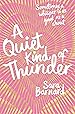
A Quiet Kind of Thunder,
please sign up.

Anintriguingspeciman
You might have already read this book, so I'll answer for anyone reading this who is undecided.
I'm an adult with selective mutism and I've had a severe form of it for most of my life. I thought the representation of SM was fair. I could tell the author did her research and really tried to portray it well. But I could also tell that she didn't have SM herself and didn't truly understand it. I personally could not relate to the main character. She's a 16-year-old girl with a best friend since childhood. She is also able to talk to a lot of people and even has a job. Then she gets a boyfriend and experiences a lot of firsts with him. I can't relate to any of this and I'm a decade older than her. If I had read this when I was 16, I probably would have felt even more alone and alienated than I did back then. But since I read it now, I could easily distance myself from her. And ironically, that made it easier for me to read this book because it didn't feel so personal. I didn't feel like I was even reading about someone with SM - that's how little I related to the main character.
It irritated me that the author never showed writing as a legitimate way to communicate. Steffi, her parents and her therapist all put so much emphasis on talking being the solution. It was really difficult to read about a girl who was so ashamed of having SM while everyone around her (though well-meaning and supportive) just reinforced that she wasn't enough if she didn't talk. That's why I appreciated the Deaf representation. Because that allowed Steffi to see, if only momentarily, that there were other ways to communicate besides talking.
One major flaw is that Steffi never seems to feel any anxiety or insecurity about kissing, making out, engaging in foreplay, or even having sex. At the beginning of the book, she shows no interest when her friend starts talking about boys and kissing. But when she suddenly develops a crush on a boy and has her first kiss, she is completely into it. She never showcases any anxiety or insecurity but simply gets excited every single time she is physically intimate with her boyfriend. Even in other media about teens, including those where the main character doesn't have an anxiety disorder, they show anxiety and insecurity about dating, kissing, and sex. So it seems unrealistic that a girl with severe social anxiety and SM does not show any of this anxiety.
I felt like the author didn't know how to realistically portray Steffi's anxiety without making her come across as weak. So she had to portray Steffi as being an empowered feminist who grows more and more independent by the end of the book. But it comes across as if portraying SM realistically, with all of the painful and ugly experiences it entails, would be seen as weak and pitiable. Because muteness has always been portrayed as pitiable, if it's portrayed at all. But the only way to combat the misconceptions that is to share the honest, raw and ugly truth - to portray our experiences exactly as they are instead of being ashamed of them. But the author doesn't do this. And unfortunately, I haven't seen a portrayal of SM that does this.
I'm an adult with selective mutism and I've had a severe form of it for most of my life. I thought the representation of SM was fair. I could tell the author did her research and really tried to portray it well. But I could also tell that she didn't have SM herself and didn't truly understand it. I personally could not relate to the main character. She's a 16-year-old girl with a best friend since childhood. She is also able to talk to a lot of people and even has a job. Then she gets a boyfriend and experiences a lot of firsts with him. I can't relate to any of this and I'm a decade older than her. If I had read this when I was 16, I probably would have felt even more alone and alienated than I did back then. But since I read it now, I could easily distance myself from her. And ironically, that made it easier for me to read this book because it didn't feel so personal. I didn't feel like I was even reading about someone with SM - that's how little I related to the main character.
It irritated me that the author never showed writing as a legitimate way to communicate. Steffi, her parents and her therapist all put so much emphasis on talking being the solution. It was really difficult to read about a girl who was so ashamed of having SM while everyone around her (though well-meaning and supportive) just reinforced that she wasn't enough if she didn't talk. That's why I appreciated the Deaf representation. Because that allowed Steffi to see, if only momentarily, that there were other ways to communicate besides talking.
One major flaw is that Steffi never seems to feel any anxiety or insecurity about kissing, making out, engaging in foreplay, or even having sex. At the beginning of the book, she shows no interest when her friend starts talking about boys and kissing. But when she suddenly develops a crush on a boy and has her first kiss, she is completely into it. She never showcases any anxiety or insecurity but simply gets excited every single time she is physically intimate with her boyfriend. Even in other media about teens, including those where the main character doesn't have an anxiety disorder, they show anxiety and insecurity about dating, kissing, and sex. So it seems unrealistic that a girl with severe social anxiety and SM does not show any of this anxiety.
I felt like the author didn't know how to realistically portray Steffi's anxiety without making her come across as weak. So she had to portray Steffi as being an empowered feminist who grows more and more independent by the end of the book. But it comes across as if portraying SM realistically, with all of the painful and ugly experiences it entails, would be seen as weak and pitiable. Because muteness has always been portrayed as pitiable, if it's portrayed at all. But the only way to combat the misconceptions that is to share the honest, raw and ugly truth - to portray our experiences exactly as they are instead of being ashamed of them. But the author doesn't do this. And unfortunately, I haven't seen a portrayal of SM that does this.

Anna
From my own personal experience of Selective Mutism, I was not disappointed at all. I thought it was portrayed respectfully and truthfully, and recommend that all who know someone with SM or who have struggled with it, read this book to understand it better.

J
I can't say for the representation as I have no experience to compare it to, instead I will tell you a few specific things within the book that will help you decide if it looks like good representation.
The selective mutism is described by Steffi as not being as much of a choice as people would think.
We find out early on that Steffi does talk to the people closest to her but that this is not all the time
There is medication referenced as well as the fact that Steffi, medically, is no longer selectively mute but has severe social anxiety disorder.
Steffi mentions how the little victories matter.
She can easily use sign language as she and Rhys are usually the only two in one place that know it.
We see a couple of her therapy sessions.
This is all I can think of but i hope it's helpful in deciding whether or not you want to read the book.
The selective mutism is described by Steffi as not being as much of a choice as people would think.
We find out early on that Steffi does talk to the people closest to her but that this is not all the time
There is medication referenced as well as the fact that Steffi, medically, is no longer selectively mute but has severe social anxiety disorder.
Steffi mentions how the little victories matter.
She can easily use sign language as she and Rhys are usually the only two in one place that know it.
We see a couple of her therapy sessions.
This is all I can think of but i hope it's helpful in deciding whether or not you want to read the book.

RV
I have SM. I haven't managed to finish it. Some of the language used is problematic, like the main character often claims not to have Selective Mutism anymore for some reason. I thought the premise was problematic to begin with and never really changes into not being that.
About Goodreads Q&A
Ask and answer questions about books!
You can pose questions to the Goodreads community with Reader Q&A, or ask your favorite author a question with Ask the Author.
See Featured Authors Answering Questions
Learn more